Acids and Bases: Understanding the pH Scale
Lemon juice, soap, stomach acid, and drain cleaner all show up on opposite ends of the same measurement: the pH scale. Whether something is classified as an acid or a base comes down to a single, precise chemical property, how it affects the concentration of hydrogen ions in a solution, and that same property explains why acids taste sour, why bases feel slippery, and why mixing the two neutralizes them both.
What Makes Something an Acid or a Base?
The most widely used definition in introductory chemistry is the Brønsted-Lowry definition:
- An acid is a substance that donates a hydrogen ion (H⁺) to another substance.
- A base is a substance that accepts a hydrogen ion (H⁺) from another substance.
When an acid is dissolved in water, it releases H⁺ ions into the solution. When a base is dissolved in water, it either releases hydroxide ions (OH⁻) directly or accepts H⁺ ions from the water itself, which has the same net effect of reducing the concentration of free H⁺ in the solution.
Example: Hydrochloric acid (HCl) dissolves in water and donates its hydrogen ion, forming H⁺ and Cl⁻ ions, which is why stomach acid (largely HCl) is such a strong acid.
Example: Sodium hydroxide (NaOH), commonly known as lye, dissociates in water to release OH⁻ ions directly, making it a strong base.
The pH Scale: Measuring Acidity Directly
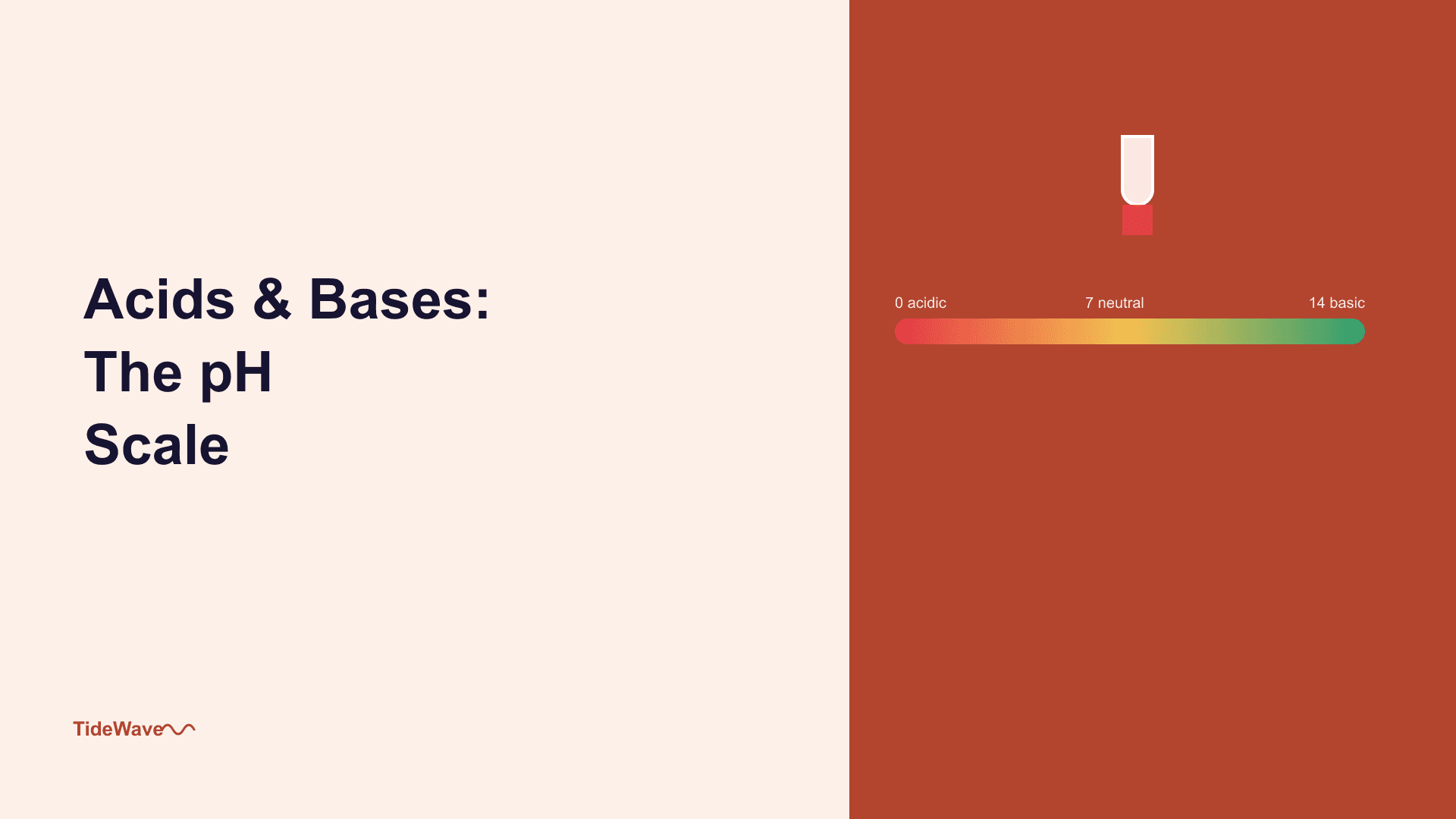
The pH scale runs from 0 to 14 and measures the concentration of hydrogen ions (H⁺) in a solution:
- pH less than 7: acidic, meaning a high concentration of H⁺ ions.
- pH exactly 7: neutral (pure water at 25°C).
- pH greater than 7: basic (also called alkaline), meaning a low concentration of H⁺ ions relative to OH⁻.
The scale is logarithmic, not linear, which is one of the most important and most commonly misunderstood facts about it. Each whole-number step on the pH scale represents a tenfold change in hydrogen ion concentration. This means a solution with a pH of 3 isn't twice as acidic as one with a pH of 6, it's 1,000 times more acidic (a difference of 3 steps = 10³).
Common Substances on the pH Scale
| Substance | Approximate pH | Classification |
|---|---|---|
| Battery acid | 0-1 | Strongly acidic |
| Stomach acid | 1-2 | Strongly acidic |
| Lemon juice | 2 | Acidic |
| Black coffee | 5 | Weakly acidic |
| Pure water | 7 | Neutral |
| Blood | 7.4 | Weakly basic |
| Baking soda solution | 9 | Basic |
| Ammonia | 11 | Strongly basic |
| Drain cleaner (lye) | 13-14 | Strongly basic |
Strong vs. Weak Acids and Bases
A common point of confusion is that "strong" doesn't mean "concentrated," and "weak" doesn't mean "dilute." These describe entirely different properties:
- Strength refers to how completely an acid or base dissociates (breaks apart into ions) in water. A strong acid like HCl dissociates almost 100%, while a weak acid like acetic acid (found in vinegar) only partially dissociates, leaving most of it as intact, un-ionized molecules in solution.
- Concentration refers to how much of the acid or base is dissolved in a given volume of solution, regardless of how completely it dissociates.
This means it's entirely possible to have a concentrated solution of a weak acid, or a dilute solution of a strong acid, and the two properties need to be considered separately when predicting a solution's actual pH.
Neutralization: What Happens When Acids Meet Bases
When an acid and a base are combined, they react in a neutralization reaction, where H⁺ ions from the acid combine with OH⁻ ions from the base to form water, while the remaining ions combine to form a salt:
HCl + NaOH → NaCl + H₂O
(acid) + (base) → (salt) + (water)
This is why antacid tablets (mild bases) relieve heartburn: they neutralize excess stomach acid, raising its pH back toward neutral and reducing the burning sensation caused by excess H⁺.
How pH Is Actually Measured
There are two common approaches for measuring pH in practice:
- pH indicators: chemical dyes that change color at specific pH ranges. Litmus paper turns red in acidic solutions and blue in basic ones. Universal indicator shifts through a full rainbow of colors corresponding to different pH values, giving a rough numeric estimate.
- pH meters: electronic devices with a probe that measures the actual voltage generated by hydrogen ion concentration, giving a precise numeric pH reading rather than an approximate color match.
Indicators are fast and cheap but imprecise; meters are more accurate but require calibration and maintenance, which is why labs requiring precise measurements (like water treatment or pharmaceutical testing) rely on meters rather than color-based indicators.
Why pH Matters Beyond the Lab
pH isn't just a laboratory measurement, it governs processes throughout biology, industry, and the environment:
- Human blood is tightly regulated to stay within pH 7.35-7.45; even small deviations outside this range can be medically dangerous, which is why the body has multiple buffering systems to resist pH change.
- Soil pH affects which nutrients are available to plants, which is why farmers and gardeners test and adjust soil pH before planting certain crops.
- Ocean acidification, a drop in seawater pH caused by absorbed atmospheric CO₂, is a major concern for marine ecosystems, since many organisms (like coral and shellfish) are highly sensitive to even small pH shifts.
FAQ
The pH scale is defined as the negative base-10 logarithm of hydrogen ion concentration (pH = -log[H⁺]). Hydrogen ion concentrations in real solutions span an enormous range, from about 1 mol/L in strong acids to 0.0000000000001 mol/L in strong bases, and a logarithmic scale compresses that huge range into a simple, manageable 0-14 scale.
Yes, though it's uncommon outside of specialized industrial or laboratory settings. Extremely concentrated strong acids can have a calculated pH below 0, and extremely concentrated strong bases can exceed pH 14; the 0-14 range simply covers the vast majority of everyday and biological solutions.
Even pure water undergoes a tiny amount of self-ionization, where a small fraction of H₂O molecules split into H⁺ and OH⁻ ions. At 25°C, this results in an H⁺ concentration of exactly 10⁻⁷ mol/L, which corresponds to a pH of 7, the definition of "neutral" precisely because H⁺ and OH⁻ concentrations are equal.
It depends entirely on their strength and concentration. Mixing a weak acid (like vinegar) with a weak base (like baking soda) is safe and even produces the fizzing reaction used in classic science experiments. Mixing strong, concentrated acids and bases, however, can release a large amount of heat very quickly and should only be done carefully and deliberately, since the neutralization reaction is exothermic.
An indicator is a substance used to measure or estimate pH by changing color. A buffer is entirely different: it's a solution that resists changes in pH when small amounts of acid or base are added, typically made from a weak acid and its conjugate base (or vice versa). Buffers are essential in biological systems, like blood, where pH must stay within a narrow range despite ongoing chemical activity.
Conclusion
Acids and bases come down to a simple exchange: whether a substance donates or accepts hydrogen ions in solution, and the pH scale gives that exchange a precise, logarithmic number. Understanding that each pH step represents a tenfold change, and that strength and concentration are two separate properties, clears up most of the common confusion around acids and bases. From your own blood chemistry to the soil in a garden, this single measurement quietly governs far more of the world than its simple 0-14 scale suggests.
Here are some useful references if you want to go deeper:
- Khan Academy – Acids and Bases — free lessons covering pH, strong vs. weak acids, and neutralization.
- Chemguide – The pH Scale — a detailed explanation of how pH is calculated and measured.
- USGS – pH and Water — how pH is measured and why it matters for water quality and the environment.