Alkali Metals: Properties and Reactivity Explained
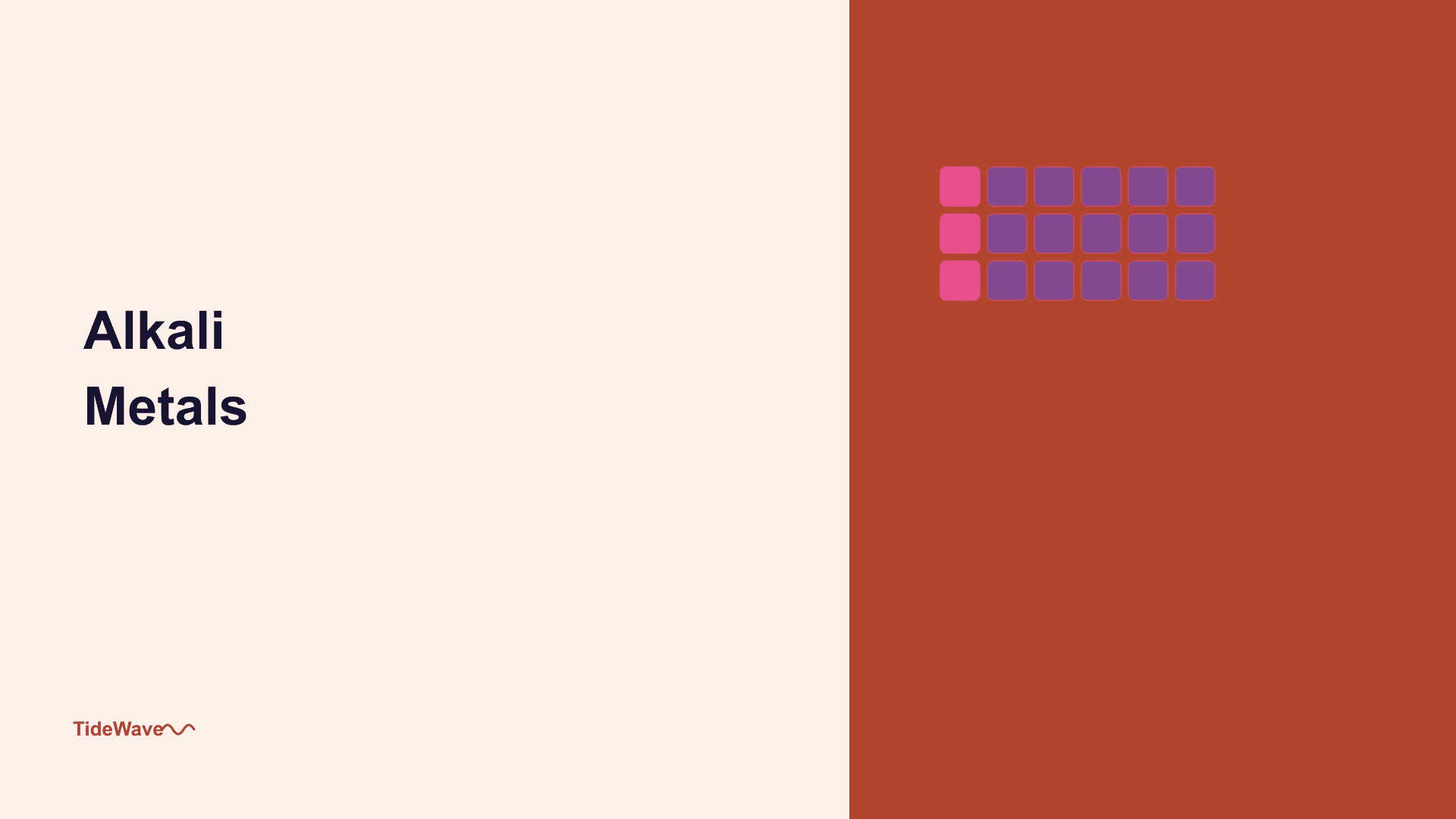
Group 1 of the periodic table, the alkali metals, lithium, sodium, potassium, rubidium, cesium, and francium, contains some of the most reactive metals known. A small piece of sodium dropped into water doesn't just dissolve quietly; it skitters across the surface, fizzes violently, and can ignite the hydrogen gas it produces. Understanding why comes down to a single, simple structural feature shared by every element in the group.
The One Feature That Defines the Group
Every alkali metal has exactly one valence electron, sitting alone in its outermost shell. This single electron is held relatively loosely, since it's shielded from the nucleus by all the inner, filled electron shells beneath it, making it easy for the atom to lose. Losing that one electron leaves the atom with a complete, stable outer shell (matching the nearest noble gas configuration) and a +1 charge, which is exactly the configuration alkali metals "want" to reach.
This single fact, one loosely held valence electron, explains nearly every property alkali metals share:
- High reactivity, since losing that one electron is energetically easy.
- Strong reducing agents, since they readily donate electrons to other substances.
- Always found as +1 ions in compounds, never as multiply-charged ions.
- Form ionic bonds almost exclusively, especially with the highly electronegative halogens.
Reactivity Increases Down the Group
Reactivity among alkali metals doesn't stay constant, it increases significantly as you move down the group, from lithium to francium. This follows directly from the periodic trends in atomic radius and ionization energy: each row down adds an entire new electron shell, placing the lone valence electron farther from the nucleus and shielded by more inner electrons. This makes it progressively easier to remove, lowering ionization energy and increasing reactivity.
Reaction with water, a classic demonstration used to illustrate this trend directly:
2Na + 2H₂O → 2NaOH + H₂
- Lithium: reacts steadily with water, fizzing gently.
- Sodium: reacts vigorously, melting into a small ball from the heat released and skittering across the surface.
- Potassium: reacts violently enough to ignite the hydrogen gas produced, burning with a lilac flame.
- Rubidium and cesium: react explosively on contact with water, and are rarely handled outside of tightly controlled laboratory conditions specifically because of this extreme reactivity.
Physical Properties
Despite being classified as metals, alkali metals behave unusually compared to the metals most people picture (like iron or copper):
- Soft enough to cut with a knife, since their metallic bonding is relatively weak (a direct result of having only one delocalized electron per atom contributing to that bonding).
- Low melting points compared to most other metals, and the melting point decreases further down the group.
- Low density, so much so that lithium, sodium, and potassium are all less dense than water and would float on it, if they didn't react with it immediately.
- Shiny, silvery appearance when freshly cut, though they tarnish almost immediately on exposure to air, reacting with oxygen and moisture.
Why Alkali Metals Are Never Found in Their Pure Elemental Form in Nature
Because alkali metals are so reactive, they're never found as free, uncombined elements in nature; they're always locked up in stable compounds, most commonly ionic salts like sodium chloride (table salt) or potassium chloride. Extracting the pure metal typically requires electrolysis, forcing electrons back onto the metal ion using an external electric current, since no ordinary chemical reducing agent is strong enough to do it. This is exactly how sodium metal is industrially produced, via electrolysis of molten sodium chloride.
Why Alkali Metals Still Matter, Despite the Danger
Given how hazardous the pure metals are, it's worth being clear that the compounds alkali metals form are often perfectly safe and essential:
- Sodium as sodium chloride (table salt) is essential to human physiology and food preservation, despite pure sodium metal being dangerously reactive.
- Lithium compounds are used in mood-stabilizing medication, and lithium metal itself is a critical component of lithium-ion batteries, though safely contained and never present as bare, exposed metal in a working battery.
- Potassium is an essential nutrient for both plants (a core ingredient in fertilizer) and human health (critical for nerve and muscle function), always consumed as a stable compound like potassium chloride, never as the pure element.
The danger associated with alkali metals is entirely a property of the uncombined element; once bonded into a stable ionic compound, that reactivity is spent, and the resulting substance behaves completely differently.
FAQ
Hydrogen has a single valence electron, just like alkali metals, and can form a +1 ion (a bare proton) in some reactions, which is why it's often positioned above the group for structural convenience on the periodic table. However, hydrogen is a nonmetal under normal conditions and behaves quite differently overall, so it isn't actually classified as an alkali metal.
Reactivity for alkali metals is governed by how easily the single valence electron can be removed (ionization energy), which decreases down the group due to increasing atomic size and electron shielding. Other properties, like electronegativity, follow the same decreasing trend down a group for the same underlying reason, so this isn't actually an exception, it's the same trend applied consistently.
Francium is intensely radioactive with an extremely short half-life (its most stable isotope lasts only about 22 minutes), and only trace, fleeting amounts have ever existed on Earth at any one time. It's far too scarce and unstable to study or use in the same practical way as sodium or potassium.
Yes. Because they react readily with both oxygen and moisture in ordinary air, alkali metals like sodium and potassium are typically stored submerged in an inert liquid, such as mineral oil, which physically prevents air and water from reaching the metal's surface.
It's extremely rare under normal conditions. Their very low ionization energy and the high electronegativity of the nonmetals they typically react with almost always favors complete electron transfer (an ionic bond) rather than sharing, though a few unusual, highly specialized organolithium and organosodium compounds used in advanced organic synthesis do involve more covalent character than typical alkali metal compounds.
Conclusion
Alkali metals demonstrate just how much a single structural detail, one loosely held valence electron, can determine an entire group's chemistry. That one electron explains their extreme reactivity, their tendency to form +1 ions and ionic bonds, their unusually soft and low-density physical properties, and why the metals themselves are never found free in nature. It's a clean example of how periodic trends aren't abstract patterns, they're a direct, predictable consequence of atomic structure playing out consistently across an entire column of the table.
Here are some useful references if you want to go deeper:
- Royal Society of Chemistry – Group 1: Alkali Metals — element-by-element data for the full alkali metal group.
- Khan Academy – Periodic Table Trends — free lessons connecting reactivity to atomic structure.
- Chemguide – The Alkali Metals — a detailed breakdown of alkali metal reactions and trends.