Halogens: The Most Reactive Nonmetals
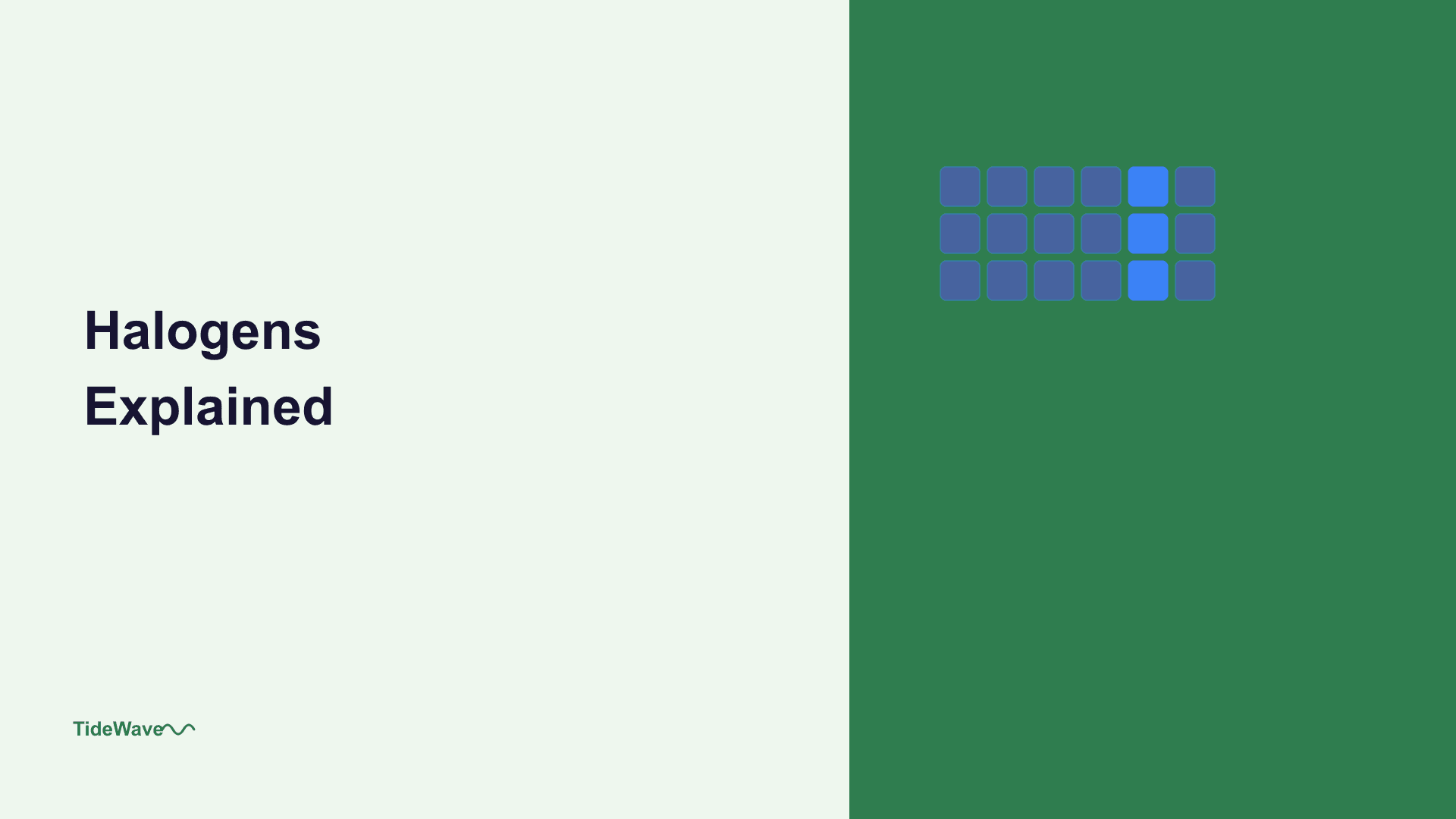
Group 17 of the periodic table, the halogens, fluorine, chlorine, bromine, iodine, and astatine, sits directly opposite the alkali metals in almost every meaningful way. Where alkali metals are eager to lose their single valence electron, halogens are just as eager to gain one, making them the most reactive group of nonmetals on the table. That shared eagerness to grab an extra electron is exactly why halogens react so readily with almost everything they encounter, including, famously, alkali metals themselves.
The One Feature That Defines the Group
Every halogen has exactly seven valence electrons, just one short of a complete, stable octet. This makes gaining a single electron extremely favorable, since it immediately completes the outer shell and matches the nearest noble gas configuration, forming a stable -1 ion called a halide.
This single feature explains the group's shared behavior:
- High reactivity, since gaining one electron is energetically favorable.
- Strong oxidizing agents, since they readily accept electrons from other substances.
- Highest electronegativity of any group on the table, with fluorine at the very top overall.
- Form -1 ions in ionic compounds, and form covalent bonds with each other and with other nonmetals.
Reactivity Decreases Down the Group
Unlike alkali metals, where reactivity increases down the group, halogen reactivity decreases moving from fluorine down to iodine. This might seem contradictory at first, but it follows the exact same underlying logic as any other periodic trend: as atomic radius increases down the group, the incoming electron ends up farther from the nucleus and is more shielded by inner electron shells, making it less strongly attracted and harder to add.
- Fluorine: the most reactive element on the entire periodic table, reacting explosively with many substances, including glass and water.
- Chlorine: highly reactive, used industrially for disinfection and bleaching precisely because of how readily it oxidizes other substances.
- Bromine: reactive, though noticeably less vigorously than chlorine.
- Iodine: the least reactive of the commonly encountered halogens, existing as a stable solid at room temperature rather than a gas.
Displacement Reactions: Watching Reactivity in Action
A classic demonstration of the halogen reactivity trend is a halogen displacement reaction, where a more reactive halogen displaces a less reactive one from a compound:
Cl₂ + 2KBr → 2KCl + Br₂
Here, chlorine (more reactive) displaces bromine from potassium bromide, forming potassium chloride and releasing free bromine. This reaction only proceeds in this direction; bromine cannot displace chlorine from potassium chloride, since it's less reactive. Running this kind of displacement test with different halogen and halide combinations is a common laboratory method for experimentally confirming the group's reactivity order.
Halogens in Everyday Life
Chlorine: Water Treatment and Bleach
Chlorine's strong oxidizing power makes it effective at killing bacteria and other pathogens, which is why it's added in small, controlled amounts to municipal drinking water and swimming pools. The same oxidizing action is what makes chlorine-based bleach effective at breaking down colored compounds in fabric and removing stains.
Fluorine: Toothpaste and Non-Stick Coatings
Fluorine compounds called fluorides are added to toothpaste and some water supplies because they help strengthen tooth enamel and resist decay. Fluorine is also a key component of PTFE (Teflon), the non-stick coating used in cookware, where its extremely strong and stable carbon-fluorine bonds resist heat and chemical reaction far better than most other coatings.
Iodine: Antiseptics and Nutrition
Iodine solutions have long been used as antiseptics for wounds, again exploiting its (comparatively milder) oxidizing action against bacteria. Iodine is also an essential dietary nutrient, required by the thyroid gland to produce hormones that regulate metabolism, which is why table salt is often sold "iodized," with a small added amount of iodine compound to prevent deficiency.
Bromine: Flame Retardants
Bromine compounds have historically been widely used as flame retardants in textiles, electronics, and furniture, since brominated compounds interfere with the chemical chain reactions that sustain combustion. Environmental and health concerns have led to increased regulation of some brominated flame retardants in recent years.
Astatine: The Rare Exception
Astatine is the least understood halogen by far. It's intensely radioactive, and it's estimated that less than one ounce of astatine exists naturally on Earth at any given time, spread across the entire planet's crust as a fleeting product of radioactive decay chains. Because it's so scarce and unstable, chemists have never been able to observe a visible, bulk sample of the element, and much of what's "known" about astatine's expected properties is extrapolated from the clear trends established by the other four halogens rather than direct observation.
FAQ
A lone halogen atom has seven valence electrons, one short of a stable octet. By covalently bonding with another atom of the same element, each atom shares one electron with the other, completing both atoms' outer shells simultaneously. This is why halogens, like several other nonmetal elements, naturally exist as pairs rather than isolated atoms.
Yes, halogens are nonmetals; forming ionic compounds isn't exclusive to metals. What makes halogens nonmetals is their high electronegativity and tendency to gain electrons (forming negative ions) rather than lose them, the opposite chemical behavior of a metal, even though the resulting ionic compound (like sodium chloride) involves both a metal and a nonmetal.
Fluorine's extremely high reactivity (the highest of any element) means it reacts violently and immediately with an enormous range of substances, including materials often assumed to be inert, like glass and some metals. Chlorine, while still hazardous, is comparatively less aggressive and more predictable to handle under controlled laboratory and industrial conditions.
No, and this itself reflects the group's trends: fluorine and chlorine are gases, bromine is one of only two elements that's a liquid at room temperature, and iodine is a solid. This progression toward higher melting and boiling points down the group follows the same increasing strength of intermolecular forces seen in many other element groups as atomic size and mass increase.
Iodine isn't evenly distributed geologically; inland and mountainous regions often have iodine-poor soil, meaning locally grown food (and the people who rely on it without additional dietary sources) can be naturally low in iodine. Iodizing table salt was specifically introduced as a low-cost, widespread public health measure to correct this regional imbalance.
Conclusion
Halogens are, structurally, the mirror image of the alkali metals: where one group is defined by an eagerness to lose an electron, the other is defined by an equally strong eagerness to gain one. That single shared trait, seven valence electrons reaching for a complete octet, explains the group's high reactivity, its role as some of the strongest oxidizing agents on the table, and its wide range of everyday uses, from disinfecting water to strengthening tooth enamel. As with so much of the periodic table, one structural detail at the electron level turns out to explain an entire column's worth of chemistry.
Here are some useful references if you want to go deeper:
- Royal Society of Chemistry – Group 17: The Halogens — element-by-element data for the full halogen group.
- Khan Academy – Periodic Table Trends — free lessons connecting electronegativity to group behavior.
- Chemguide – The Halogens — a detailed breakdown of halogen reactivity and displacement reactions.