Noble Gases: Why the Least Reactive Elements Still Matter
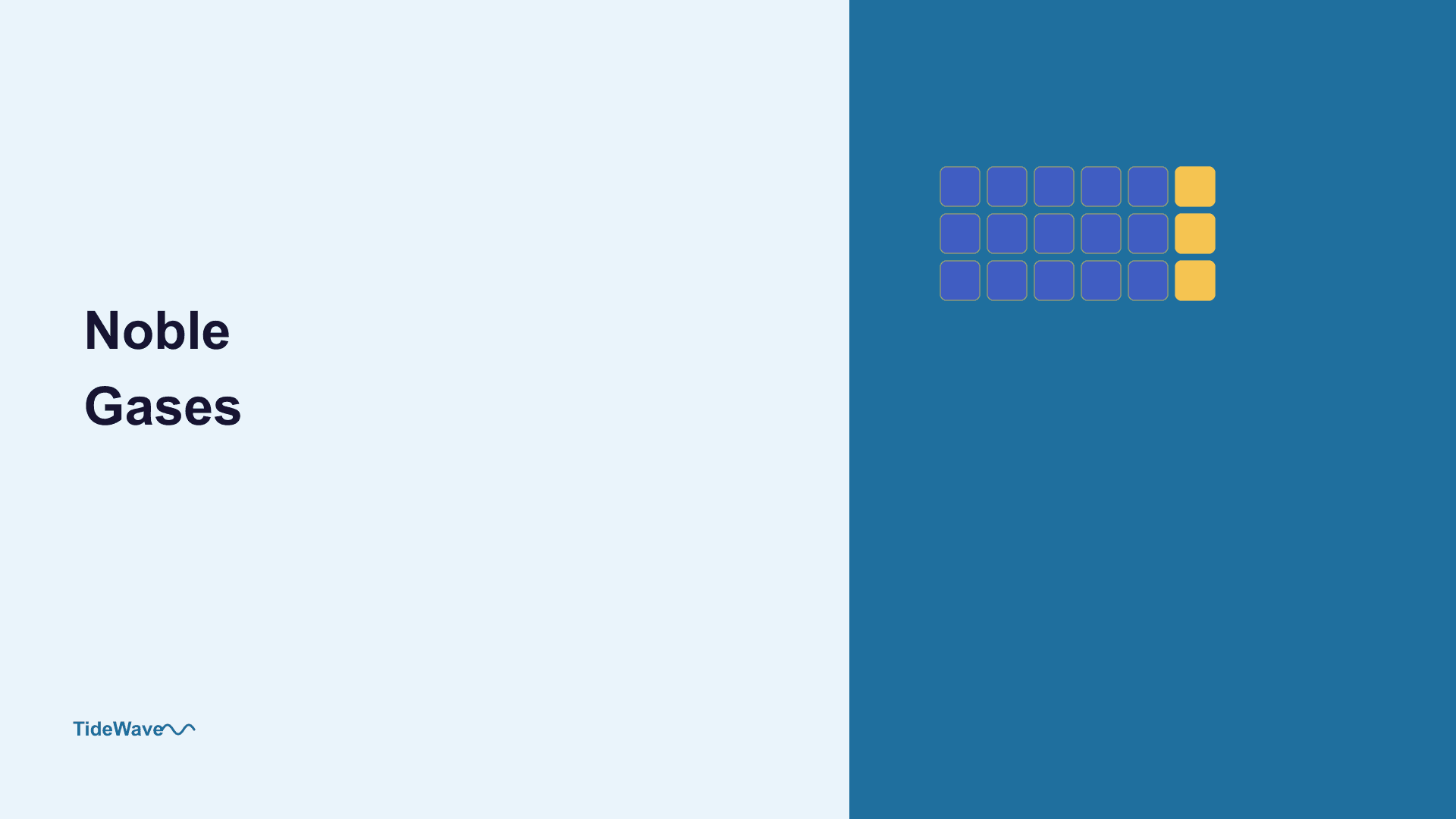
Most of the periodic table is defined by what elements do, how eagerly they bond, react, and transform into new compounds. The noble gases, occupying the entire rightmost column of the table, are defined largely by what they don't do. Helium, neon, argon, krypton, xenon, and radon are collectively the least reactive elements known, and for most of chemical history, they were assumed to be entirely inert, incapable of forming compounds at all. That near-total lack of reactivity turns out to be exactly what makes them so useful.
Why Noble Gases Barely React
The defining feature of a noble gas is a complete outer electron shell. Helium has 2 electrons filling its single shell; every other noble gas has 8 valence electrons filling its outermost shell, satisfying the octet rule without needing to gain, lose, or share any electrons with another atom.
Since chemical bonding exists specifically to help atoms achieve a stable, complete outer shell, an atom that already has one has essentially no motivation to bond at all. This is why noble gases exist as lone, individual atoms even in their gas form, unlike other gaseous elements like oxygen (O₂) or nitrogen (N₂), which pair up into diatomic molecules to share electrons and complete their own outer shells.
The Noble Gas Family
| Element | Symbol | Notable Property | Common Use |
|---|---|---|---|
| Helium | He | Lowest boiling point of any element | Balloons, cooling MRI magnets |
| Neon | Ne | Glows orange-red under electric current | Neon signs |
| Argon | Ar | Makes up about 1% of Earth's atmosphere | Welding, incandescent light bulbs |
| Krypton | Kr | Used in high-performance camera flashes | Photography, some lasers |
| Xenon | Xe | Heaviest stable noble gas | Car headlights, ion propulsion |
| Radon | Rn | Radioactive, no stable isotopes | (Naturally occurring; a health hazard, not a practical use) |
Real-World Uses of "Unreactive" Gases
It might seem strange that an element valued specifically for doing nothing chemically would have so many practical applications, but that inertness is precisely the useful property in every case below.
Neon Signs
Passing an electric current through neon gas at low pressure excites its electrons to higher energy levels; as those electrons fall back down, they release energy as visible light, in neon's case, a distinctive orange-red glow. Other noble gases produce different colors under the same principle (argon glows lavender-blue, krypton glows pale white), which is why "neon signs" using other gases are often mixed or coated to produce the full range of colors seen in signage today.
Helium Balloons and Cooling
Helium is far less dense than air, which is why helium-filled balloons float, but its chemical inertness matters just as much as its low density: since helium won't react with anything, it's safe to use in situations where a reactive gas (like flammable hydrogen, which was historically used for airships) would be dangerous. Helium's extremely low boiling point (-269°C, just a few degrees above absolute zero) also makes liquid helium essential for cooling the powerful superconducting magnets inside MRI machines.
Argon in Welding
Argon is used to create a shielding atmosphere around a weld to prevent the hot, reactive metal from bonding with oxygen or nitrogen in the surrounding air, which would weaken the weld. Because argon is chemically inert, it blankets the weld area without introducing any unwanted reactions of its own, and it's also used inside incandescent light bulbs for the same reason, preventing the hot filament from reacting with oxygen and burning out prematurely.
Xenon in Headlights and Space Travel
Xenon headlights (technically high-intensity discharge, or HID, lamps) pass an electric current through xenon gas to produce a bright, white light without a traditional heated filament. Xenon is also used as the propellant in ion thrusters, a form of spacecraft propulsion that ionizes xenon atoms and accelerates them using an electric field to generate thrust, used on several deep-space missions specifically because xenon is dense, easy to store as a compressed gas, and chemically inert enough to avoid corroding thruster components over long missions.
Noble Gases Aren't Perfectly Unreactive
For most of the 20th century, chemists believed noble gases were entirely incapable of forming compounds, a belief strong enough that they were originally called the "inert gases." That changed in 1962, when chemist Neil Bartlett successfully synthesized xenon hexafluoroplatinate, the first confirmed noble gas compound, by exploiting xenon's relatively low ionization energy (among noble gases) to force a reaction with an extremely strong oxidizing agent.
Since then, chemists have created a modest number of xenon and krypton compounds (like xenon difluoride, XeF₂), almost always requiring extreme conditions and highly reactive partner elements like fluorine. Helium, neon, and argon remain essentially unreactive under any known conditions, since their smaller size and correspondingly higher ionization energies make forcing a bond vastly more difficult. This history is exactly why the group's name was formally updated from "inert gases" to "noble gases," a term that acknowledges rare reactivity without claiming complete inertness.
FAQ
Their shared property, a complete outer electron shell, produces such consistently similar (lack of) reactivity across the entire group that they naturally cluster together on the periodic table, exactly the same principle that groups reactive metals or halogens together in their own columns.
Yes, though not because of any chemical reaction. Noble gases are simple asphyxiants: breathing an atmosphere of pure noble gas displaces oxygen entirely, which can cause unconsciousness and death from oxygen deprivation, even though the gas itself doesn't react with or poison the body directly.
Radon is radioactive with no stable isotopes, and its longest-lived isotope has a half-life of only about 3.8 days, far too short and hazardous for the kind of everyday applications helium or argon are used for. Radon is mainly discussed in a health and safety context, since it can accumulate in basements from natural uranium decay in soil and rock.
Bartlett had recently created a platinum-fluorine compound powerful enough to remove an electron from oxygen gas, itself a very difficult thing to oxidize. Since xenon's ionization energy is actually lower than oxygen's, he reasoned that the same oxidizer should be able to react with xenon too, and testing that specific hypothesis led directly to the first noble gas compound.
They occur naturally. Argon makes up almost 1% of Earth's atmosphere (making it the third most abundant atmospheric gas after nitrogen and oxygen), while the others are present in much smaller trace amounts. Industrially, they're extracted from air through fractional distillation of liquefied air, not synthesized from scratch.
Conclusion
Noble gases prove that "unreactive" isn't the same as "useless." Their complete outer electron shells make them famously resistant to bonding, but that same inertness is exactly what makes them safe for balloons, effective as a welding shield, and reliable as a light source that won't degrade the moment it's switched on. Even the group's rare exceptions, xenon's handful of forced compounds, tell a useful story about how electron configuration governs reactivity across the entire periodic table, not just for the elements eager to react.
Here are some useful references if you want to go deeper:
- Royal Society of Chemistry – Group 18: The Noble Gases — element-by-element data and history for the full noble gas group.
- Khan Academy – Periodic Table Trends — free lessons connecting electron configuration to group behavior.
- Chemguide – The Noble Gases — a detailed look at noble gas properties and the discovery of noble gas compounds.