Activation Energy and the Role of Catalysts
Paper burning releases a large amount of energy, and yet a stack of paper can sit in a room for decades without spontaneously combusting. If the reaction is so energetically favorable, why doesn't it just happen on its own? The answer is activation energy, an energy barrier that every reaction, no matter how favorable its final energy balance, must first climb over before it can proceed at all. Understanding this barrier is also the key to understanding what a catalyst actually does, and just as importantly, what it doesn't.
What Activation Energy Actually Is
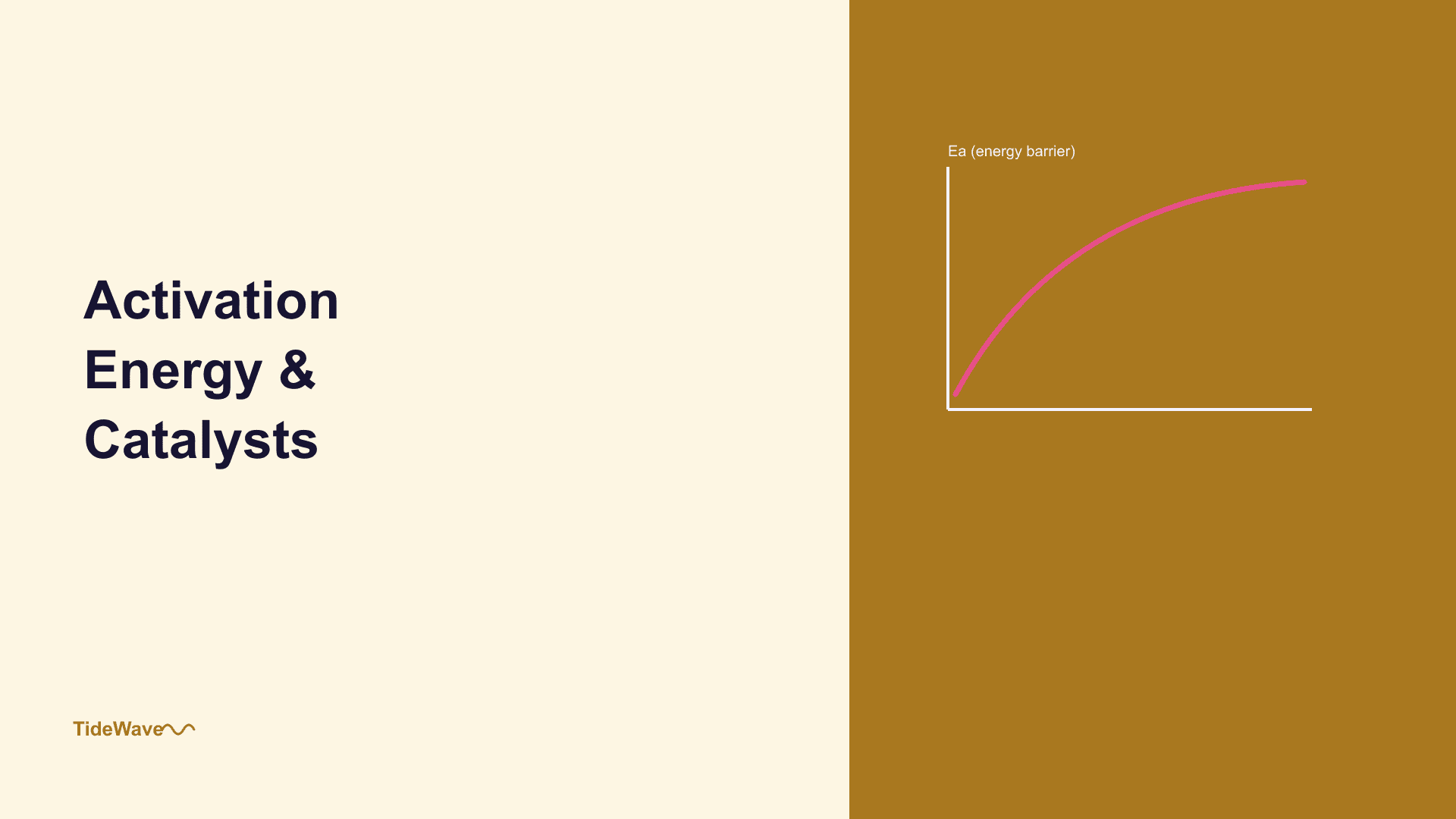
Activation energy (Ea) is the minimum energy that colliding reactant particles must possess for a reaction to actually occur, as introduced in collision theory. Even a highly exothermic reaction, one that will ultimately release a large amount of energy, still requires this initial energy investment to get started, in the same way a ball resting in a small dip on top of a hill needs a push to get over the lip before it can roll all the way down.
This is exactly why paper doesn't spontaneously combust at room temperature: at normal temperatures, essentially none of the colliding molecules carry enough energy to clear the activation energy barrier, even though the overall reaction (once started) is strongly exothermic. Apply a match, however, and the localized heat provides enough energy for nearby molecules to clear that barrier, after which the reaction's own released heat sustains the process in the surrounding material.
Visualizing Activation Energy: The Reaction Energy Diagram
A reaction energy diagram plots the energy of a reacting system against the progress of the reaction, and it makes the relationship between activation energy and overall enthalpy change visually clear:
Energy
  |           ___
  |          /   \  ← peak = transition state
  |         /     \
  |   Ea → /       \
  |       /         \___
  |  reactants          products (exothermic: lower than reactants)
  |________________________________
              Reaction Progress
The peak of this curve represents the transition state (sometimes called the activated complex), a fleeting, unstable, high-energy arrangement where old bonds are partially broken and new bonds are partially formed simultaneously. It exists for such a short time that it can never actually be isolated or observed directly; it's a theoretical peak the system must pass through, not a stable intermediate that pauses there.
- Ea (forward) is the energy difference between the reactants and the peak.
- Ea (reverse) is the energy difference between the products and the peak, always different from the forward Ea unless ΔH happens to be exactly zero.
- ΔH is the net energy difference between reactants and products, exactly the same value regardless of whether a catalyst is present.
How Catalysts Actually Work
A catalyst is a substance that increases reaction rate by providing an alternative reaction pathway with a lower activation energy, without being permanently consumed in the overall process. On a reaction energy diagram, a catalyst effectively lowers the peak of the curve, without changing the height of the reactants or products at all:
Energy
  |         ___(uncatalyzed peak, higher Ea)
  |        /   \
  |       /  __ \  ← catalyzed peak (lower Ea)
  |      / /    \ \
  |     //      \ \___
  |  reactants        products (same ΔH either way)
  |________________________________
              Reaction Progress
This is the single most important fact about catalysts to internalize: a catalyst changes the rate of a reaction, never its thermodynamics. The starting energy (reactants) and ending energy (products) are identical with or without a catalyst present, which means ΔH, ΔG, and the position of equilibrium are all completely unaffected. What changes is purely how quickly the system can get from one to the other.
How Catalysts Provide a Lower-Energy Pathway
Catalysts typically work through one of a few general mechanisms:
- Providing a surface for reactants to bind to (heterogeneous catalysis), holding reactant molecules in close proximity and in favorable orientations, increasing the likelihood of successful collisions. This is how catalytic converters in cars use platinum and palladium surfaces to speed up the breakdown of toxic exhaust gases.
- Forming a temporary intermediate compound (homogeneous catalysis), where the catalyst briefly reacts with a reactant to form a new, lower-energy pathway to the final product, before being regenerated unchanged at the end of the reaction.
- Positioning substrates precisely, as biological catalysts (enzymes) do, holding reacting molecules in exactly the right orientation and proximity to dramatically lower the effective activation energy needed for a reaction to proceed.
Because a catalyst is regenerated at the end of the reaction rather than consumed, a small amount of catalyst can facilitate the conversion of a very large amount of reactant over time, which is exactly why catalysts are used in such small quantities relative to the reactants in industrial processes.
Catalysts vs. Reaction Intermediates: A Common Mix-Up
It's worth distinguishing a catalyst from a reaction intermediate, since both appear only temporarily during a reaction mechanism, they play opposite roles:
- A catalyst appears in the mechanism's early steps and is regenerated in a later step; it appears on the reactant side of an early elementary step and the product side of a later one.
- An intermediate is produced during an early step and then consumed in a later step; it's a genuine, if temporary, product of the overall reaction pathway, never present in the original reactants or final products themselves.
Why This Matters Beyond the Reaction Diagram
- Industrial efficiency: catalysts like iron in the Haber process make otherwise impractically slow industrial reactions commercially viable, without needing to sacrifice the reaction's favorable equilibrium position.
- Environmental protection: catalytic converters rely on precisely this principle to convert harmful exhaust gases into less harmful ones fast enough to matter within a car's exhaust system.
- Biology: enzymes are biological catalysts that make essential metabolic reactions happen fast enough to sustain life at body temperature, reactions that would otherwise proceed far too slowly to be useful without that assistance.
FAQ
Catalysts can become physically fouled, poisoned by contaminants that bind to their active sites, or gradually degrade structurally through repeated use, none of which is the catalyst being "consumed" by the reaction itself in a strict chemical sense. Over time, this practical wear reduces a catalyst's effectiveness, eventually requiring replacement even though it was never a reactant.
Yes, most real reactions proceed through multiple elementary steps, each with its own transition state and activation energy, rather than one single step. The overall reaction rate is generally limited by whichever individual step has the highest activation energy, called the rate-determining step.
No, the effect of a given activation energy reduction is actually more pronounced at lower temperatures, since a smaller fraction of molecules have enough energy to react at low temperature in the first place, so lowering the barrier has proportionally more impact on how many can now succeed.
No, though both can appear unchanged at the reaction's end. A solvent primarily provides a medium for the reaction to occur in (dissolving reactants, moderating temperature) without necessarily participating directly in the bond-breaking and bond-forming steps, while a catalyst actively participates in the reaction mechanism itself by forming temporary bonds or interactions that lower the activation energy.
The transition state exists for an extraordinarily brief moment, on the order of the time it takes a single bond vibration to occur, far shorter than even the fastest modern spectroscopic techniques can resolve directly. Chemists infer its properties indirectly, through kinetic measurements and theoretical modeling, rather than observing it directly.
Conclusion
Activation energy explains the gap between "this reaction would release energy" and "this reaction is actually happening right now": every reaction, however favorable its final outcome, must first climb over an energy barrier to get started. Catalysts don't eliminate that barrier or cheat thermodynamics; they simply carve out a lower path over it, speeding up how quickly a reaction reaches the same destination it was always going to reach anyway. That distinction, rate versus thermodynamics, is exactly what separates a catalyst's real role from a common misconception about what it does.
Here are some useful references if you want to go deeper:
- Khan Academy – Activation Energy and Catalysts — free lessons with labeled reaction energy diagrams.
- Chemguide – Catalysis — a detailed explanation of catalytic mechanisms.
- LibreTexts Chemistry – Activation Energy — an open textbook resource covering transition state theory in more depth.