Chemical Equilibrium and Le Chatelier's Principle Explained
Not every chemical reaction runs to completion and stops. Many reactions are reversible, meaning the products can react again to reform the original reactants, and under the right conditions, both the forward and reverse reactions happen simultaneously, forever, without either one ever fully "winning." This dynamic standoff is called chemical equilibrium, and it governs everything from how efficiently industrial ammonia is produced to how oxygen is carried through your bloodstream.
What Equilibrium Actually Means
Consider a reversible reaction, denoted with a double arrow (⇌) instead of a single one:
A + B ⇌ C + D
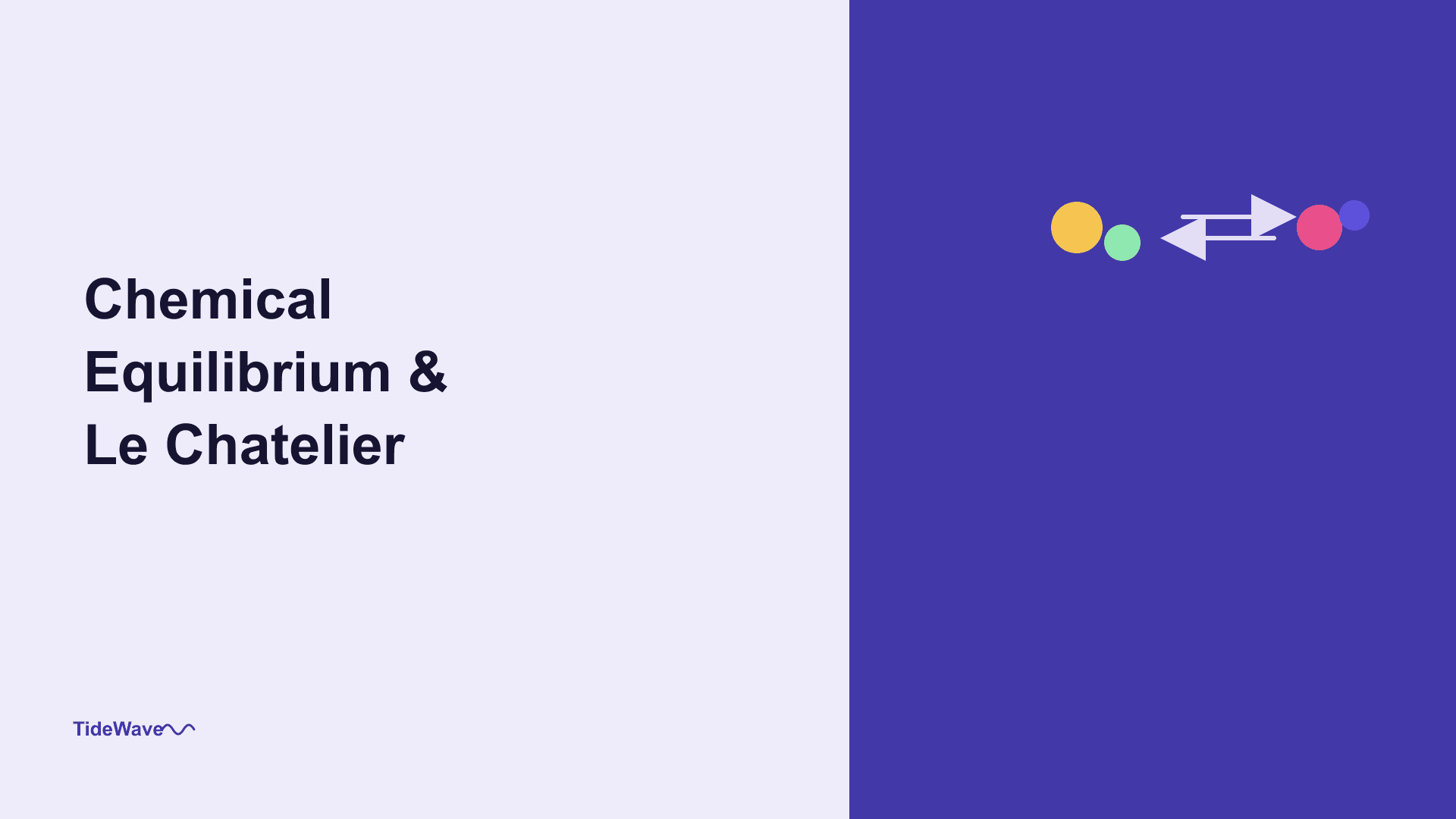
When this reaction begins, only the forward reaction (A + B → C + D) occurs, since no products exist yet. But as C and D accumulate, the reverse reaction (C + D → A + B) starts happening too. Over time, the forward reaction slows down (as A and B get used up) while the reverse reaction speeds up (as C and D build up), until eventually:
Rate of forward reaction = Rate of reverse reaction
At this point, the system has reached chemical equilibrium. Critically, this doesn't mean the reaction has stopped; both the forward and reverse reactions are still actively occurring, just at equal, canceling rates. This is why equilibrium is described as dynamic, not static: the concentrations of reactants and products stay constant over time, but only because production and consumption are perfectly balanced, not because all activity has ceased.
The Equilibrium Constant (K)
Every reversible reaction at equilibrium has a characteristic ratio between product and reactant concentrations, called the equilibrium constant, K. For a general reaction:
aA + bB ⇌ cC + dD
The equilibrium constant expression is:
K = [C]^c [D]^d / [A]^a [B]^b
where brackets indicate molar concentration, and the exponents match the coefficients from the balanced equation. The value of K tells you a great deal about a reaction at a glance:
- K much greater than 1: at equilibrium, products dominate; the reaction favors the forward direction.
- K much less than 1: at equilibrium, reactants dominate; the reaction favors the reverse direction.
- K ≈ 1: significant amounts of both reactants and products are present at equilibrium.
Importantly, K is constant for a given reaction at a given temperature, no matter the starting concentrations you began with. Change the temperature, and K itself changes, but at any fixed temperature, a reaction will always settle at the same characteristic ratio.
Le Chatelier's Principle: Predicting the Response to Disturbance
Le Chatelier's Principle, named after French chemist Henri Le Chatelier, states that if a system at equilibrium is disturbed, the system will shift in whichever direction relieves that disturbance, re-establishing a new equilibrium. It's essentially a chemical system's version of resistance to change, and it lets you predict the direction a reaction will shift without needing to recalculate K from scratch.
There are three common types of disturbance:
1. Changing Concentration
Adding more reactant shifts equilibrium forward (toward products), as the system works to consume the excess. Removing a product as it forms has the same effect, pulling the reaction forward continuously, which is exactly the strategy used in many industrial processes to maximize yield. Conversely, adding more product or removing reactant shifts equilibrium backward.
2. Changing Pressure (for Gaseous Reactions)
For reactions involving gases, increasing pressure (by decreasing volume) shifts equilibrium toward the side with fewer total moles of gas, since that side takes up less volume and partially relieves the increased pressure. Decreasing pressure shifts equilibrium toward the side with more moles of gas. Reactions where both sides have equal moles of gas are unaffected by pressure changes entirely.
3. Changing Temperature
Temperature is unique among these disturbances because it's the only one that actually changes the value of K itself, not just the position of equilibrium. Treating heat as if it were a reactant or product makes this predictable:
- For an exothermic reaction (releases heat), heat behaves like a product. Increasing temperature shifts equilibrium backward (toward reactants), since the system treats the added heat like an excess product.
- For an endothermic reaction (absorbs heat), heat behaves like a reactant. Increasing temperature shifts equilibrium forward (toward products).
What Doesn't Shift Equilibrium
Catalysts are a common point of confusion. A catalyst speeds up both the forward and reverse reactions equally, helping the system reach equilibrium faster, but it doesn't change the position of equilibrium itself, or the value of K. It gets you to the same destination sooner, not to a different destination.
A Real Industrial Example: The Haber Process
The industrial production of ammonia (NH₃) from nitrogen and hydrogen gas is a textbook application of Le Chatelier's Principle:
N₂(g) + 3H₂(g) ⇌ 2NH₃(g) (exothermic)
Notice the left side has 4 total moles of gas (1 + 3), while the right side has only 2. To maximize ammonia yield, engineers apply high pressure, shifting equilibrium toward the side with fewer gas moles (the products). Because the reaction is exothermic, lower temperature would also favor more product, but in practice, a moderately high temperature is used instead as a practical compromise, since very low temperatures make the reaction far too slow to be commercially useful, even though it would theoretically favor a higher yield. A catalyst (iron) is added specifically to compensate for that slower rate, letting the reaction reach its (pressure-optimized) equilibrium in a reasonable amount of time.
Why Equilibrium Matters Beyond a Chemistry Classroom
- Human respiration: hemoglobin binds oxygen through an equilibrium reaction; at the lungs, high oxygen concentration shifts equilibrium to bind oxygen, while in tissues, lower oxygen concentration shifts equilibrium to release it.
- Ocean chemistry: dissolved CO₂ exists in equilibrium with carbonic acid and bicarbonate ions in seawater, a balance directly affected by rising atmospheric CO₂ levels.
- Buffer solutions: the acid-base equilibria in blood and other biological fluids resist pH changes precisely because of Le Chatelier's Principle acting on weak acid/base pairs.
FAQ
No, this is a very common misconception. Equilibrium means the concentrations have stopped changing over time, not that they're equal to each other. The equilibrium constant K tells you the actual ratio, which can heavily favor either reactants or products depending on the specific reaction.
Catalysts don't change where equilibrium sits, but they dramatically reduce the time needed to reach it. Without a catalyst, an industrially useful reaction might take an impractically long time to reach equilibrium even at a favorable pressure and temperature, making the process commercially unviable regardless of the theoretical yield.
No, true equilibrium requires the reverse reaction to also be occurring, which means measurable amounts of both reactants and products must be present (even if one is present in a very small amount). A reaction that goes to 100% completion, with no meaningful reverse reaction at all, isn't considered a true chemical equilibrium in the traditional sense.
Continuously removing product prevents the reverse reaction from ever building up meaningfully, since Le Chatelier's Principle predicts the system will keep shifting forward to replace what's being removed. This is a common industrial strategy, sometimes called "pulling" the reaction, used specifically to push a reversible reaction toward a much higher practical yield than its natural equilibrium would otherwise allow.
It's best understood as a useful predictive shortcut derived from more fundamental thermodynamic and kinetic principles, rather than a standalone law of nature. It reliably predicts the direction of a shift without requiring you to solve the full equilibrium expression mathematically, which is exactly why it's so widely taught and used in practice.
Conclusion
Chemical equilibrium describes a state of balance, not a state of rest: reactions continue happening in both directions, just at equal, canceling rates. Le Chatelier's Principle turns that balance into a genuinely predictive tool, letting you reason through how concentration, pressure, and temperature changes will shift a system without recalculating an equilibrium constant from scratch. From industrial ammonia production to the way your own blood carries oxygen, this dynamic balancing act is happening constantly, almost always invisibly.
Here are some useful references if you want to go deeper:
- Khan Academy – Chemical Equilibrium — free lessons covering equilibrium constants and Le Chatelier's Principle with worked examples.
- Chemguide – Le Chatelier's Principle — a detailed explanation of each type of equilibrium disturbance.
- Royal Society of Chemistry – The Haber Process — an in-depth look at how equilibrium principles are applied industrially.