Balancing Chemical Equations: A Step-by-Step Guide
Every chemical equation is a claim about what happens to matter during a reaction, and matter doesn't simply appear or disappear. This is the Law of Conservation of Mass: the total number of atoms of each element must be identical on both sides of a chemical equation. An unbalanced equation isn't just sloppy notation, it describes a reaction that violates a fundamental law of physics. Balancing equations is the skill of making sure your notation actually matches reality.
Why Equations Need Balancing At All
Consider the reaction between hydrogen gas and oxygen gas to form water:
H₂ + O₂ → H₂O (unbalanced)
Count the atoms on each side: the left has 2 hydrogen atoms and 2 oxygen atoms. The right has 2 hydrogen atoms but only 1 oxygen atom. One oxygen atom has vanished, which is impossible; atoms are neither created nor destroyed in a chemical reaction, only rearranged into new combinations. This equation, as written, describes something that cannot actually happen.
The One Rule You Can't Break
When balancing an equation, you're only allowed to change the numbers placed in front of each compound (called coefficients). You can never change the small numbers within a chemical formula (called subscripts), since doing so would describe an entirely different substance.
- Changing a coefficient (like turning H₂O into 2H₂O) means "two molecules of water," still the same substance.
- Changing a subscript (like turning H₂O into H₂O₂) means you've just described hydrogen peroxide instead, a completely different compound with different properties.
This distinction is the single most important rule in balancing equations, and it's worth internalizing before doing anything else.
Step-by-Step Method
Step 1: Write the Unbalanced Equation
Start with the correct chemical formulas for every reactant and product, with no coefficients yet:
H₂ + O₂ → H₂O
Step 2: Count Atoms of Each Element on Both Sides
| Element | Left side | Right side |
|---|---|---|
| H | 2 | 2 |
| O | 2 | 1 |
Hydrogen is already balanced; oxygen is not.
Step 3: Add Coefficients, Starting With the Most Complex Molecule
A reliable strategy is to balance elements that appear in the fewest compounds first, and save elements that appear alone (like O₂ and H₂ here) for later, since they're easiest to adjust at the end. Balance oxygen by placing a coefficient of 2 in front of H₂O:
H₂ + O₂ → 2H₂O
Step 4: Recheck All Elements After Every Change
Changing one coefficient often unbalances an element you'd already fixed. Recount:
| Element | Left side | Right side |
|---|---|---|
| H | 2 | 4 |
| O | 2 | 2 |
Oxygen is now balanced, but hydrogen is not (2 vs. 4). Fix hydrogen by placing a coefficient of 2 in front of H₂:
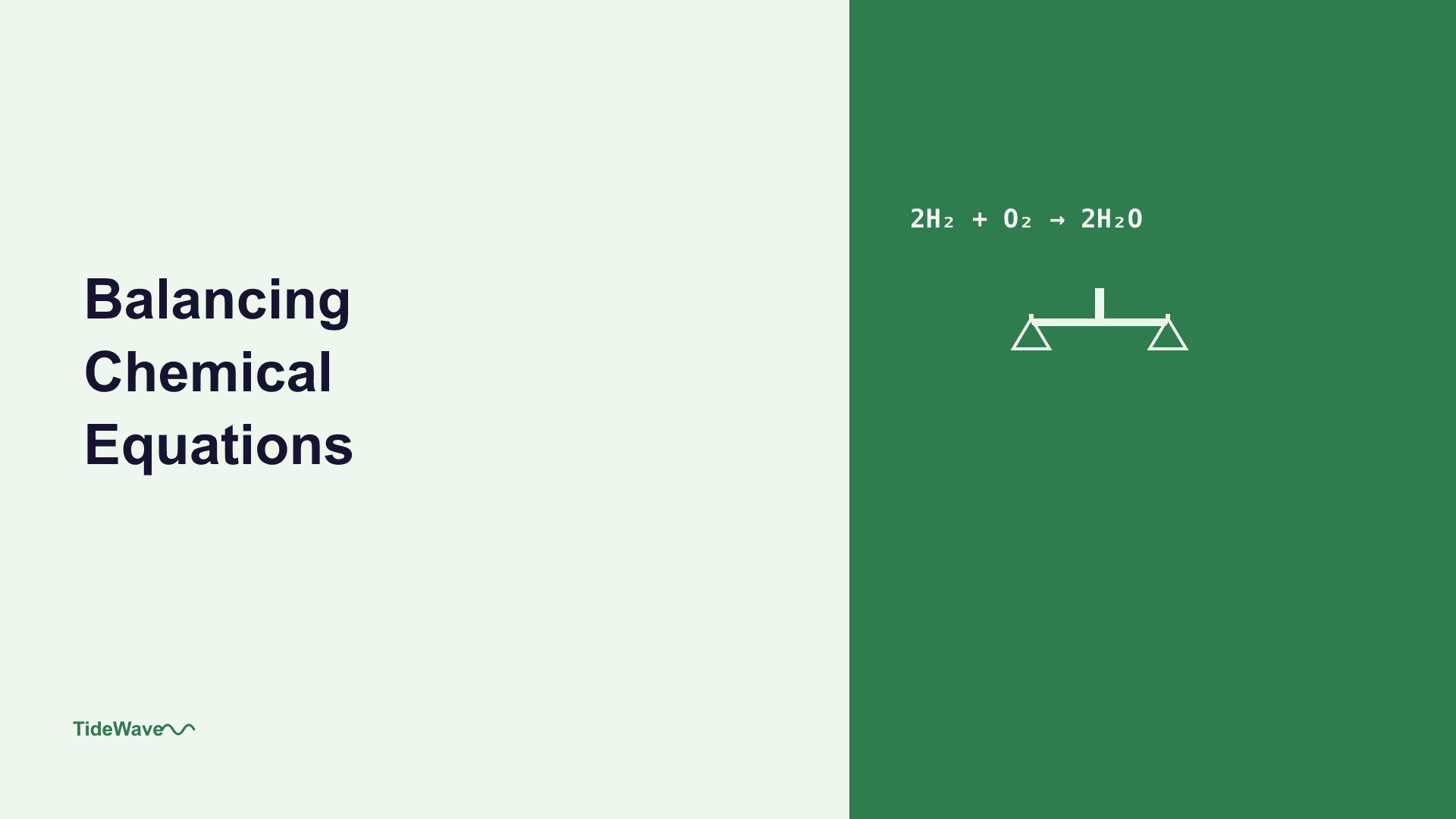
2H₂ + O₂ → 2H₂O
Step 5: Verify the Final Equation
| Element | Left side | Right side |
|---|---|---|
| H | 4 | 4 |
| O | 2 | 2 |
Both elements match. The equation is balanced.
A More Complex Example
Balancing gets more involved with larger molecules, but the same method scales up. Take the combustion of propane:
C₃H₈ + O₂ → CO₂ + H₂O (unbalanced)
Balance carbon first (it appears in one compound on each side): propane has 3 carbons, so place a 3 in front of CO₂:
C₃H₈ + O₂ → 3CO₂ + H₂O
Balance hydrogen next: propane has 8 hydrogens, and each H₂O has 2, so place a 4 in front of H₂O:
C₃H₈ + O₂ → 3CO₂ + 4H₂O
Balance oxygen last, since it now appears in two products, making it the most complex to solve. Count oxygen on the right: 3 CO₂ contributes 6 oxygen atoms, and 4 H₂O contributes 4 oxygen atoms, for a total of 10. Place a coefficient in front of O₂ that gives 10 oxygen atoms on the left:
C₃H₈ + 5O₂ → 3CO₂ + 4H₂O
Verify: Left side has 3 C, 8 H, and 10 O (5 × 2). Right side has 3 C (from 3CO₂), 8 H (from 4H₂O), and 10 O (6 from CO₂ + 4 from H₂O). Balanced.
Handling Fractional Coefficients
Sometimes the balancing process naturally produces a fraction, like ½O₂. Fractional coefficients are mathematically valid, but chemists conventionally avoid them in a final answer since you can't have half a molecule in practice. If you end up with a fraction, multiply every coefficient in the entire equation by the same whole number (usually 2) to clear it: bash
C₂H₆ + 7/2 O₂ → 2CO₂ + 3H₂O   (has a fraction)

× 2 everything:

2C₂H₆ + 7O₂ → 4CO₂ + 6H₂O   (final, whole-number answer)
A Quick Sanity Check: Simplify First
Before declaring an equation balanced, double-check that all coefficients share no common factor. An equation like 4H₂ + 2O₂ → 4H₂O is technically balanced, but it should be simplified by dividing every coefficient by 2, giving the standard, simplest form: 2H₂ + O₂ → 2H₂O. Chemists always report the simplest whole-number ratio.
FAQ
Changing subscripts (the numbers inside a chemical formula) to force a balance describes an entirely different, often nonexistent, compound rather than balancing the original reaction. Balancing must only ever be done by adjusting coefficients in front of complete formulas, never the formulas themselves.
A generally reliable order is: balance elements that appear in only one reactant and one product first, save any element that appears as a free element (like O₂ or H₂) for near the end, and balance hydrogen and oxygen last if water is involved, since they tend to shift as other elements are adjusted.
This usually means one of the chemical formulas was written incorrectly to begin with, rather than a balancing problem. Double-check that every reactant and product has the correct formula (based on valence and known compound names) before assuming the equation itself can't be balanced.
Coefficients directly represent the mole ratio in which reactants combine and products form, which is the basis of stoichiometry calculations. A balanced equation like 2H₂ + O₂ → 2H₂O tells you that exactly 2 moles of hydrogen react with every 1 mole of oxygen to produce 2 moles of water, a real, measurable ratio, not just a notational convenience.
Yes, when a polyatomic ion (like sulfate, SO₄²⁻, or nitrate, NO₃⁻) appears unchanged on both sides of an equation, it can be balanced as one complete unit rather than counting its individual atoms separately, which often simplifies the process considerably.
Conclusion
Balancing chemical equations comes down to one non-negotiable rule (adjust coefficients, never subscripts) and one reliable process: count atoms on each side, adjust coefficients systematically starting with the most straightforward elements, and recheck everything after every change. It can feel like trial and error at first, but with the ordered approach above, most equations, even complex combustion reactions, become a predictable, mechanical exercise rather than a guessing game. Once balancing feels automatic, it becomes the foundation for stoichiometry, where those same coefficients let you calculate exact quantities of reactants and products.
Here are some useful references if you want to go deeper:
- Khan Academy – Balancing Chemical Equations — free video walkthroughs of increasingly complex balancing examples.
- Chemguide – Balancing Equations — a methodical explanation with worked examples.
- LibreTexts Chemistry – Reaction Stoichiometry — an open textbook resource connecting balanced equations to quantitative calculations.