Moles and Stoichiometry: The Chemist's Counting System
Atoms and molecules are far too small and far too numerous to count individually, a single drop of water contains roughly 1.7 sextillion molecules, so chemists needed a practical way to count them anyway. The solution is the mole, a unit that lets chemists convert between the invisible world of individual atoms and the measurable world of grams on a lab scale. Once you understand the mole, stoichiometry, using a balanced chemical equation to calculate exact quantities of reactants and products, becomes a straightforward series of conversions rather than an intimidating branch of math.
What Exactly Is a Mole?
A mole is simply a specific, very large number, in the same way that "a dozen" always means exactly 12, regardless of whether you're counting eggs or basketballs. One mole is defined as exactly:
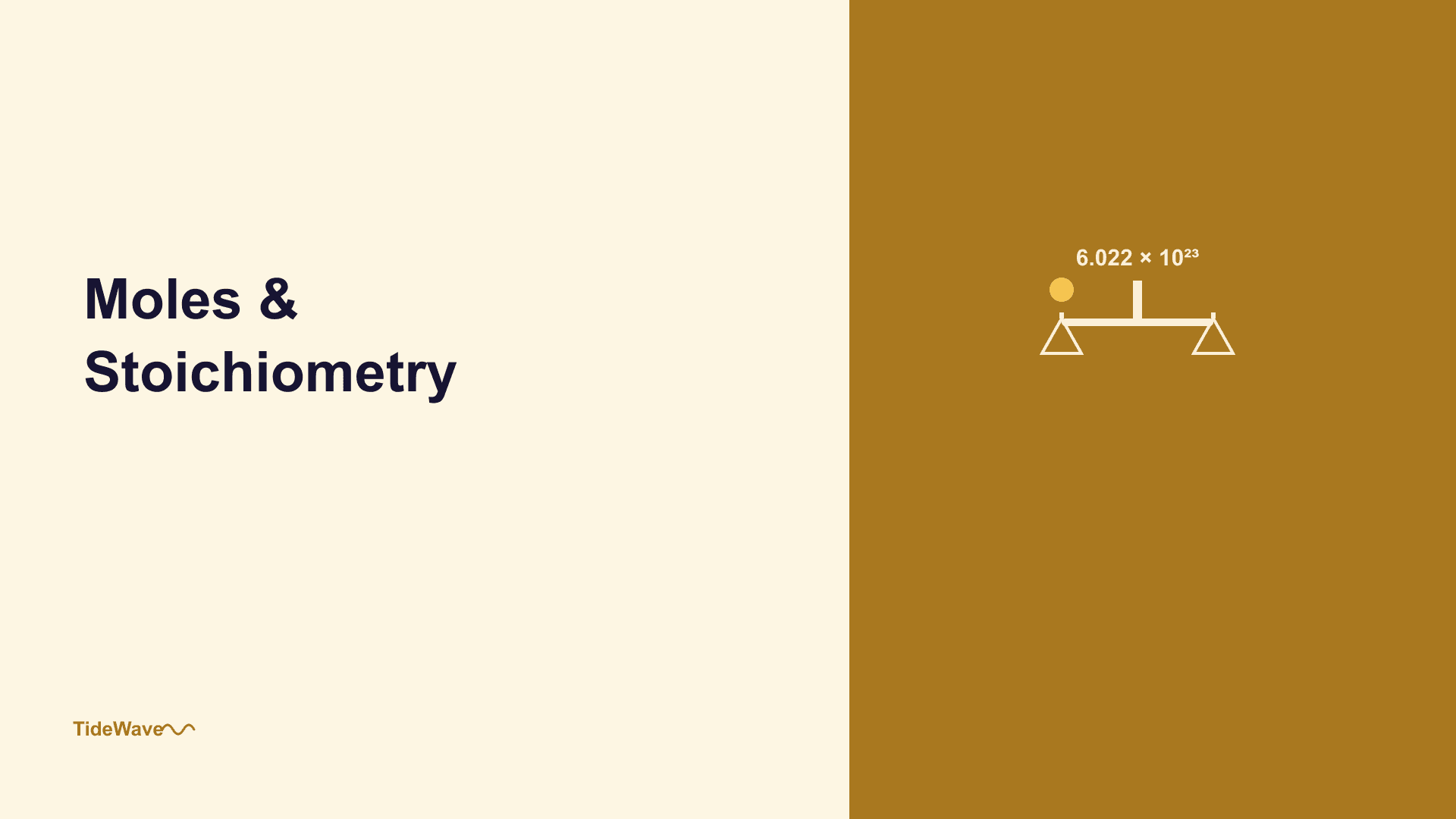
6.022 × 10²³
This number is called Avogadro's number, named after the Italian scientist Amedeo Avogadro. One mole of anything, atoms, molecules, or even something everyday like grains of sand, contains that many individual units.
Why this particular number? It's defined so that the mass of one mole of a substance, in grams, equals that substance's atomic or molecular mass in atomic mass units (amu). This connection is what makes the mole so useful: it bridges the microscopic scale (individual atoms, measured in amu) and the macroscopic scale (grams, measured on a lab balance).
Molar Mass: The Bridge Between Atoms and Grams
The molar mass of a substance is the mass, in grams, of one mole of that substance. It's numerically identical to the atomic mass shown on the periodic table, just with different units attached.
Example: Carbon has an atomic mass of about 12.01 amu on the periodic table. This means one mole of carbon atoms (6.022 × 10²³ atoms) has a mass of exactly 12.01 grams.
For compounds, molar mass is calculated by adding up the molar masses of every atom in the formula:
Example: Water (H₂O)
2 × H (1.01 g/mol) = 2.02 g/mol
1 × O (16.00 g/mol) = 16.00 g/mol
Total molar mass of H₂O = 18.02 g/mol
This means 18.02 grams of water contains exactly one mole (6.022 × 10²³) of water molecules.
Converting Between Grams, Moles, and Particles
Molar mass and Avogadro's number together let you convert freely between three quantities: mass, moles, and number of particles. This is usually visualized as a simple triangle of conversions:
- Grams → Moles: divide by molar mass.
- Moles → Grams: multiply by molar mass.
- Moles → Particles: multiply by Avogadro's number (6.022 × 10²³).
- Particles → Moles: divide by Avogadro's number.
Example: How many moles are in 36.04 grams of water?
36.04 g ÷ 18.02 g/mol = 2 mol
Example: How many water molecules are in those 2 moles?
2 mol × 6.022 × 10²³ = 1.2044 × 10²⁴ molecules
Stoichiometry: Using Balanced Equations to Predict Quantities
Stoichiometry is the practical application of the mole concept: using the coefficients in a balanced chemical equation to calculate exactly how much of each substance is involved in a reaction. The coefficients in a balanced equation represent the mole ratio in which substances react.
Example: Consider the balanced equation for the combustion of methane:
CH₄ + 2O₂ → CO₂ + 2H₂O
This equation tells you that 1 mole of methane reacts with 2 moles of oxygen to produce 1 mole of carbon dioxide and 2 moles of water, every single time, regardless of the actual quantities involved.
A Worked Stoichiometry Problem
Question: How many grams of water are produced when 8 grams of methane (CH₄) burns completely?
Step 1: Convert grams of methane to moles.
Molar mass of CH₄ = 12.01 + (4 × 1.01) = 16.05 g/mol
8 g ÷ 16.05 g/mol = 0.498 mol CH₄
Step 2: Use the mole ratio from the balanced equation.
The equation shows 1 mol CH₄ produces 2 mol H₂O, so:
0.498 mol CH₄ × (2 mol H₂O / 1 mol CH₄) = 0.996 mol H₂O
Step 3: Convert moles of water back to grams.
Molar mass of H₂O = 18.02 g/mol
0.996 mol × 18.02 g/mol = 17.95 g H₂O
Answer: Burning 8 grams of methane produces approximately 17.95 grams of water.
This three-step pattern, grams → moles → (mole ratio) → moles → grams, is the core structure of nearly every stoichiometry problem you'll encounter, regardless of the specific reaction involved.
The Limiting Reactant
In real reactions, you rarely have the exact mole ratio the equation calls for; usually one reactant runs out before the other. The reactant that's used up first is called the limiting reactant, since it limits how much product can actually form, while the substance left over is called the excess reactant.
Identifying the limiting reactant means calculating how much product each reactant could theoretically produce on its own, then recognizing that whichever reactant produces the smaller amount of product is the one that actually runs out first, and its result is the real, achievable yield.
FAQ
Avogadro's number is defined based on the number of atoms in exactly 12 grams of carbon-12, the isotope chosen as the reference standard for atomic mass. It isn't an arbitrary round number because it emerges from matching the atomic mass scale to a practical, measurable gram-based scale, rather than being chosen for convenience.
Molecular mass (or molecular weight) is the mass of a single molecule, typically expressed in atomic mass units (amu), and describes an individual particle. Molar mass is the mass of one full mole (6.022 × 10²³) of that same substance, expressed in grams per mole. The numerical value is identical; only the unit and the scale being described differ.
Only if you're converting between two different substances in a reaction (like grams of methane to grams of water). If you're just converting a single substance between grams, moles, and particles, without comparing it to anything else, you only need that substance's molar mass and Avogadro's number, no equation required.
There's no reliable shortcut that skips the calculation entirely, since limiting reactant depends on both the amount available and the mole ratio required, not simply which one you have less of by mass. The safest method is always to calculate how much product each reactant could produce independently, then compare the two results directly.
Stoichiometry calculates the theoretical yield, the maximum amount of product possible under perfect conditions. Real reactions almost always produce less than this due to side reactions, incomplete reactions, or product lost during collection, so percent yield (actual yield ÷ theoretical yield × 100) measures how efficiently a real reaction performed compared to that theoretical maximum.
Conclusion
The mole solves a genuinely difficult problem: counting particles too small and too numerous to count directly, by tying that count to a quantity you can actually measure, mass in grams. Once molar mass and Avogadro's number are second nature, stoichiometry stops feeling like a separate, harder topic and becomes exactly what it is: a straightforward chain of conversions built on top of a balanced chemical equation. Master the grams-to-moles-to-grams pattern, and you can predict the outcome of any reaction with a known equation, before you ever step foot in a lab.
Here are some useful references if you want to go deeper:
- Khan Academy – The Mole and Avogadro's Number — free lessons with practice problems on mole conversions.
- Chemguide – Reacting Masses and Volumes — detailed worked examples of stoichiometry calculations.
- NIST – Physical Measurement Laboratory — the U.S. standards body responsible for maintaining precise definitions of measurement units, including the mole.