Chemical Kinetics: Understanding Reaction Rates
An explosion happens in milliseconds. Iron rusting takes months. A diamond slowly converting to graphite could take longer than human civilization has existed. All three are genuine chemical reactions, and the branch of chemistry that explains why they proceed at such wildly different speeds is called chemical kinetics, the study of reaction rates and the factors that control them.
It's worth being clear upfront that kinetics is a completely separate question from whether a reaction is thermodynamically favorable at all; that question belongs to Gibbs free energy. A reaction can be thermodynamically spontaneous yet still take centuries to actually happen, which is exactly what kinetics is designed to explain.
What "Reaction Rate" Actually Means
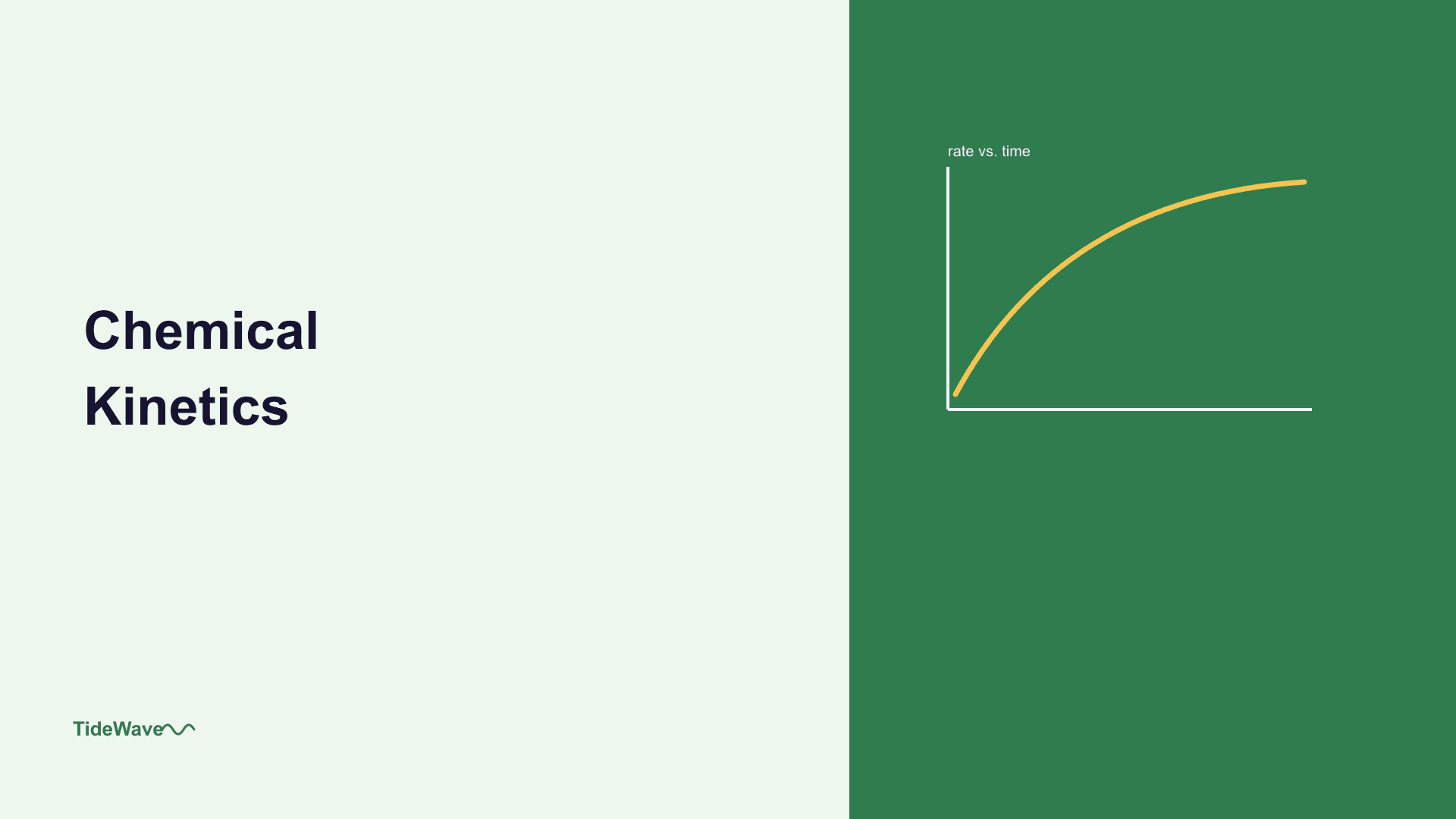
Reaction rate measures how quickly reactants are consumed or products are formed over time, typically expressed as a change in concentration per unit time:
rate = -Δ[reactant]/Δt = +Δ[product]/Δt
The negative sign on the reactant term simply reflects that reactant concentration is decreasing over time, while product concentration is increasing; both expressions describe the same underlying reaction progress, just from opposite perspectives.
Rate Laws and Reaction Order
For many reactions, the rate depends on reactant concentration in a specific, measurable way, described by a rate law:
rate = k[A]^m[B]^n
where k is the rate constant (a fixed value for a given reaction at a given temperature), and m and n are the reaction orders with respect to each reactant, determined experimentally, not simply read off the balanced equation's coefficients.
- Zero order (m = 0): changing that reactant's concentration has no effect on rate at all.
- First order (m = 1): rate is directly proportional to that reactant's concentration; doubling concentration doubles the rate.
- Second order (m = 2): rate is proportional to the square of that reactant's concentration; doubling concentration quadruples the rate.
The overall reaction order is the sum of all the individual orders (m + n + ...). Critically, reaction order can only be determined through actual experimental data, typically by measuring how rate changes as each reactant's concentration is varied independently; it cannot be predicted just by looking at a balanced chemical equation.
The Four Main Factors That Affect Reaction Rate
1. Concentration
Higher reactant concentration generally means more particles packed into the same volume, increasing the frequency of collisions between reacting particles, and therefore increasing reaction rate. This relationship is exactly what a rate law quantifies precisely.
2. Temperature
Increasing temperature increases reaction rate, often dramatically, for two combined reasons: particles move faster (increasing collision frequency), and a larger fraction of those collisions carry enough energy to actually react (overcoming the activation energy barrier). As a rough rule of thumb, many reactions roughly double in rate for every 10°C increase in temperature, though the exact relationship is captured more precisely by the Arrhenius equation.
3. Surface Area (for Reactions Involving Solids)
For reactions where a solid reacts with a liquid or gas, only particles at the solid's exposed surface can actually react. Increasing surface area, for example, by crushing a solid into powder rather than leaving it as one large chunk, dramatically increases reaction rate by exposing far more particles to potential collisions at any given moment.
4. Catalysts
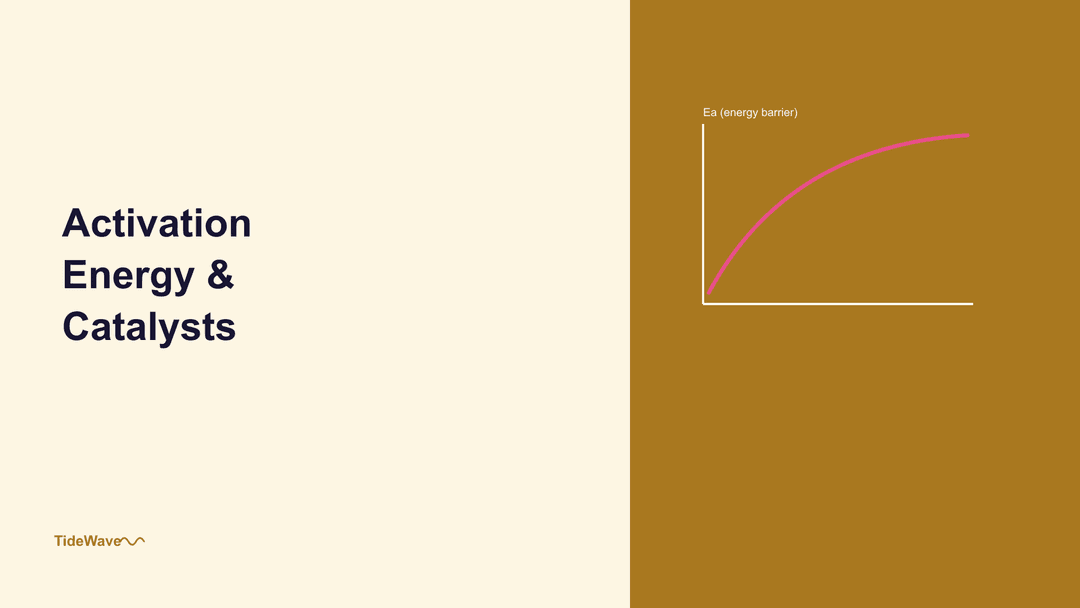
A catalyst provides an alternative reaction pathway with a lower activation energy, increasing reaction rate without being permanently consumed in the process. Catalysts are covered in much greater depth in their own dedicated discussion, but it's worth noting here that they affect rate specifically, without changing the reaction's overall thermodynamics (its ΔG or equilibrium position) at all.
Collision Theory: Why These Factors Work
Collision theory provides the conceptual foundation tying all four factors together: for a reaction to occur, particles must collide with both sufficient energy (enough to overcome the activation energy barrier) and correct orientation (positioned so the right atoms can actually interact and form new bonds). Any factor that increases either the frequency of collisions or the fraction of collisions with sufficient energy and correct orientation will increase the overall reaction rate.
This explains why not every collision between reactant particles actually results in a reaction: most collisions either lack sufficient energy, have the wrong orientation, or both, which is exactly why reaction rates are so much slower than the raw frequency of particle collisions would otherwise suggest.
A Worked Rate Law Example
Given the following experimental data for the reaction A + B → C:
| Experiment | [A] (M) | [B] (M) | Initial Rate (M/s) |
|---|---|---|---|
| 1 | 0.10 | 0.10 | 0.02 |
| 2 | 0.20 | 0.10 | 0.08 |
| 3 | 0.20 | 0.20 | 0.16 |
Finding the order with respect to A: comparing experiments 1 and 2, [A] doubles while [B] stays constant, and rate quadruples (0.02 → 0.08). Since 2² = 4, the reaction is second order in A.
Finding the order with respect to B: comparing experiments 2 and 3, [B] doubles while [A] stays constant, and rate doubles (0.08 → 0.16). Since 2¹ = 2, the reaction is first order in B.
The rate law is therefore:
rate = k[A]²[B]
with an overall reaction order of 3 (2 + 1). This kind of systematic comparison, changing one variable at a time while holding others constant, is exactly how real reaction orders are determined experimentally in a lab.
Why Reaction Rates Matter Practically
- Industrial process design: engineers need reactions to proceed fast enough to be commercially viable, which is exactly why catalysts are so heavily used in industry, as seen in the Haber process for ammonia production.
- Food preservation: refrigeration slows the reaction rates of spoilage-causing chemical and enzymatic processes, extending shelf life without changing the food's ultimate thermodynamic fate.
- Pharmaceutical shelf life: drug manufacturers use kinetics to predict how quickly a medication will degrade under different storage conditions, directly informing expiration dates.
FAQ
Yes, though it's less common in introductory examples. Fractional orders often indicate a complex, multi-step reaction mechanism, while a negative order means increasing that reactant's concentration actually decreases the rate, usually because it's involved in an inhibiting side equilibrium. Both cases are entirely valid experimental results.
A balanced equation only describes the overall stoichiometric relationship between reactants and products, not the actual step-by-step mechanism by which the reaction occurs at the molecular level. Reaction order reflects that underlying mechanism, which can only be revealed through direct experimental measurement of how rate actually responds to concentration changes.
No, rate and total energy change are unrelated. A reaction's speed is governed by kinetics (activation energy, collision frequency), while the total energy released or absorbed is governed by thermodynamics (enthalpy). A slow reaction can release just as much or more total energy than a fast one; it simply takes longer to release it.
Increasing surface area only affects how many particles are exposed and available to collide with the other reactant at any given moment; it doesn't change the fundamental chemistry of what's reacting or what bonds are forming. The same overall reaction and the same final products occur either way, just faster with more exposed surface area.
Yes, the Arrhenius equation (k = Ae^(−Ea/RT)) precisely relates the rate constant k to temperature and activation energy, and is far more accurate than the rough doubling rule, which is really just a loose approximation that happens to work reasonably well for many common reactions within typical laboratory temperature ranges.
Conclusion
Chemical kinetics answers a question thermodynamics never addresses: not whether a reaction can happen, but how fast it actually will. Concentration, temperature, surface area, and catalysts all influence rate by changing how often particles collide with enough energy and the right orientation to react, exactly what collision theory predicts. Determining a rate law experimentally, rather than guessing from a balanced equation, is what lets chemists actually control and predict reaction speed in everything from industrial reactors to drug shelf life.
Here are some useful references if you want to go deeper:
- Khan Academy – Chemical Kinetics — free lessons covering rate laws, reaction order, and collision theory.
- Chemguide – Rates of Reaction — detailed explanations with worked rate law problems.
- LibreTexts Chemistry – Chemical Kinetics — an open textbook resource covering rate laws and reaction mechanisms in depth.