Electrolysis Explained: Using Electricity to Drive Reactions
Aluminum is one of the most abundant metals in the Earth's crust, yet it wasn't commonly used until well into the 19th century, long after iron and copper had already shaped entire eras of human history. The reason is simple: aluminum is far too reactive to be extracted from its ore by ordinary chemical means. The only practical way to pull it free is electrolysis, using an external electric current to force a chemical reaction that would never happen on its own. Electrolysis is the deliberate, industrial-scale version of the same redox chemistry that powers a battery, just run in reverse.
What Makes Electrolysis Different From a Battery
A battery, technically called a galvanic cell, generates electricity from a chemical reaction that happens spontaneously on its own. An electrolytic cell does the opposite: it consumes electrical energy from an external power source to force a non-spontaneous reaction to occur. Both are built from the same basic redox principles, oxidation at one electrode and reduction at the other, but the energy flows in opposite directions.
- Galvanic cell: chemical energy → electrical energy (spontaneous).
- Electrolytic cell: electrical energy → chemical energy (non-spontaneous, requires outside power).
The Basic Setup
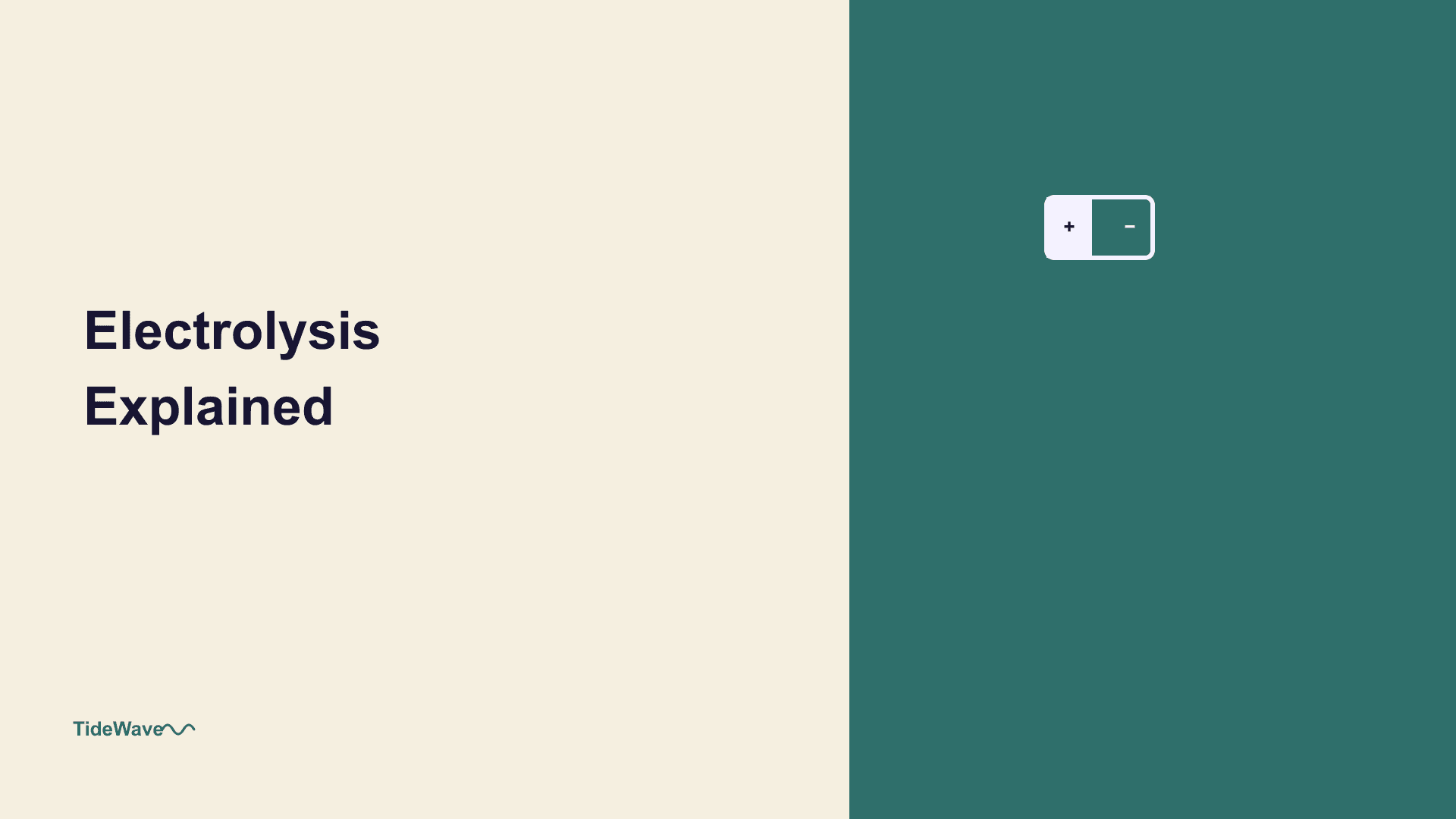
An electrolytic cell consists of two electrodes (conductors, usually metal or graphite) submerged in a liquid or molten substance capable of conducting ions, called the electrolyte, connected to an external power source such as a battery or power supply.
- The cathode is connected to the negative terminal of the power source and attracts positive ions, where reduction occurs (ions gain electrons).
- The anode is connected to the positive terminal and attracts negative ions, where oxidation occurs (ions lose electrons).
This might feel backward if you're used to thinking of a galvanic cell, where the anode is negative; in an electrolytic cell, the external power source forces the polarity, and it's the opposite assignment. What stays consistent across both cell types is the definition itself: oxidation always happens at the anode, and reduction always happens at the cathode.
A Worked Example: Electrolysis of Molten Sodium Chloride
Passing an electric current through molten (melted) sodium chloride splits it into its elements:
At the cathode (reduction): Na⁺ + e⁻ → Na
At the anode (oxidation):   2Cl⁻ → Cl₂ + 2e⁻
Sodium ions migrate toward the cathode and are reduced to metallic sodium, while chloride ions migrate toward the anode and are oxidized to chlorine gas. This is, in fact, the industrial method (the Downs process) used to produce elemental sodium metal, which is far too reactive to exist naturally on its own and can't be produced through a simple chemical reaction, only by forcing electrons back onto its ion with an external current.
Note that this only works with molten sodium chloride, not a dissolved solution. In water, the water molecules themselves participate in the reaction, and the cathode instead produces hydrogen gas while the anode still produces chlorine, since water is easier to reduce than sodium ions under these conditions.
Why Electrolysis Matters Industrially
Extracting Reactive Metals
Metals like aluminum, sodium, and magnesium are too reactive to be extracted from their compounds using a simpler reducing agent (unlike iron, which can be extracted by reacting iron ore with carbon in a blast furnace). Electrolysis is the only commercially viable method for these metals. The Hall-Héroult process, used to produce virtually all of the world's aluminum, dissolves aluminum oxide in molten cryolite and passes a massive electric current through it, reducing aluminum ions to liquid aluminum metal at the cathode.
Electroplating
Electroplating uses electrolysis to deposit a thin, even layer of one metal onto the surface of another object, typically to prevent corrosion or improve appearance. The object to be plated is made the cathode, submerged in a solution containing ions of the plating metal (like silver, chromium, or gold), and as current flows, metal ions are reduced and deposited directly onto the object's surface.
Splitting Water
Running a current through water (with a small amount of dissolved electrolyte to make it conductive, since pure water conducts electricity poorly) splits it into hydrogen and oxygen gas:
At the cathode: 4H₂O + 4e⁻ → 2H₂ + 4OH⁻
At the anode:   2H₂O → O₂ + 4H⁺ + 4e⁻
This process, called water electrolysis, is a major area of research for producing "green hydrogen" as a clean fuel, particularly when the electricity used comes from renewable sources like solar or wind power.
Faraday's Laws: Predicting How Much Product Forms
Michael Faraday, who did much of the foundational work on electrolysis, established two laws that let chemists calculate exactly how much substance is produced at an electrode for a given amount of electric charge passed through the cell:
- Faraday's First Law: the mass of a substance produced or consumed at an electrode is directly proportional to the total electric charge passed through the cell.
- Faraday's Second Law: for a fixed amount of charge, the mass of different substances liberated at an electrode is proportional to their equivalent weight (molar mass divided by the number of electrons involved in their reaction).
In practice, this means electrolysis isn't just a qualitative process; it's precise enough that industrial operations can calculate exactly how much metal will be deposited or extracted for a given amount of electrical energy spent, which matters enormously for the economics of large-scale metal production.
FAQ
In molten NaCl, sodium and chloride ions are the only species available to react at the electrodes. In an aqueous solution, water molecules are also present and are easier to reduce than sodium ions, so the cathode produces hydrogen gas instead of sodium metal, while the anode still produces chlorine gas from the chloride ions.
Iron can be extracted using a chemical reducing agent (carbon, in a blast furnace), which is relatively cheap and energy-efficient. Aluminum's ions are too difficult to reduce that way, so it requires continuous electrical energy via electrolysis, which is why aluminum production consumes such a large share of industrial electricity and why recycling aluminum saves so much energy compared to producing it from ore.
It's determined entirely by the external power source: the electrode connected to the positive terminal is always the anode (where oxidation occurs), and the electrode connected to the negative terminal is always the cathode (where reduction occurs), regardless of what the electrodes are made of.
Not directly through the same electrolytic setup, since electrolysis produces separate products (like sodium metal and chlorine gas) rather than reversing itself automatically. However, those separated products can be recombined in a spontaneous redox reaction, which is exactly the principle rechargeable batteries use, alternating between electrolytic (charging) and galvanic (discharging) operation.
Both. Chrome plating on car parts and gold plating on jewelry are largely decorative, but electroplating is also used functionally, such as zinc-plating (galvanizing) steel to prevent rust, or plating electrical contacts with gold or silver to improve conductivity and resist corrosion.
Conclusion
Electrolysis takes the same electron-transfer principles behind every redox reaction and runs them in the direction nature wouldn't choose on its own, using an external electric current to force oxidation and reduction to happen at separate electrodes. It's the reason reactive metals like aluminum and sodium exist as usable materials at all, the basis of electroplating, and an increasingly important tool for producing clean hydrogen fuel. Once you see electrolysis as simply "a galvanic cell running backward, powered from outside," the industrial processes built on it stop feeling like separate topics and start looking like natural extensions of the same electrochemistry.
Here are some useful references if you want to go deeper:
- Khan Academy – Electrolytic Cells — free lessons covering electrolysis and Faraday's laws.
- Chemguide – Introducing Electrolysis — a detailed breakdown of electrolytic cells and worked examples.
- Royal Society of Chemistry – Extraction of Aluminium — an in-depth look at the Hall-Héroult process used industrially.