Redox Reactions and the Basics of Electrochemistry
Every battery that powers a phone, every patch of rust on an old car, and every breath your cells take to release energy from food all rely on the same fundamental chemical process: electrons moving from one substance to another. This category of reaction is called a redox reaction, short for reduction-oxidation, and understanding it is the foundation of electrochemistry, the branch of chemistry that studies the relationship between chemical reactions and electricity.
What "Redox" Actually Means
A redox reaction always involves two things happening simultaneously:
- Oxidation: a substance loses electrons.
- Reduction: a substance gains electrons.
These two processes are inseparable; electrons don't simply vanish or appear out of nowhere, so if one substance is losing electrons, another substance in the same reaction must be gaining them. A helpful memory device for keeping the two straight is "OIL RIG": Oxidation Is Loss, Reduction Is Gain.
Example: When solid zinc metal is placed in a solution of copper sulfate, zinc atoms lose electrons and become zinc ions, while copper ions in solution gain those same electrons and become solid copper:
Zn → Zn²⁺ + 2e⁻   (oxidation: zinc loses electrons)
Cu²⁺ + 2e⁻ → Cu   (reduction: copper gains electrons)
Combined, this gives the overall redox reaction:
Zn + Cu²⁺ → Zn²⁺ + Cu
Oxidation States: Tracking Electrons Without Watching Them Move
Since you can't literally watch electrons transfer between atoms, chemists use a bookkeeping tool called oxidation state (or oxidation number) to track which atoms are gaining or losing electron "ownership" in a reaction. An oxidation state becoming more positive indicates oxidation (electron loss); becoming more negative indicates reduction (electron gain).
A few of the most useful rules for assigning oxidation states:
- An atom in its elemental form (like Zn, O₂, or Fe) always has an oxidation state of 0.
- A monatomic ion's oxidation state equals its charge (Na⁺ is +1, Cl⁻ is -1).
- Oxygen is usually -2 in compounds (with a few exceptions, like peroxides).
- Hydrogen is usually +1 in compounds (except when bonded to a metal, where it's -1).
- The oxidation states in a neutral compound must sum to zero; in a polyatomic ion, they must sum to the ion's overall charge.
Using these rules on the zinc/copper example: zinc goes from 0 (elemental) to +2 (as Zn²⁺), an increase, confirming oxidation. Copper goes from +2 (as Cu²⁺) to 0 (elemental), a decrease, confirming reduction.
Oxidizing Agents and Reducing Agents
It's easy to mix up which substance is "doing" the oxidizing versus which is being oxidized, so it's worth being precise:
- The oxidizing agent is the substance that causes oxidation in another substance, by accepting its electrons. In doing so, the oxidizing agent itself gets reduced.
- The reducing agent is the substance that causes reduction in another substance, by donating electrons to it. In doing so, the reducing agent itself gets oxidized.
In the zinc/copper example, Cu²⁺ is the oxidizing agent (it accepts electrons from zinc, causing zinc's oxidation, while Cu²⁺ itself is reduced), and Zn is the reducing agent (it donates electrons to copper, causing copper's reduction, while Zn itself is oxidized).
Electrochemistry: Turning Redox Reactions Into Electricity
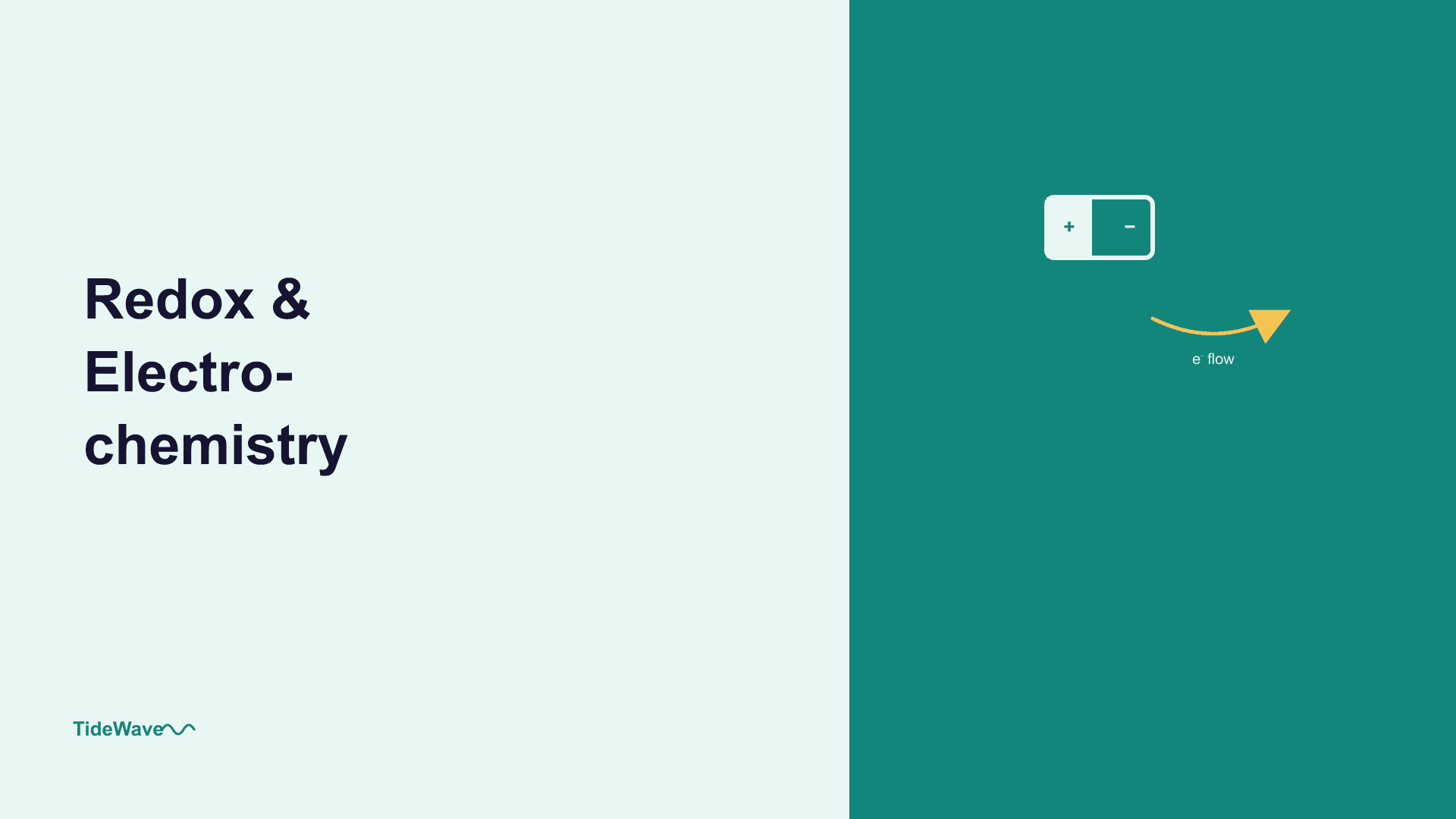
Electrochemistry is what happens when you physically separate the oxidation and reduction half-reactions, forcing electrons to travel through an external wire to get from one to the other, instead of transferring directly on contact. That flow of electrons through a wire is, by definition, an electric current.
Galvanic (Voltaic) Cells: Generating Electricity From Chemistry
A galvanic cell (commonly known as a battery) uses a spontaneous redox reaction to generate electrical energy. It's built from two separate compartments called half-cells:
- The anode: where oxidation occurs, releasing electrons into the external circuit.
- The cathode: where reduction occurs, accepting electrons from the external circuit.
Electrons flow through the external wire from anode to cathode, powering whatever device is connected in between, while a salt bridge (or porous barrier) allows ions to migrate between the two half-cells to keep both solutions electrically neutral as the reaction proceeds. This is the exact underlying design of every disposable and rechargeable battery, from AA batteries to the lithium-ion battery in a smartphone.
Electrolytic Cells: Using Electricity to Force a Reaction
An electrolytic cell works in the opposite direction: it uses an external electrical power source to force a non-spontaneous redox reaction to occur. This is the basis of electrolysis, used industrially to:
- Extract reactive metals from their ores, like aluminum from bauxite, since aluminum is too reactive to be extracted using simpler chemical methods.
- Electroplate objects, depositing a thin layer of one metal (like chromium or gold) onto another object's surface for protection or appearance.
- Split water into hydrogen and oxygen gas, a process being explored for hydrogen fuel production.
Redox Reactions You Encounter Every Day
- Rusting: iron reacts with oxygen and water in a slow redox reaction, where iron is oxidized and oxygen is reduced, forming iron oxide (rust).
- Combustion: burning any fuel, from wood to gasoline, is a rapid redox reaction where the fuel is oxidized and oxygen is reduced, releasing energy as heat and light.
- Cellular respiration: your cells oxidize glucose and reduce oxygen in a controlled, stepwise redox process to release the energy your body runs on.
- Photosynthesis: plants run essentially the reverse process, using light energy to reduce carbon dioxide into glucose while oxidizing water and releasing oxygen.
FAQ
The term predates the modern electron-transfer explanation of redox chemistry. Historically, "reduction" referred to reducing the mass of a metal ore during extraction (removing oxygen from a metal oxide), and the name stuck even after chemists identified the underlying electron transfer as the actual mechanism.
Yes. Redox reactions occur throughout organic and biological chemistry too, wherever oxidation states change, including combustion, respiration, and photosynthesis, none of which necessarily involve a metal changing between ionic and elemental form.
A galvanic cell generates electricity from a reaction that happens on its own (spontaneous), which is how batteries work. An electrolytic cell consumes electricity from an external source to force a reaction that wouldn't happen by itself (non-spontaneous), which is how electroplating and metal extraction work.
A rechargeable battery is designed so its discharge reaction (acting as a galvanic cell) can be reversed by applying an external electrical current (acting as an electrolytic cell), converting the products back into the original reactants. Charging is literally running the electrolytic version of the same reaction in reverse.
Check whether any element's oxidation state changes between the reactant and product side. If every element has the same oxidation state before and after the reaction (as in many acid-base neutralization reactions), it isn't a redox reaction; if at least one element's oxidation state changes, it is.
Conclusion
Redox reactions are, at their core, a story about electrons changing hands: one substance loses them (oxidation), another gains them (reduction), and neither can happen without the other. Electrochemistry simply takes that same electron transfer and routes it through a wire instead of letting it happen directly, which is the entire principle behind every battery, and the reverse principle behind electroplating and metal extraction. Once you can track oxidation states confidently, spotting a redox reaction, and understanding the device built around it, becomes second nature.
Here are some useful references if you want to go deeper:
- Khan Academy – Oxidation-Reduction Reactions — free lessons covering oxidation states and balancing redox equations.
- Chemguide – Introducing Redox Reactions — a clear breakdown of oxidation states and electron transfer.
- U.S. Department of Energy – How Batteries Work — an accessible explanation connecting redox chemistry to real battery technology.