Ionic vs. Covalent Bonds: Understanding How Atoms Combine
Every substance you interact with, from the salt on your table to the water you drink to the plastic in your keyboard, is held together by chemical bonds. Atoms rarely exist alone; they combine to form more stable arrangements, and the way they do this falls into two fundamental categories: ionic bonds and covalent bonds. Understanding the difference between them explains not just how molecules form, but why table salt dissolves in water while diamond doesn't, and why some substances conduct electricity while others don't.
Both bond types come down to the same underlying goal: atoms bonding to achieve a more stable electron configuration, usually by filling their outermost shell. The difference is entirely in how they get there.
What Determines Which Bond Forms?
Whether two atoms form an ionic or covalent bond depends largely on their electronegativity, a measure of how strongly an atom attracts electrons toward itself. The key factor is the electronegativity difference between the two atoms involved:
- Large electronegativity difference (roughly greater than 1.7 on the Pauling scale) → electrons are transferred completely from one atom to another → ionic bond.
- Small or no electronegativity difference → electrons are shared between atoms → covalent bond.
This is why ionic bonds typically form between a metal and a nonmetal (like sodium and chlorine), while covalent bonds typically form between two nonmetals (like two hydrogen atoms, or hydrogen and oxygen). Metals tend to have low electronegativity and readily give up valence electrons, while nonmetals have high electronegativity and tend to pull electrons toward themselves.
Ionic Bonds: Complete Electron Transfer
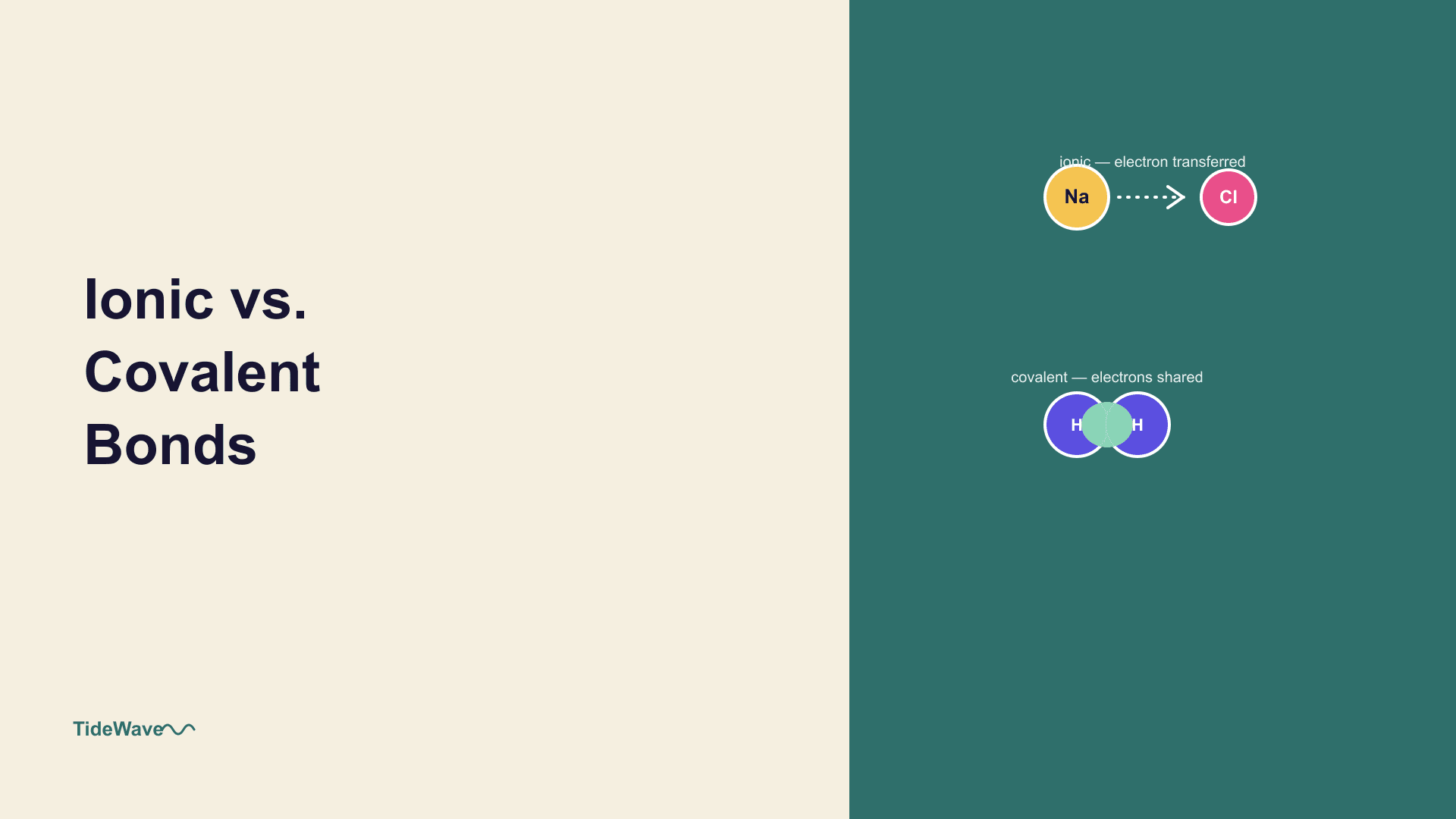
An ionic bond forms when one atom transfers one or more valence electrons entirely to another atom. The atom that loses electrons becomes a positively charged ion (a cation), and the atom that gains electrons becomes a negatively charged ion (an anion). These oppositely charged ions are then held together by strong electrostatic attraction, the same basic force that makes opposite magnetic poles pull toward each other.
Example: Sodium Chloride (NaCl)
- Sodium (Na) has one valence electron and readily loses it to achieve a stable, noble-gas-like electron configuration.
- Chlorine (Cl) has seven valence electrons and readily gains one to complete its outer shell.
- Sodium transfers its single valence electron to chlorine, forming Na⁺ and Cl⁻ ions.
- The resulting electrostatic attraction between Na⁺ and Cl⁻ is the ionic bond.
Properties of Ionic Compounds
Because ionic bonds involve strong, non-directional electrostatic forces, ionic compounds share a consistent set of physical properties:
- High melting and boiling points, since a large amount of energy is needed to break the strong electrostatic attraction holding the ion lattice together.
- Form crystal lattices, a repeating three-dimensional arrangement of alternating positive and negative ions, rather than discrete individual molecules.
- Conduct electricity when dissolved in water or molten, since the ions become free to move and carry charge, but not as a solid, where the ions are locked in place.
- Often soluble in water, since water's polar molecules can surround and stabilize individual ions, pulling the lattice apart.
Covalent Bonds: Sharing Instead of Transferring
A covalent bond forms when two atoms share one or more pairs of valence electrons, rather than one giving them up entirely. This typically happens between two nonmetal atoms with similar electronegativity, neither of which is willing to fully surrender an electron, but both of which benefit from a completed outer shell through sharing.
Example: Water (H₂O)
- Oxygen needs two more electrons to complete its outer shell; each hydrogen atom needs one.
- Each hydrogen atom shares its single electron with oxygen, and oxygen shares one electron back with each hydrogen.
- This creates two shared electron pairs, one per O-H bond, satisfying all three atoms simultaneously.
Polar vs. Nonpolar Covalent Bonds
Not all covalent bonds share electrons perfectly evenly, which introduces an important sub-distinction:
- Nonpolar covalent bonds form when two atoms have identical or nearly identical electronegativity (like two atoms of the same element, as in H₂ or O₂), so the shared electrons spend equal time near each atom.
- Polar covalent bonds form when there's a moderate electronegativity difference (too small to fully transfer an electron, but large enough to pull the shared pair closer to one atom). In water, oxygen pulls the shared electrons closer to itself, giving oxygen a slight negative charge and each hydrogen a slight positive charge, which is exactly why water molecules are polar and why water is such an effective solvent.
Properties of Covalent Compounds
- Lower melting and boiling points than ionic compounds, generally, since the forces holding separate covalent molecules together (called intermolecular forces) are much weaker than the electrostatic attraction in an ionic lattice.
- Exist as discrete molecules, with a definite formula and shape, rather than an extended lattice.
- Generally poor conductors of electricity, since there are no free-moving charged ions.
- Solubility varies widely depending on polarity; polar covalent molecules tend to dissolve in polar solvents like water, while nonpolar covalent molecules dissolve better in nonpolar solvents.
A Side-by-Side Comparison
| Property | Ionic Bonds | Covalent Bonds |
|---|---|---|
| Electron behavior | Transferred completely | Shared between atoms |
| Typical elements | Metal + nonmetal | Nonmetal + nonmetal |
| Melting/boiling point | High | Generally lower |
| Structure | Crystal lattice | Discrete molecules |
| Electrical conductivity | Yes, when molten or dissolved | Generally no |
| Example | NaCl (table salt) | H₂O (water), CH₄ (methane) |
It's Rarely a Perfect Line
In practice, the ionic-versus-covalent distinction is better understood as a spectrum rather than two entirely separate categories. Very few bonds are 100% ionic or 100% covalent; most fall somewhere in between, with a degree of "ionic character" that increases as the electronegativity difference grows. Hydrogen fluoride (HF), for example, is generally classified as a polar covalent compound, but its bond has substantial ionic character because fluorine is so much more electronegative than hydrogen.
This is also why the distinction matters for predicting a compound's behavior even when it isn't a textbook-clean example: knowing roughly where a bond falls on that spectrum tells you a lot about how the resulting substance will behave, long before you've measured a single physical property in a lab.
FAQ
Yes. A common example is sodium hydroxide (NaOH), which contains an ionic bond between the sodium ion (Na⁺) and the hydroxide ion (OH⁻), while the bond between oxygen and hydrogen within the hydroxide ion itself is covalent. Many salts of polyatomic ions work this way.
In a solid ionic lattice, the ions are locked into fixed positions and can't move to carry an electric current. When dissolved in water or melted, the ions become free to move independently, allowing them to carry charge, which is exactly what electrical conductivity requires.
No, metallic bonding is a distinct third category. In metals, valence electrons become delocalized, forming a shared "sea" of electrons that moves freely around a lattice of positive metal ions. This explains properties unique to metals, like electrical conductivity in the solid state, malleability, and metallic luster.
A reliable shortcut is checking the position of the two elements on the periodic table: a metal bonding with a nonmetal is almost always ionic, while two nonmetals bonding together is almost always covalent. This works because metals cluster on the left/bottom of the table (low electronegativity) and nonmetals cluster on the right/top (high electronegativity).
Water's polar covalent bonds give it a partial negative charge near oxygen and partial positive charges near each hydrogen, which allows it to surround and dissolve ionic compounds and other polar molecules effectively. This property, called being a "universal solvent," is central to nearly every biological process, from digestion to how proteins fold.
Conclusion
Ionic and covalent bonds represent two different strategies atoms use to reach the same goal: a more stable electron configuration. Ionic bonds achieve this through complete electron transfer, producing charged ions held together by electrostatic attraction, while covalent bonds achieve it through shared electron pairs, producing discrete molecules. Neither is "better," and most real-world chemistry involves both, often within the same compound. Once you can recognize which type of bond you're looking at, predicting a substance's melting point, solubility, and conductivity becomes far more intuitive than memorizing properties one compound at a time.
Here are some useful references if you want to go deeper:
- Khan Academy – Ionic, Covalent, and Metallic Bonds — free video lessons and practice problems on all three bonding types.
- Chemguide – Ionic Bonding — a detailed breakdown of how and why ionic bonds form.
- Royal Society of Chemistry – Periodic Table — a useful reference for checking electronegativity trends across elements.