Lambda Functions in Python: Uses, Limits, and Better Alternatives
Python's lambda keyword lets you create a small function inline, without giving it a name. It's handy when an API wants a function and the logic fits in one expression, like a sort key or a quick callback. It's also one of the most overused features in the language: lambdas assigned to variables, lambdas wrapped around a single method call, and lambdas stretched into unreadable one-liners all show up regularly in real code.
This post covers what a lambda actually is, the syntax and its limits, the places where lambdas are the right tool, and the alternatives (def, the operator module, functools.partial, comprehensions) that are usually clearer when a lambda starts to strain.
What a Lambda Is
A lambda expression creates a function object. It's the same kind of object def creates, with two differences: it has no name of its own, and its body is a single expression whose value is returned automatically.
square = lambda x: x * x


def square2(x):
    return x * x


print(square(4), square2(4))
print(square.__name__, square2.__name__)
print(type(square))
16 16
<lambda> square2
<class 'function'>
Both are ordinary function objects. The only visible difference here is the name: every lambda is called <lambda>, no matter what variable you assign it to.
The general form is:
lambda parameters: expression
The parameter list supports everything a def signature does: defaults, *args, keyword-only parameters, and **kwargs.
f = lambda x, y=2, *args, **kwargs: (x, y, args, kwargs)
print(f(1, 3, 4, z=5))
(1, 3, (4,), {'z': 5})
What Lambdas Can't Do
The single-expression rule is the defining limit. A lambda body can't contain statements, which rules out:
return,pass,raise,assert,del,import,global, andnonlocalif/elif/elseblocks,forandwhileloops,try/except, andwith- Ordinary assignment (
x = 1) and augmented assignment (x += 1) - Type annotations on parameters or the return value
- A docstring
Some of these have expression equivalents. A conditional expression replaces an if statement, a comprehension replaces a loop, and the walrus operator can bind a name:
classify = lambda n: "neg" if n < 0 else "zero" if n == 0 else "pos"
print([classify(n) for n in (-1, 0, 5)])

h = lambda: (n := 5) + n
print(h())
['neg', 'zero', 'pos']
10
The fact that these work doesn't mean you should use them. A chained conditional expression is already harder to read than the equivalent if/elif block, and a walrus inside a lambda is a strong sign the logic wants to be a named function.
Debugging Costs
Because every lambda shares the name <lambda>, tracebacks are less helpful:
Traceback (most recent call last):
  File "app.py", line 1, in <module>
    (lambda: 1 / 0)()
    ~~~~~~~~~~~~~~~^^
  File "app.py", line 1, in <lambda>
    (lambda: 1 / 0)()
             ~~^~~
ZeroDivisionError: division by zero
Python 3.11+ points at the exact sub-expression, which helps, but a traceback full of in <lambda> frames from several different lambdas still forces you to go by line numbers. A named function shows up as in parse_price, which tells you immediately where you are. The same anonymity hurts in profilers, logging output (%(funcName)s), and repr() output when you print a data structure holding callbacks.
Pickling
Lambdas can't be pickled by the standard pickle module, because pickle stores functions by their importable qualified name and <lambda> isn't one:
import pickle

square = lambda x: x * x
pickle.dumps(square)
_pickle.PicklingError: Can't pickle <function <lambda> at 0x102cc49a0>: attribute lookup <lambda> on __main__ failed
This matters in practice: multiprocessing and concurrent.futures.ProcessPoolExecutor pickle the functions they send to worker processes. A lambda passed to pool.map() fails, while a module-level def works.
Where Lambdas Shine
The good uses share a pattern: an API accepts a callable, the logic is short, and the function is used exactly once, right there.
Sort, Min, and Max Keys
This is the most common legitimate use. sorted(), list.sort(), min(), max(), and heapq.nsmallest() all accept a key function:
users = [
    {"name": "Lena", "age": 34},
    {"name": "arjun", "age": 27},
    {"name": "Bea", "age": 41},
]

print(sorted(users, key=lambda u: u["age"]))
print([u["name"] for u in sorted(users, key=lambda u: u["name"].lower())])
print(max(users, key=lambda u: u["age"])["name"])
[{'name': 'arjun', 'age': 27}, {'name': 'Lena', 'age': 34}, {'name': 'Bea', 'age': 41}]
['arjun', 'Bea', 'Lena']
Bea
Returning a tuple from the key gives you multi-level sorting. Negating a numeric field flips its direction while keeping the others ascending:
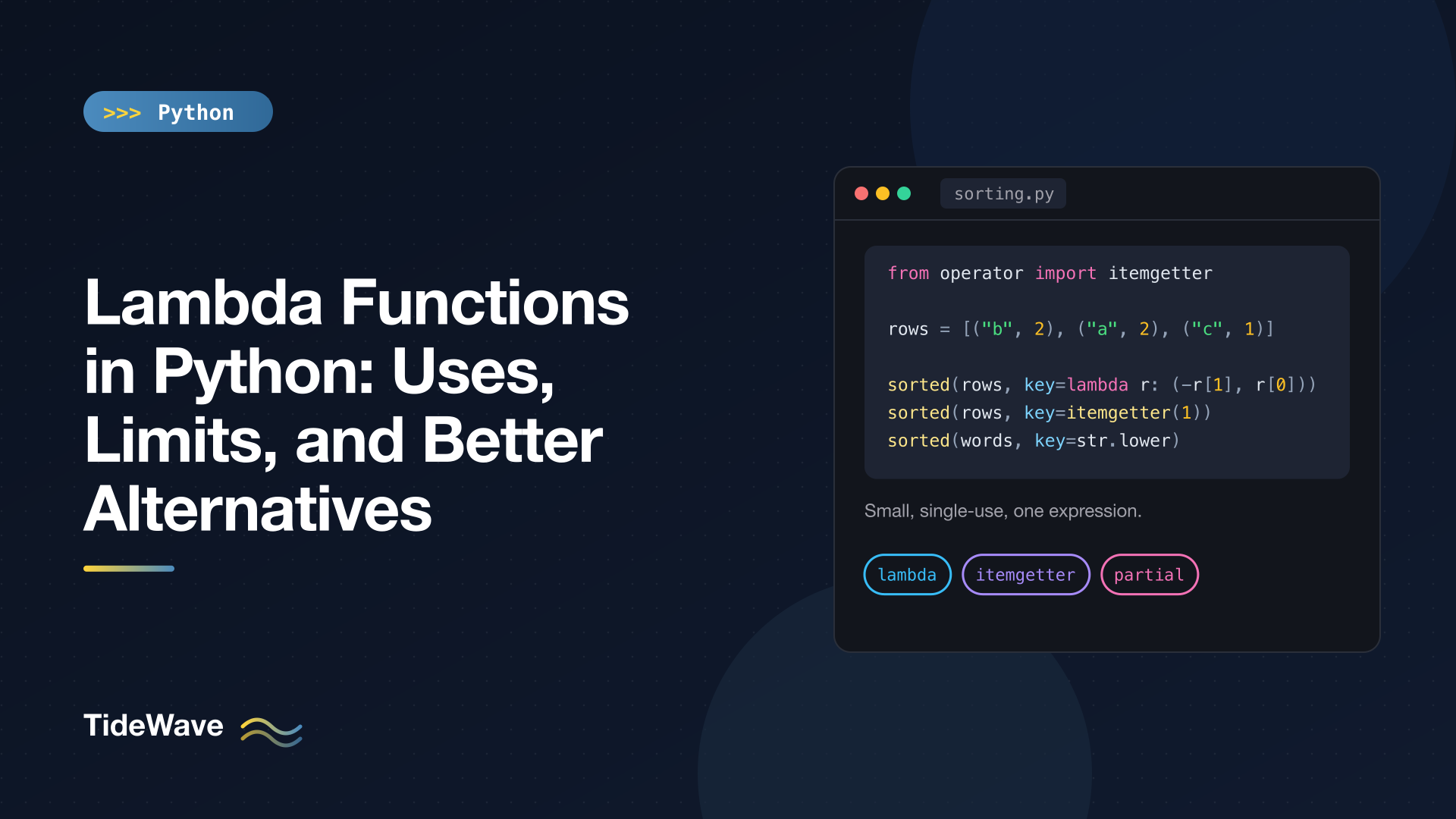
rows = [("b", 2), ("a", 2), ("c", 1)]
print(sorted(rows, key=lambda r: (-r[1], r[0])))
[('a', 2), ('b', 2), ('c', 1)]
That sorts by the count descending, then by the letter ascending, in one readable line.
Small Callbacks
GUI toolkits, event systems, and some library hooks take a zero-argument callback. A lambda is a natural fit for adapting a function that needs arguments:
button.configure(command=lambda: save_document(current_path))
The same goes for defaultdict factories that aren't a built-in type:
from collections import defaultdict

d = defaultdict(lambda: "unknown")
print(d["x"])
unknown
Dispatch Tables, Sometimes
A dictionary mapping keys to tiny transformations can be fine with lambdas:
handlers = {
    "upper": lambda s: s.upper(),
    "strip": lambda s: s.strip(),
}

print(handlers["strip"]("  hi "))
hi
As you'll see below, this particular table doesn't need lambdas at all, and once the entries grow beyond one short expression, named functions are easier to test and document.
Better Alternatives
Use def When You'd Name It Anyway
PEP 8 is explicit about this: don't assign a lambda to a name.
# Avoid
parse_price = lambda raw: int(raw.strip().replace(",", ""))


# Prefer
def parse_price(raw: str) -> int:
    """Turn a string like ' 1,000' into an int."""
    return int(raw.strip().replace(",", ""))
The def version is one line longer and gains a real __name__, type hints, a docstring, and readable tracebacks. The whole point of a lambda is being anonymous; once you bind it to a name you've given that up and kept only the drawbacks. Ruff flags the assignment form as E731.
Pass Existing Functions Directly
A lambda that just forwards its argument to another function is redundant:
words = ["Banana", "apple", "cherry"]

print(sorted(words, key=lambda w: w.lower()))  # wrapper adds nothing
print(sorted(words, key=str.lower))             # same result
['apple', 'Banana', 'cherry']
['apple', 'Banana', 'cherry']
str.lower is already a function that takes a string. The same applies to len, abs, int, str.strip, and so on. That dispatch table from earlier can be written as {"upper": str.upper, "strip": str.strip}.
The operator Module
For the common "get a field" and "call a method" patterns, the operator module has ready-made, fast callables:
from operator import attrgetter, itemgetter, methodcaller

print([u["name"] for u in sorted(users, key=itemgetter("age"))])
print(itemgetter(0, 2)(["a", "b", "c"]))
print(list(map(methodcaller("upper"), ["a", "b"])))
['arjun', 'Lena', 'Bea']
('a', 'c')
['A', 'B']
itemgetter("age")is equivalent tolambda u: u["age"]. With multiple keys it returns a tuple, which is handy for multi-level sorts.attrgetter("age")islambda obj: obj.age, and it accepts dotted paths like"address.city".methodcaller("upper")islambda obj: obj.upper().
The module also exposes every operator as a function: operator.add, operator.mul, operator.not_, operator.contains, and so on. Those replace lambdas like lambda a, b: a + b.
These callables have useful repr()s, can be pickled, and are implemented in C, so they're slightly faster than the equivalent lambda in hot loops. The main reason to use them, though, is that they state intent: key=itemgetter("age") reads as "sort by age".
functools.partial for Pre-Filling Arguments
When a lambda exists only to fix some arguments of another function, partial is clearer:
from functools import partial


def power(base: int, exp: int) -> int:
    return base ** exp


cube = partial(power, exp=3)
print(cube(2))
print(cube)
8
functools.partial(<function power at 0x109761940>, exp=3)
Unlike lambda b: power(b, 3), the partial object tells you what it wraps when you print it, and it's picklable as long as the wrapped function is. The upcoming functools post goes deeper into partial and its siblings.
Comprehensions Instead of map and filter
map() and filter() with a lambda are almost always easier to read as a comprehension:
print(list(map(lambda x: x * 2, [1, 2, 3])))
print([x * 2 for x in [1, 2, 3]])

print(list(filter(lambda n: n % 2 == 0, range(10))))
print([n for n in range(10) if n % 2 == 0])
[2, 4, 6]
[2, 4, 6]
[0, 2, 4, 6, 8]
[0, 2, 4, 6, 8]
The comprehension puts the expression and the condition in reading order without the lambda ceremony. map() is still nice when you already have a named function: map(int, parts) is perfectly idiomatic. See list, dict, and set comprehensions for more patterns.
Built-ins Instead of reduce
functools.reduce with a lambda is a classic way to write code nobody wants to read. Most reductions have a built-in:
from functools import reduce
import math
import operator

print(reduce(lambda a, b: a * b, [1, 2, 3, 4]))
print(reduce(operator.mul, [1, 2, 3, 4]))
print(math.prod([1, 2, 3, 4]))
24
24
24
sum(), math.prod(), max(), min(), any(), all(), and "".join() cover the vast majority of cases.
The Late-Binding Gotcha
Lambdas created in a loop capture variables, not values. This surprises people constantly:
funcs = [lambda: i for i in range(3)]
print([fn() for fn in funcs])
[2, 2, 2]
Each lambda looks up i when it's called. By then the loop has finished and i is 2. This isn't specific to lambdas; a def inside the loop behaves identically. Lambdas just tend to get created in loops more often.
The traditional fix binds the current value as a default argument, which is evaluated when the lambda is created:
funcs = [lambda i=i: i for i in range(3)]
print([fn() for fn in funcs])
[0, 1, 2]
partial is a cleaner fix when you're wrapping a real function, because it captures the value without adding a parameter callers could accidentally override. The scope post explains the lookup rules behind this.
A Quick Decision Guide
| Situation | Use |
|---|---|
| One-off sort/min/max key with simple logic | lambda |
| Key that reads a dict key or attribute | itemgetter / attrgetter |
| Key that calls an existing function | Pass the function (str.lower, len) |
| Pre-filling arguments of a function | functools.partial |
| Transform or filter a sequence | Comprehension |
| Combining values (sum, product, max) | Built-in (sum, math.prod, max) |
| Anything you'd assign to a name | def |
| Logic needing statements, multiple steps, or a docstring | def |
| Function sent to another process | Module-level def |
Conclusion
A lambda is just a function without a name and with a single-expression body. That makes it ideal for tiny, single-use callables passed directly to another function, with sort keys being the canonical example. It also means lambdas can't hold statements, produce vague tracebacks, and can't be pickled.
When a lambda only forwards to another function, pass that function. When it reads a field or calls a method, use the operator module. When it pre-fills arguments, use partial. And when you find yourself giving it a name, write a def. Your future self, reading the traceback, will appreciate it.