Chromatography: Separating Mixtures by Molecular Behavior
Forensic labs use it to identify drugs from a single fiber of evidence. Doping agencies use it to catch athletes using banned substances. Chemistry students use it to separate the colored pigments hiding inside a black marker. All of these rely on chromatography, a family of techniques that separates a mixture into its individual components by exploiting a simple fact: different molecules interact differently with two competing environments, and that difference in behavior can be used to pull them apart.
The Core Idea: Two Competing Phases
Every chromatography technique relies on the same basic setup: a stationary phase (a solid or a liquid held in place, that doesn't move) and a mobile phase (a liquid or gas that flows through or across the stationary phase, carrying the mixture with it).
As the mobile phase moves, each component of the mixture is constantly being pulled in two directions: forward, by the flowing mobile phase, and held back, by its attraction to the stationary phase. Components that interact more strongly with the stationary phase move slowly and lag behind; components that interact more strongly with the mobile phase (or barely interact with the stationary phase at all) move quickly and race ahead. Over time, this difference in speed physically separates a mixture that started out completely combined.
Paper Chromatography
Paper chromatography is the simplest and most commonly taught version: a strip of absorbent paper serves as the stationary phase, and a solvent (like water or alcohol) serves as the mobile phase, wicking up the paper by capillary action.
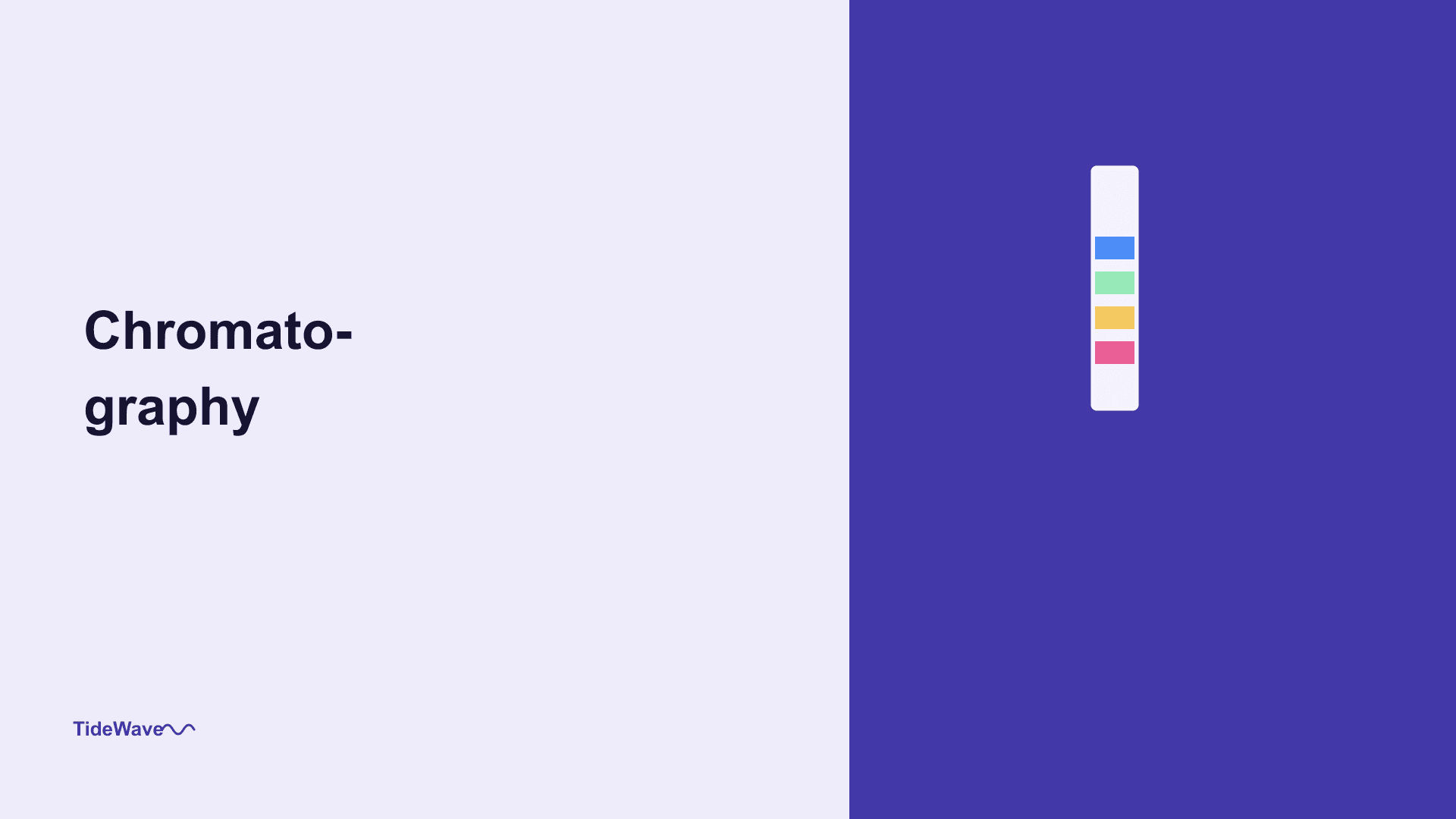
Example procedure: A spot of black ink is placed near the bottom of a paper strip, which is then dipped just below the ink spot into a shallow solvent. As the solvent travels up the paper, it carries the ink's individual pigments along at different speeds, based on how strongly each pigment binds to the paper fibers versus how readily it dissolves in the solvent. After enough time, the single black spot has separated into a visible series of distinct colored bands, revealing that the "black" ink was actually a mixture of several pigments all along.
Calculating the Rf Value
Chromatography results are quantified using the retention factor (Rf), a ratio that lets you compare results across different runs and even different labs:
Rf = distance traveled by the substance / distance traveled by the solvent front
Worked example: If a pigment spot travels 3.2 cm from the origin, and the solvent front travels 8.0 cm in the same amount of time:
Rf = 3.2 cm / 8.0 cm = 0.40
Each specific substance has a characteristic Rf value under a given set of conditions (same paper, same solvent, same temperature), which is exactly what allows chromatography to be used for identification, not just separation: an unknown substance's Rf value can be compared directly against known reference substances run under identical conditions.
Thin-Layer Chromatography (TLC)
Thin-layer chromatography works on the same principle as paper chromatography, but uses a thin layer of a solid adsorbent (commonly silica gel or alumina) coated onto a glass or plastic plate instead of paper. TLC generally separates mixtures faster and with sharper, more defined bands than paper chromatography, which is why it's the standard quick-check method used in organic chemistry labs to monitor whether a reaction has finished, or to check the purity of a synthesized compound.
Column Chromatography
Column chromatography scales the same idea up for a genuinely practical purpose: not just detecting or identifying components, but physically collecting them in a pure, usable form. A vertical glass column is packed with a solid stationary phase (often silica gel), and the liquid mixture is poured in at the top. As solvent is added and allowed to flow downward, different components exit the bottom of the column ("elute") at different times, and each fraction can be collected separately in its own clean container.
Gas Chromatography (GC)
Gas chromatography replaces the liquid mobile phase with an inert carrier gas (commonly helium or nitrogen), and the stationary phase is a liquid or solid coating the inside of a long, thin, coiled column, often housed inside an oven to precisely control temperature. The mixture is vaporized and carried through the column by the gas, and components separate based on both their interaction with the stationary phase coating and their boiling point (since the column's temperature can be gradually increased during a run).
GC is exceptionally sensitive and precise, which is why it's the standard technique used in:
- Forensic toxicology, detecting trace drugs or poisons in blood samples.
- Environmental testing, identifying pollutants in air or water samples at extremely low concentrations.
- Anti-doping testing, detecting banned performance-enhancing substances in athlete samples.
High-Performance Liquid Chromatography (HPLC)
HPLC is essentially a highly refined, pressurized version of column chromatography, forcing liquid mobile phase through a tightly packed column at high pressure, which dramatically improves separation speed, resolution, and sensitivity compared to a gravity-fed column. HPLC is the workhorse technique of the pharmaceutical industry, used to verify drug purity and precisely measure the concentration of active ingredients in a formulation.
FAQ
Each colored component (or any dissolved substance) has a unique combination of polarity, molecular size, and chemical structure, which determines how strongly it's attracted to the stationary phase versus how readily it dissolves in and travels with the mobile phase. Components more strongly attracted to the stationary phase move slower; those more attracted to the mobile phase move faster.
Rf values are useful supporting evidence but not fully definitive alone, since two different substances can occasionally share a similar Rf value under the same conditions. In practice, chromatography is usually combined with other identification methods (like comparing directly against known reference samples run side by side, or pairing with mass spectrometry) for confident identification.
GC requires the sample to be vaporized without decomposing, which limits it to compounds that are naturally volatile or can be heated into a gas phase without breaking down chemically. Large, heat-sensitive, or non-volatile molecules (like many proteins) are generally better suited to a liquid-phase technique like HPLC instead.
TLC is primarily an analytical tool, used to quickly check what's present in a mixture or confirm a reaction's progress, and it doesn't produce usable quantities of separated material. Column chromatography is a preparative tool, designed specifically to physically collect each separated component in a pure, usable form for further use.
Generally yes, faster movement through the system indicates weaker interaction with the stationary phase (and often stronger interaction with the mobile phase), though the specific relationship depends on the exact type of chromatography and the properties of the phases chosen, which is why comparing results only makes sense under identical experimental conditions.
Conclusion
Chromatography works because no two molecules interact with a given pair of stationary and mobile phases in exactly the same way, and that small difference, amplified over the length of a paper strip, a glass column, or a coiled GC tube, is enough to pull even complex mixtures apart into identifiable, sometimes even collectible, individual components. Whether it's a simple ink-spot experiment on paper or a forensic lab running gas chromatography on a blood sample, the underlying principle never changes: separate by exploiting difference, then measure or collect what falls out.
Here are some useful references if you want to go deeper:
- Khan Academy – Chromatography — foundational lessons on separation techniques in chemistry.
- Chemguide – Chromatography — detailed breakdowns of paper, TLC, column, and gas chromatography.
- Royal Society of Chemistry – Chromatography Techniques — resources and educational material on analytical separation methods.