Empirical Formula vs. Molecular Formula Explained
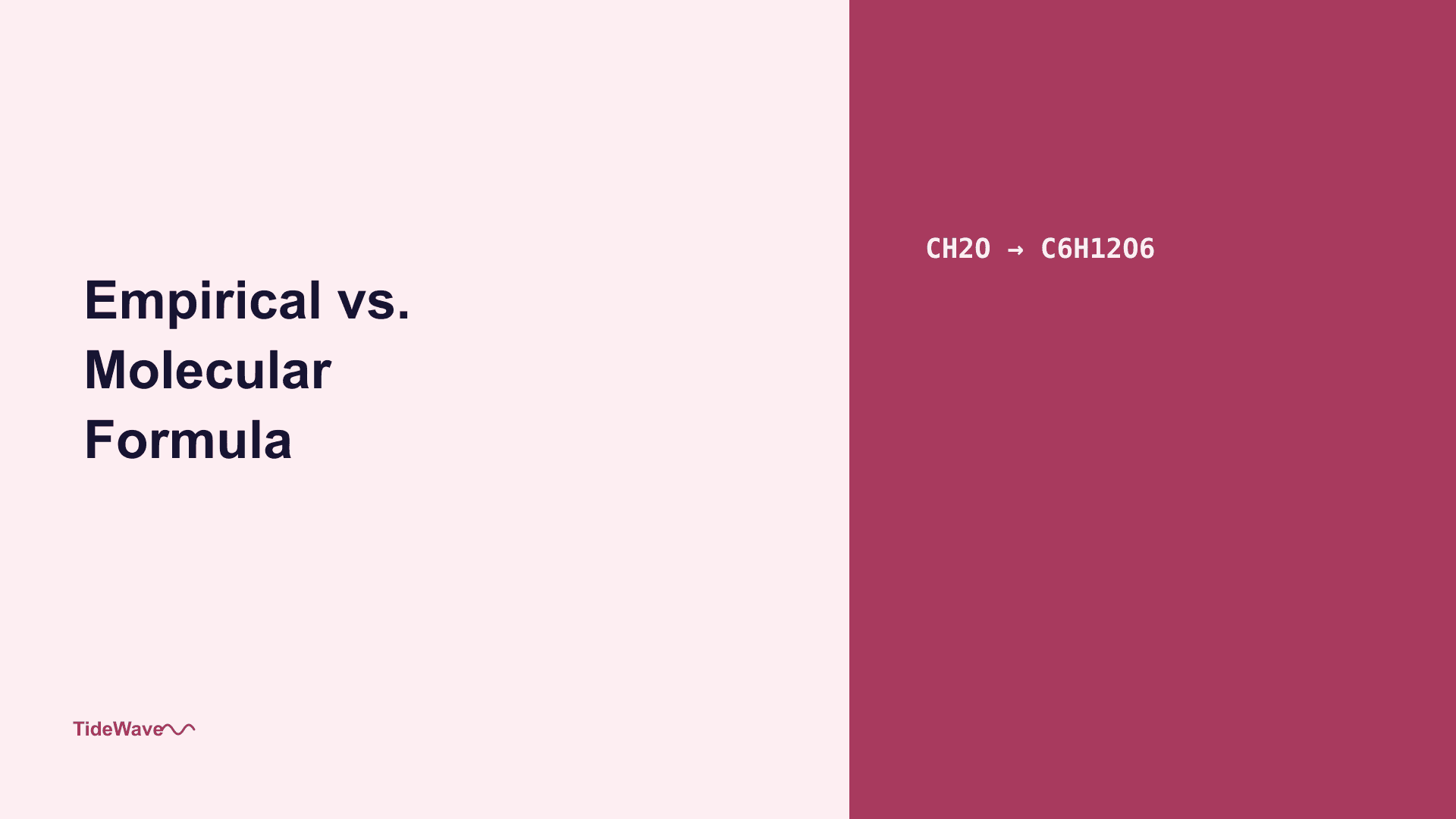
Formaldehyde (a preservative and industrial chemical) and glucose (the sugar your body runs on) share something surprising: the exact same simplest ratio of carbon, hydrogen, and oxygen atoms. What separates them entirely, one a toxic gas, the other essential to life, is scale: glucose is simply six times larger than formaldehyde, built from six repeats of that same basic ratio. This distinction, between a compound's simplest ratio and its true, actual composition, is exactly what separates an empirical formula from a molecular formula.
The Difference, Defined
- Empirical formula: shows the simplest whole-number ratio of atoms in a compound. It doesn't tell you the actual number of atoms in a real molecule, only their proportion relative to each other.
- Molecular formula: shows the actual, true number of each type of atom in one real molecule of the compound.
Example: Formaldehyde has the molecular formula CH₂O. Glucose has the molecular formula C₆H₁₂O₆. If you divide every subscript in glucose's formula by 6, you get exactly CH₂O, the same ratio as formaldehyde. Both compounds share the identical empirical formula, CH₂O, even though they are entirely different substances with dramatically different properties, because the actual number of atoms making up each real molecule is completely different.
The molecular formula is always a whole-number multiple of the empirical formula:
Molecular formula = (Empirical formula) × n

where n = Molecular molar mass ÷ Empirical formula molar mass
Calculating an Empirical Formula From Percent Composition
Empirical formulas are typically determined starting from experimental data: the percent composition of a compound, usually obtained through combustion analysis or similar lab techniques.
Worked Example: Finding an Empirical Formula
Question: A compound is found to be 40.0% carbon, 6.7% hydrogen, and 53.3% oxygen by mass. Find its empirical formula.
Step 1: Assume a 100-gram sample. This conveniently converts each percentage directly into grams:
Carbon: 40.0 g
Hydrogen: 6.7 g
Oxygen: 53.3 g
Step 2: Convert grams to moles using each element's molar mass (from the periodic table):
Carbon:   40.0 g ÷ 12.01 g/mol = 3.33 mol
Hydrogen: 6.7 g ÷ 1.01 g/mol   = 6.63 mol
Oxygen:   53.3 g ÷ 16.00 g/mol = 3.33 mol
Step 3: Divide every mole value by the smallest one, to find the simplest ratio:
Carbon:   3.33 ÷ 3.33 = 1.00
Hydrogen: 6.63 ÷ 3.33 = 1.99 ≈ 2
Oxygen:   3.33 ÷ 3.33 = 1.00
Step 4: Use these ratios as the subscripts. The resulting empirical formula is:
CH₂O
This particular compound turns out to have the same empirical formula as both formaldehyde and glucose from the earlier example, which is exactly why the next step, determining the molecular formula, is essential to know which compound you're actually dealing with.
When the Ratios Aren't Whole Numbers
Sometimes Step 3 produces a ratio like 1.5 instead of a clean whole number. When this happens, multiply every ratio by the smallest whole number that converts all of them into whole numbers (commonly 2, sometimes 3), rather than simply rounding, since rounding at this stage would distort the true ratio.
Example: ratios of 1.00, 1.5, and 2.00 should all be multiplied by 2, giving a corrected ratio of 2, 3, and 4.
Calculating a Molecular Formula From an Empirical Formula
Once you have the empirical formula, finding the true molecular formula requires one additional piece of information: the compound's actual molar mass, typically determined experimentally through a separate technique like mass spectrometry.
Worked Example: Finding a Molecular Formula
Question: A compound has the empirical formula CH₂O and an experimentally measured molar mass of 180.16 g/mol. Find its molecular formula.
Step 1: Calculate the molar mass of the empirical formula.
CH₂O = 12.01 + (2 × 1.01) + 16.00 = 30.03 g/mol
Step 2: Divide the actual molar mass by the empirical formula's molar mass.
n = 180.16 ÷ 30.03 ≈ 6
Step 3: Multiply every subscript in the empirical formula by n.
(CH₂O) × 6 = C₆H₁₂O₆
This confirms the molecular formula is C₆H₁₂O₆, glucose, distinguishing it clearly from formaldehyde (CH₂O, where n = 1) despite sharing the same underlying atomic ratio.
Why the Distinction Actually Matters
Knowing only a compound's empirical formula tells you its atomic proportions, useful information, but not enough to identify the compound with certainty or predict its true physical and chemical behavior, since molecule size itself affects properties like boiling point, reactivity, and biological function. The molecular formula is what actually corresponds to a real, physically accurate molecule, which is why lab analysis always aims to determine both the percent composition (for the empirical formula) and an independent molar mass measurement (to scale up to the true molecular formula).
FAQ
Yes, this is called isomerism. Compounds with the identical molecular formula but a different arrangement of atoms are called isomers, and they can have very different chemical and physical properties despite containing exactly the same atoms in exactly the same quantities.
Yes, whenever n (the multiplier connecting the two) equals exactly 1. Water, for example, has the molecular formula H₂O, and its empirical formula is also H₂O, since the ratio 2:1 is already in its simplest whole-number form.
Assuming exactly 100 grams is simply a convenient mathematical shortcut: since percentages are already defined as parts per 100, assuming a 100-gram sample means each percentage converts directly into an equivalent mass in grams without any extra conversion step, making the following mole calculations more straightforward.
Combustion analysis is the classic method for organic compounds: a sample is completely burned, and the resulting carbon dioxide and water are captured and precisely weighed, allowing the original mass of carbon and hydrogen in the sample to be calculated (with oxygen, if present, often determined by mass difference).
Not exactly. Ionic compounds don't exist as discrete, individual molecules; they form extended crystal lattices, so chemists use the term "formula unit" instead, representing the simplest ratio of ions, which is effectively identical in concept to an empirical formula rather than a true molecular formula.
Conclusion
An empirical formula tells you the simplest ratio of atoms in a compound; a molecular formula tells you exactly how many of each atom a real molecule actually contains, and the two are connected by a single whole-number multiplier derived from an independently measured molar mass. Working through percent composition to reach an empirical formula, then scaling it up using molar mass, is one of the most practical, frequently tested calculation sequences in introductory chemistry, precisely because it mirrors how compounds are genuinely identified in a real lab.
Here are some useful references if you want to go deeper:
- Khan Academy – Empirical and Molecular Formulas — free lessons with worked practice problems.
- Chemguide – Calculating Empirical Formulas — a detailed walkthrough of the calculation method.
- LibreTexts Chemistry – Determining Molecular Formulas — an open textbook resource connecting molar mass to molecular formula determination.