Flame Tests and Atomic Emission Spectra: Why Fireworks Are Colorful
Copper burns green, strontium burns red, and sodium burns a persistent, unmistakable yellow-orange, and none of this is decorative coincidence. Every element produces its own specific, reproducible set of colors when heated, a phenomenon so reliable that chemists use it as a genuine identification tool, and firework designers use it to engineer specific colors on demand. Both applications rely on the exact same underlying mechanism: electrons absorbing and releasing energy in precisely defined amounts.
Why Heated Elements Emit Light
When an element is heated (in a flame, an electrical spark, or any sufficiently energetic environment), its electrons absorb some of that energy and jump from their normal, lowest-energy position (the ground state) up to a higher-energy position (an excited state). This excited state is inherently unstable, so the electron quickly falls back down to a lower energy level, and in doing so, it releases the extra energy it had absorbed, in the form of a photon of light.
The key detail that explains everything about flame test colors is this: electrons can only occupy specific, quantized energy levels within an atom, not just any arbitrary amount of energy. Since an electron can only fall between two specific, fixed energy levels, the photon it emits always carries one very specific amount of energy, and the energy of a photon directly determines its wavelength, meaning its color.
Why Every Element Has a Unique Color Signature
Every element has a unique arrangement of electrons and unique energy levels available to them, governed by that element's specific electron configuration. Because the available energy-level transitions differ from element to element, the specific photon wavelengths (colors) each element can emit are also unique, essentially an atomic fingerprint.
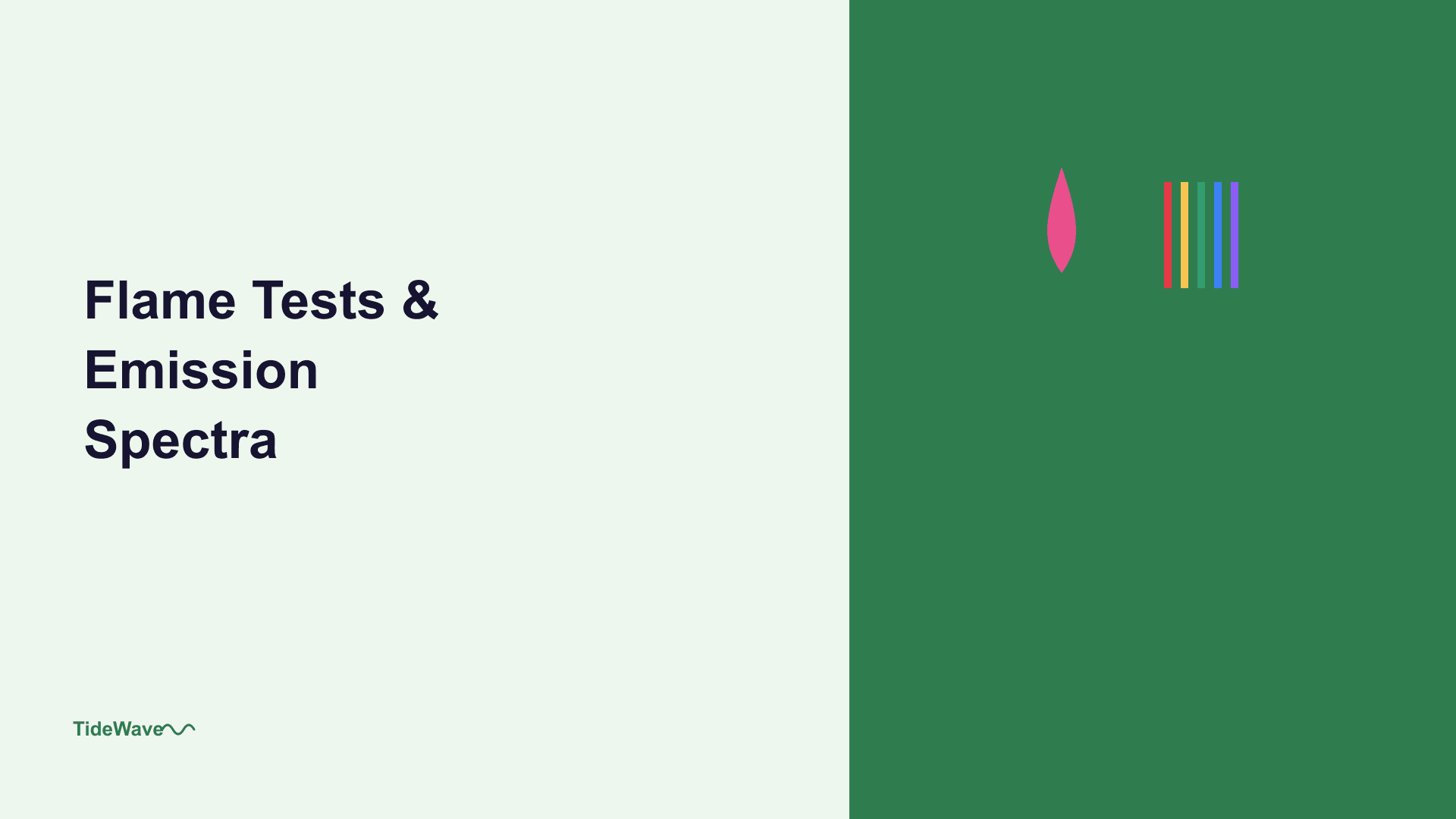
This produces what's called an atomic emission spectrum: rather than a continuous rainbow of all colors, a heated element emits light only at a specific, discrete set of wavelengths, visible as distinct bright lines when the light is passed through a prism or diffraction grating. No two elements produce an identical emission spectrum, which is exactly why this technique is reliable enough to use for real identification, not just a rough visual approximation.
Common Flame Test Colors
| Element | Flame Color |
|---|---|
| Lithium (Li) | Deep red |
| Sodium (Na) | Persistent yellow-orange |
| Potassium (K) | Lilac/light purple |
| Calcium (Ca) | Orange-red |
| Strontium (Sr) | Bright red |
| Barium (Ba) | Pale/apple green |
| Copper (Cu) | Blue-green |
Sodium's yellow-orange color is so intense that even trace contamination from sodium (present in sweat or on skin) can overpower and mask the flame test color of other elements present in a sample, which is exactly why chemists take care to use clean equipment and sometimes view a flame test through a blue cobalt glass filter, which specifically blocks out sodium's yellow light to reveal other, fainter colors underneath.
How Fireworks Use This Exact Chemistry
Firework designers exploit atomic emission directly, packing specific metal compounds into a firework shell to produce a desired color when ignited:
- Strontium salts (like strontium carbonate) produce the deep reds commonly seen in fireworks displays.
- Barium salts produce vivid greens.
- Copper compounds produce blues, notably one of the harder colors to produce vividly, since copper's blue emission is comparatively weak and easily overwhelmed by other colors nearby.
- Sodium salts produce a bright yellow, though used carefully given how strongly it can dominate over other colors in the same display.
- Aluminum and titanium powders don't produce colored emission the same way; instead, they burn extremely brightly, producing the bright white sparks and glittering effects seen alongside colored fireworks.
A firework's designed color effect is, quite literally, a controlled demonstration of atomic emission spectroscopy happening on a large, visible scale.
Flame Tests as a Real Analytical Tool
Beyond fireworks and classroom demonstrations, atomic emission is the basis of a genuine, widely used analytical technique: atomic emission spectroscopy (AES), along with the closely related atomic absorption spectroscopy (AAS). These instrument-based methods measure emission or absorption at specific wavelengths far more precisely than the human eye can distinguish in a simple flame test, allowing scientists to both identify which elements are present in a sample and measure their concentration with high accuracy. This technique is used routinely in environmental testing (checking water for trace metal contamination), medical laboratories (measuring mineral levels in blood samples), and quality control in manufacturing.
FAQ
Not every element has strong emission lines conveniently located in the visible light range; some emit primarily in the ultraviolet or infrared range instead, which the human eye simply cannot detect, even though the underlying electron transition and emission process is happening exactly the same way. Instrument-based spectroscopy can still detect and measure these emissions even when a simple visual flame test can't.
Yes, essentially the same fundamental mechanism, exciting electrons and capturing the light released as they fall back to lower energy levels, just using an electrical discharge to supply the excitation energy instead of a flame. This is exactly why neon signs glow with characteristic colors specific to the gas used inside them (neon itself glows red-orange, while other noble gases used in similar signage produce different characteristic colors).
Sodium's most intense emission line happens to fall at a wavelength the human eye is particularly sensitive to, and sodium contamination is also extremely common (present in sweat, most glassware, and many other compounds), so even a small trace amount can produce a visually dominant yellow that masks fainter colors from other elements present in the same sample.
An ordinary colored object gets its color through selective absorption and reflection of the broad, continuous spectrum of ambient white light, no light is being newly generated by the object itself. Atomic emission is fundamentally different: the heated element is actively generating and releasing new photons of light itself, at specific wavelengths determined entirely by its own internal electron transitions, independent of any external light source.
Yes, this is exactly how astronomers determine the chemical composition of stars and other distant celestial objects. By analyzing the specific wavelengths of light received from a star through a spectrograph, scientists can match the observed emission (or absorption) lines against known atomic spectra measured in laboratories on Earth, identifying which elements are present without any physical sample at all.
Conclusion
The distinct color each element produces when heated isn't decoration or coincidence, it's a direct, visible signature of that element's specific electron energy levels, which are as unique to each element as a fingerprint. From a simple classroom flame test to a professionally designed fireworks display to astronomers analyzing light from distant stars, the same core mechanism is at work: electrons absorbing energy, jumping to an excited state, and releasing exactly that same amount of energy as a photon of a very specific, characteristic color.
Here are some useful references if you want to go deeper:
- Khan Academy – Atomic Emission Spectra — free lessons covering electron transitions and emission spectra.
- Chemguide – Flame Tests — a detailed explanation of common flame test colors and technique.
- American Pyrotechnics Association – Fireworks Chemistry — an industry resource on how metal compounds are used to create firework colors.