VSEPR Theory: Predicting Molecular Geometry
A 2D Lewis structure tells you which atoms are bonded to which, but it says nothing about a molecule's actual three-dimensional shape, and shape turns out to matter enormously: it's the reason water is polar while carbon dioxide isn't, despite both having polar bonds, and it's central to why enzymes recognize one molecule but not another. VSEPR theory (Valence Shell Electron Pair Repulsion theory) is the remarkably simple set of rules that lets you predict a molecule's real shape just by counting electron pairs around its central atom.
The Core Idea Behind VSEPR
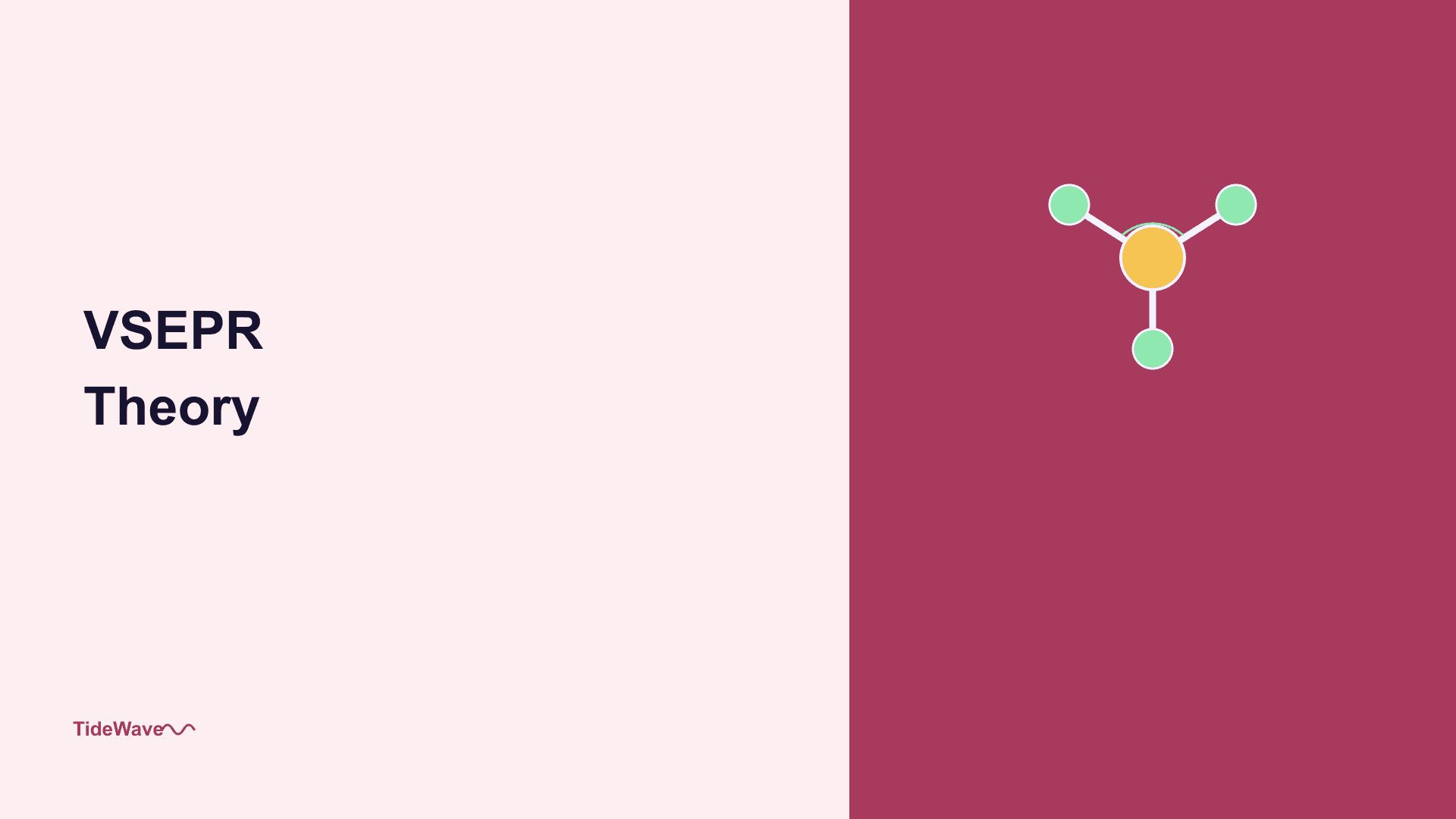
VSEPR theory rests on one intuitive physical principle: electron pairs, whether they're in bonds or unshared, repel each other and arrange themselves as far apart in space as possible, since they're all negatively charged regions trying to minimize repulsion. This single idea, electron pairs pushing away from one another to maximize distance, is all you need to predict the geometry of most simple molecules.
The electron pairs around a central atom fall into two categories, both of which count toward determining shape:
- Bonding pairs: electron pairs shared between the central atom and another atom, forming a covalent bond.
- Lone pairs: electron pairs that belong entirely to the central atom, not shared with any other atom.
The Five Basic Electron Domain Geometries
The total number of electron domains (bonding pairs plus lone pairs) around a central atom determines the underlying electron domain geometry, the arrangement that maximizes distance between all the domains:
| Electron Domains | Electron Domain Geometry | Bond Angle |
|---|---|---|
| 2 | Linear | 180° |
| 3 | Trigonal planar | 120° |
| 4 | Tetrahedral | 109.5° |
| 5 | Trigonal bipyramidal | 90°/120° |
| 6 | Octahedral | 90° |
From Electron Geometry to Molecular Geometry
Here's the crucial distinction that trips up many students: molecular geometry describes the actual arrangement of atoms (what you'd see if you could look at the molecule), while electron domain geometry includes lone pairs too. When a central atom has no lone pairs, these two geometries are identical. But when lone pairs are present, the molecular geometry (atoms only) differs from the underlying electron geometry, because lone pairs are invisible in the final observed shape even though they still influence it.
Worked Example 1: Methane (CH₄)
Carbon has 4 bonding pairs (to each hydrogen) and 0 lone pairs, for 4 total electron domains.
- Electron domain geometry: tetrahedral
- Molecular geometry: tetrahedral (identical, since there are no lone pairs to hide)
- Bond angle: 109.5°
Worked Example 2: Ammonia (NH₃)
Nitrogen has 3 bonding pairs (to each hydrogen) and 1 lone pair, for 4 total electron domains.
- Electron domain geometry: tetrahedral (based on all 4 domains)
- Molecular geometry: trigonal pyramidal (only the 3 hydrogen atoms are "visible" in the shape; the lone pair still occupies one tetrahedral position but isn't counted as part of the observed shape)
- Bond angle: approximately 107° (slightly less than 109.5°, because lone pairs repel more strongly than bonding pairs, described below)
Worked Example 3: Water (H₂O)
Oxygen has 2 bonding pairs (to each hydrogen) and 2 lone pairs, for 4 total electron domains.
- Electron domain geometry: tetrahedral
- Molecular geometry: bent (only the 2 hydrogen atoms are visible)
- Bond angle: approximately 104.5° (even smaller than ammonia's, since two lone pairs are now compressing the remaining bond angle)
Notice that all three examples share the same underlying tetrahedral electron domain geometry (4 total domains), yet produce three completely different observed molecular shapes, purely based on how many of those domains are lone pairs versus bonding pairs.
Why Lone Pairs Compress Bond Angles
Lone pairs occupy more space around the central atom than bonding pairs do, because a bonding pair is stretched between two nuclei (the central atom and the bonded atom), while a lone pair is held entirely by just the central atom's nucleus, allowing it to spread out more broadly. This produces a reliable hierarchy of repulsion strength:
lone pair-lone pair repulsion > lone pair-bonding pair repulsion > bonding pair-bonding pair repulsion
This is exactly why ammonia's bond angle (107°) is slightly compressed from the ideal tetrahedral 109.5°, and why water's bond angle (104.5°) is compressed even further: each additional lone pair pushes the remaining bonding pairs closer together to make room for its own larger repulsive influence.
A Quick Reference Table for Molecular Geometry
| Bonding Pairs | Lone Pairs | Total Domains | Molecular Geometry | Example |
|---|---|---|---|---|
| 2 | 0 | 2 | Linear | CO₂ |
| 3 | 0 | 3 | Trigonal planar | BF₃ |
| 2 | 1 | 3 | Bent | SO₂ |
| 4 | 0 | 4 | Tetrahedral | CH₄ |
| 3 | 1 | 4 | Trigonal pyramidal | NH₃ |
| 2 | 2 | 4 | Bent | H₂O |
VSEPR and Molecular Polarity
Molecular geometry, determined through VSEPR, is the deciding factor in whether a molecule with polar bonds ends up polar overall, since individual bond dipoles can either reinforce or cancel each other out depending on the molecule's shape, a relationship explored in full in molecular polarity. Carbon dioxide's linear shape (with two identical, opposite-pointing bond dipoles) causes its bond polarities to cancel exactly, making the overall molecule nonpolar despite having polar C=O bonds. Water's bent shape, by contrast, prevents its two bond dipoles from canceling, leaving the molecule with a net dipole, exactly why VSEPR-predicted geometry is the essential first step before you can determine a molecule's overall polarity.
Why VSEPR Theory Matters Practically
- Predicting molecular polarity, which in turn predicts solubility, boiling point, and countless other physical properties.
- Understanding biological recognition, since enzymes and receptors bind based on precise molecular shape, not just chemical formula.
- Explaining reactivity, since a molecule's 3D shape determines which parts are accessible for another molecule to approach and react with.
FAQ
Yes, a double or triple bond is still counted as just one electron domain for VSEPR purposes, since all the electron density between the two bonded atoms occupies roughly the same region of space, regardless of how many electron pairs are involved in that single bond. This is why carbon dioxide (with two C=O double bonds) is still correctly predicted as linear, with only 2 total electron domains around carbon.
The number of lone pairs, not just the total domain count, determines the exact bond angle. Ammonia has 1 lone pair while water has 2, and each additional lone pair adds more compressing repulsion onto the remaining bonding pairs, which is exactly why water's angle (104.5°) is smaller than ammonia's (107°), even though both start from the same tetrahedral electron domain geometry.
VSEPR theory is applied separately to each individual central atom in a larger molecule, one at a time, rather than to the molecule as a whole in one single calculation. For a molecule with multiple central atoms (like ethane or a larger organic molecule), you'd determine the geometry around each central atom independently, then combine those individual local geometries to describe the overall 3D molecular shape.
No, though the two are closely related and often taught together. VSEPR theory predicts a molecule's geometry based purely on electron pair repulsion, while hybridization is a separate model describing how atomic orbitals mix to form new orbitals capable of producing that predicted geometry. VSEPR tells you the resulting shape; hybridization offers one explanation for how the central atom's orbitals actually achieve it.
VSEPR predicts the correct general shape and the correct direction of any angle distortion (smaller than the ideal angle when lone pairs are present) reliably, but the exact numerical bond angle it suggests is often a close approximation rather than a perfectly precise value, since real bond angles are also influenced by factors like differing electronegativities of the bonded atoms that VSEPR's simple electron-counting approach doesn't fully capture.
Conclusion
VSEPR theory turns a 2D Lewis structure into a genuine 3D prediction using nothing more than counting electron domains and recognizing that lone pairs repel more strongly than bonding pairs. That simple counting exercise is enough to correctly predict why methane, ammonia, and water, all built around a central atom with 4 total electron domains, end up with three entirely different observable shapes, and why that shape difference cascades directly into differences in polarity, reactivity, and countless other real molecular properties.
Here are some useful references if you want to go deeper:
- Khan Academy – VSEPR Theory — free lessons with additional worked geometry examples.
- Chemguide – Shapes of Molecules — a detailed explanation of the electron pair repulsion model.
- LibreTexts Chemistry – VSEPR Theory — an open textbook resource covering additional molecular geometries in depth.