Chirality and Stereoisomers: Why Molecular Handedness Matters
Hold your left and right hands up, palms facing you: they're mirror images of each other, yet no matter how you rotate them, you can never perfectly overlap one on top of the other. This property, having a non-superimposable mirror image, is called chirality, and it turns out entire molecules can exhibit exactly the same handedness. Two molecules can share an identical molecular formula and identical bonds, yet be genuinely distinct substances simply because of how their atoms are arranged in three-dimensional space, a concept central to stereochemistry.
What Makes a Molecule Chiral?
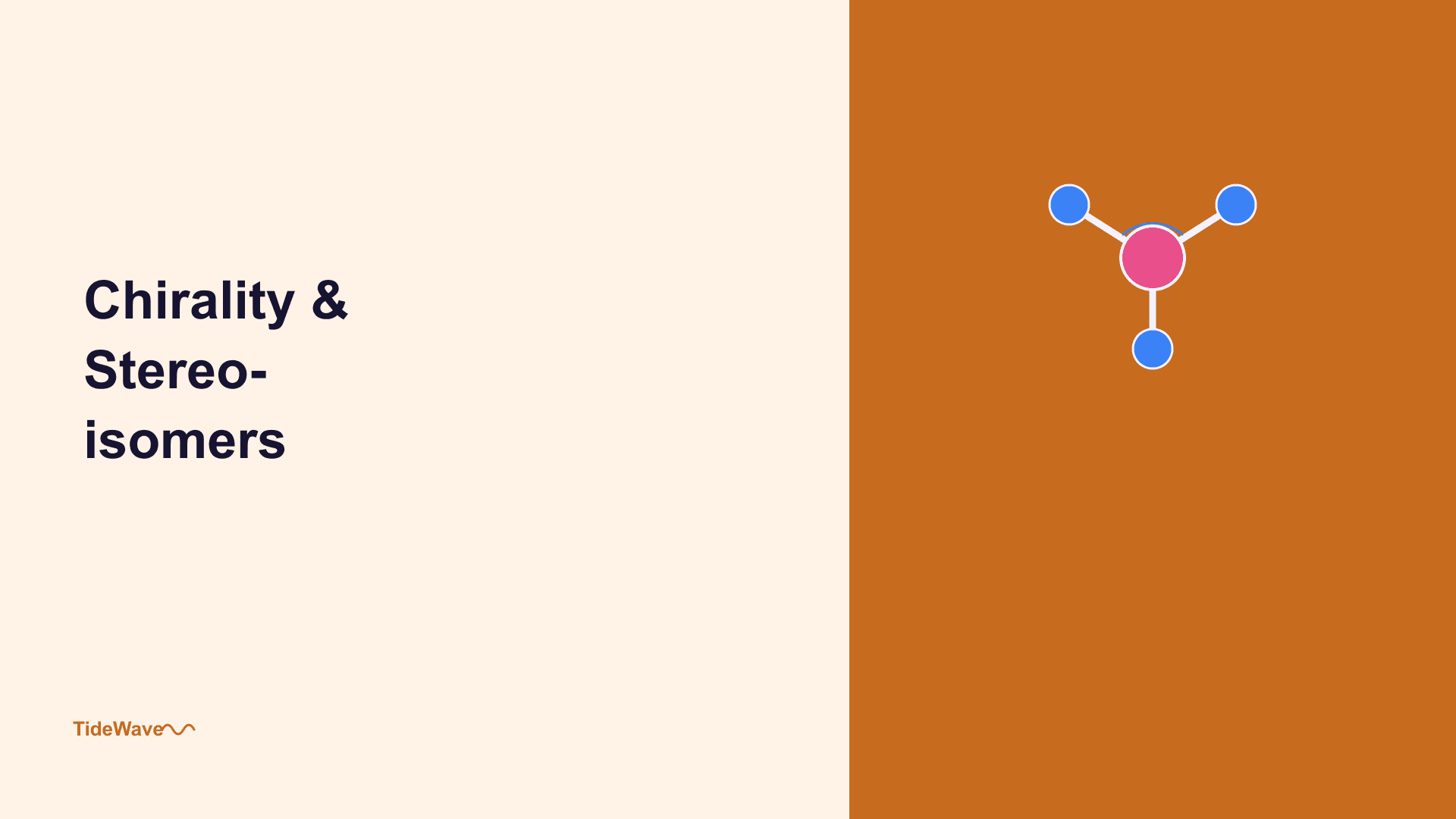
A molecule is chiral if it has at least one chiral center (also called a stereocenter), most commonly a carbon atom bonded to four different groups. When all four groups attached to a carbon are distinct, that carbon can be arranged in two different spatial configurations, mirror images of each other, that cannot be rotated into matching one another, in exactly the same way your two hands can't be superimposed.
Example: A carbon atom bonded to -H, -OH, -CH₃, and -COOH has four different groups attached, making it a chiral center. Swap the positions of any two of those groups, and you get a molecule that's a mirror image of the original, but not identical to it.
A molecule with no chiral centers (or with a chiral center whose mirror-image arrangement happens to be identical to the original due to internal symmetry) is called achiral, and it has no distinct mirror-image version.
Enantiomers: Non-Superimposable Mirror Images
Two chiral molecules that are exact mirror images of each other, and cannot be superimposed no matter how they're rotated, are called enantiomers. Enantiomers share several properties that make them easy to mistake for identical substances at a glance:
- Identical molecular formula
- Identical connectivity (the same atoms bonded to the same other atoms)
- Identical physical properties in most respects: melting point, boiling point, density, and solubility are all the same
But they differ in two important ways:
- They rotate plane-polarized light in opposite directions. One enantiomer rotates it clockwise (labeled the "+" or "dextrorotatory" form), and the other rotates it counterclockwise (labeled the "−" or "levorotatory" form), a property measured with an instrument called a polarimeter.
- They can interact completely differently with other chiral molecules, including the chiral molecules that make up living organisms.
Why Enantiomers Can Behave So Differently in Biology
This second point is the reason chirality matters far beyond an academic curiosity. Biological systems are built almost entirely from chiral molecules: proteins are built from a specific "handedness" of amino acids, and enzymes, the molecules that catalyze biological reactions, are themselves chiral. An enzyme built to recognize one enantiomer of a molecule often cannot properly recognize its mirror-image counterpart at all, in much the same way a right-handed glove doesn't properly fit a left hand.
This means two enantiomers of the same drug molecule can produce very different effects in the body: one enantiomer might be therapeutically active while its mirror image is inactive, or the two might be processed by the body's chiral enzymes in entirely different ways. This is precisely why regulatory agencies require pharmaceutical researchers to test the safety and effects of each enantiomer of a chiral drug individually, rather than assuming both mirror-image forms will behave identically just because they share the same formula.
Racemic Mixtures
A racemic mixture is a sample containing an exact 50:50 mixture of both enantiomers. Because the two enantiomers' rotations of polarized light are equal and opposite, a racemic mixture shows no net optical rotation at all, even though it's made entirely of optically active molecules. Many chemical reactions that create a chiral center from an achiral starting material produce a racemic mixture by default, since there's typically no preference for creating one mirror-image form over the other without a chiral catalyst or chiral starting material specifically directing the reaction.
Diastereomers: A Different Kind of Stereoisomer
Not every pair of stereoisomers is a pair of enantiomers. Diastereomers are stereoisomers that are not mirror images of each other, which typically occurs in molecules with two or more chiral centers. Unlike enantiomers, diastereomers can have genuinely different physical properties, different melting points, different boiling points, and different solubilities, because they aren't simply mirror-image versions of the same spatial arrangement.
| Type | Mirror Images? | Physical Properties | Optical Rotation |
|---|---|---|---|
| Enantiomers | Yes | Identical | Equal and opposite |
| Diastereomers | No | Can differ | Can differ |
How Chemists Distinguish and Name Enantiomers
Since enantiomers can't be told apart by ordinary physical properties, chemists use the R/S naming system (based on assigning priority to the four groups around a chiral center using atomic number) to unambiguously specify which mirror-image form a molecule is. A molecule labeled (R) and its (S) counterpart are enantiomers of each other, and this labeling is a standard part of full IUPAC nomenclature for any compound with a defined chiral center.
FAQ
No, a carbon only becomes a chiral center if it's bonded to four genuinely different groups. A carbon bonded to two identical groups (like two hydrogen atoms) cannot be a chiral center, which is why simple molecules like ethane have no chirality at all despite containing multiple carbons.
Yes, chirality is a general geometric property, not something unique to carbon. Certain nitrogen, phosphorus, and sulfur-containing compounds can also serve as chiral centers, and some molecules are chiral due to restricted rotation around a bond axis rather than a single chiral atom at all.
Ordinary separation techniques like distillation or standard chromatography won't work, since they rely on differences in physical properties that enantiomers don't have. Separating enantiomers typically requires a chiral separating agent, something that itself interacts differently with each enantiomer, such as a chiral chromatography column or reacting the mixture with a single-enantiomer chiral reagent to form diastereomers, which can then be separated normally.
No, this is an important distinction. A racemic mixture is made of individually chiral molecules that happen to cancel each other's optical rotation out in equal amounts; an achiral substance is made of molecules that have no handedness at all to begin with. The two look identical under a polarimeter (no net rotation) but are fundamentally different at the molecular level.
No, and this is a common point of confusion. The R/S designation is based purely on the priority ranking of the groups attached to the chiral center, a naming convention, while the (+)/(−) designation is based on the experimentally measured direction of light rotation. There's no simple, direct rule connecting the two; an (R) molecule isn't necessarily the (+) rotating one.
Conclusion
Chirality reveals that a molecular formula and even a full list of bonds don't always fully describe a molecule, sometimes the specific three-dimensional arrangement of otherwise identical atoms matters enormously. Enantiomers share every ordinary physical property yet can interact completely differently with other chiral molecules, which is exactly why this once-obscure geometric property became central to pharmaceutical safety testing and modern organic chemistry. Once you can spot a chiral center (a carbon bonded to four different groups), you can predict whether a molecule has this hidden layer of structural identity at all.
Here are some useful references if you want to go deeper:
- Khan Academy – Chirality — free lessons covering chiral centers, enantiomers, and the R/S system.
- Chemguide – Optical Isomerism — a detailed explanation of chirality and enantiomers with diagrams.
- IUPAC – Nomenclature of Organic Chemistry — the official body responsible for the R/S naming conventions referenced above.