Organic Chemistry Basics: Functional Groups and Naming Compounds
Organic chemistry is the study of carbon-based compounds, and carbon's unique ability to form stable, complex chains and rings with other carbon atoms is why more organic compounds exist than compounds of every other element combined. Faced with millions of possible molecules, organic chemistry would be impossible to learn one compound at a time. Instead, chemists rely on a much smaller set of reusable building blocks called functional groups, specific arrangements of atoms that behave predictably no matter which larger molecule they're attached to.
Why Carbon Is Special
Carbon sits at the center of organic chemistry because of a few specific properties:
- Four valence electrons, allowing it to form four covalent bonds with other atoms, more connection points than most elements.
- Catenation, the ability to bond to other carbon atoms in long chains, branches, and rings, a property carbon exhibits far more extensively than any other element.
- Bonds well with many elements, especially hydrogen, oxygen, nitrogen, and the halogens, which is what gives rise to the huge diversity of possible organic molecules.
The simplest organic compounds, called hydrocarbons, contain only carbon and hydrogen. Everything more complex in organic chemistry starts from a hydrocarbon backbone with one or more functional groups attached.
What Is a Functional Group?
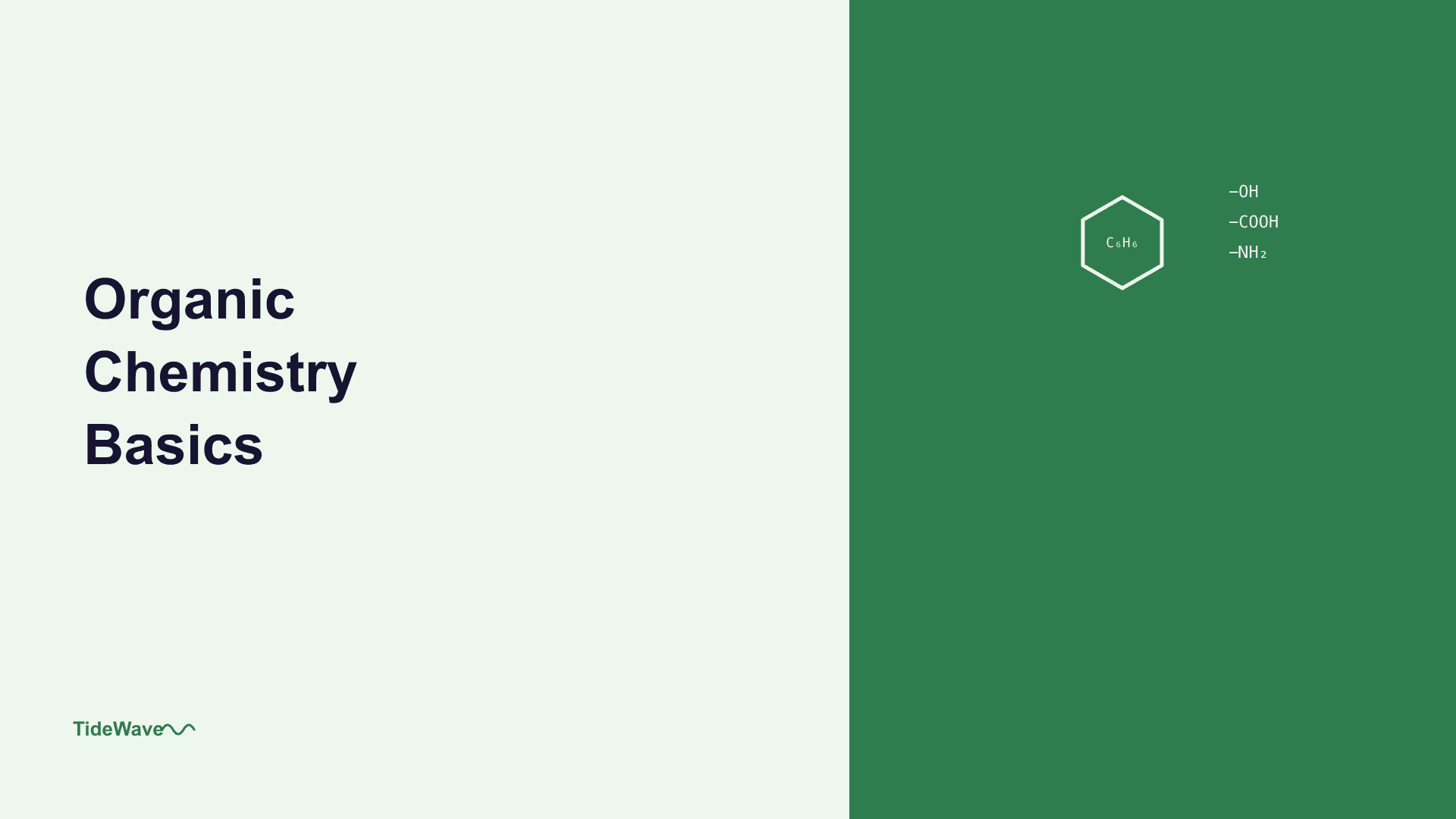
A functional group is a specific group of atoms within a molecule that's responsible for that molecule's characteristic chemical behavior, largely independent of the rest of the molecule's structure. This is the single most useful idea in organic chemistry: two molecules with completely different carbon skeletons, but the same functional group, will undergo very similar reactions and share many chemical properties.
Common Functional Groups
| Functional Group | Structure | Naming Suffix | Example |
|---|---|---|---|
| Alkane (no group) | C-C single bonds only | -ane | Ethane (C₂H₆) |
| Alkene | C=C double bond | -ene | Ethene (C₂H₄) |
| Alkyne | C≡C triple bond | -yne | Ethyne (C₂H₂) |
| Alcohol | -OH | -ol | Ethanol (C₂H₅OH) |
| Carboxylic acid | -COOH | -oic acid | Acetic acid (CH₃COOH) |
| Amine | -NH₂ | -amine | Methylamine (CH₃NH₂) |
| Ketone | C=O (mid-chain) | -one | Acetone (CH₃COCH₃) |
| Aldehyde | -CHO (end of chain) | -al | Formaldehyde (HCHO) |
| Ester | -COO- | -oate | Ethyl acetate |
Why Functional Groups Drive Predictable Behavior
Example: The -OH (hydroxyl) group is what defines an alcohol. Whether it's attached to a tiny two-carbon chain (ethanol, drinking alcohol) or a much larger carbon skeleton, that -OH group consistently makes the molecule more polar, more soluble in water, and reactive in similar ways, like being able to undergo the same type of oxidation reaction to form an aldehyde or carboxylic acid.
Example: The -COOH (carboxyl) group is what makes a carboxylic acid. It's present in acetic acid (vinegar), citric acid (citrus fruit), and countless larger organic molecules, and it consistently behaves as a weak acid, capable of donating a hydrogen ion, exactly the acid-base behavior predicted just by recognizing that one functional group.
Naming Organic Compounds: IUPAC Nomenclature
To avoid the confusion of relying on informal historical names (like "acetone" or "formaldehyde"), chemists use a systematic naming system maintained by the International Union of Pure and Applied Chemistry (IUPAC). While the full rules are extensive, the basic pattern for naming a simple organic compound follows three steps:
Step 1: Identify the Longest Carbon Chain
Find the longest continuous chain of carbon atoms in the molecule, which determines the base name (a "root"):
- 1 carbon: meth-
- 2 carbons: eth-
- 3 carbons: prop-
- 4 carbons: but-
- 5 carbons: pent-
- 6 carbons: hex-
Step 2: Identify the Functional Group and Apply the Correct Suffix
The suffix depends on the primary functional group present (see the table above). A three-carbon chain with only single bonds and no functional group is propane; the same three-carbon chain with an -OH group attached is propanol.
Step 3: Number the Chain to Give the Functional Group the Lowest Possible Number
If the functional group could be attached at more than one position, number the carbon chain (starting from whichever end gives the functional group the lowest number) and include that number in the name.
Example: An -OH group on the second carbon of a four-carbon chain is named butan-2-ol, not butan-3-ol, since numbering must start from the end that gives the functional group the lower position number.
Isomers: Same Formula, Different Structure
One of the reasons organic chemistry has so many possible compounds is isomerism: different compounds that share the exact same molecular formula but differ in how their atoms are arranged. Two major types are worth knowing:
- Structural isomers have the same atoms connected in a genuinely different order (like butane vs. isobutane, both C₄H₁₀, but one is a straight chain and the other is branched).
- Functional group isomers share the same formula but have entirely different functional groups (ethanol, C₂H₆O, an alcohol, versus dimethyl ether, also C₂H₆O, an ether), giving them completely different chemical properties despite an identical formula.
This is exactly why the systematic naming system matters so much in organic chemistry: a molecular formula alone often isn't enough information to know what compound you're actually describing.
FAQ
Carbon's combination of four bonding sites and strong catenation (chaining to itself) is unmatched by other elements. Silicon, directly below carbon on the periodic table, can also form chains to some degree, but its bonds are weaker and less stable, which is why silicon-based "life" or complex silicon chemistry remains far more limited than carbon's.
Yes, and this is extremely common in more complex molecules, including most biological molecules. Amino acids, for example, contain both a carboxylic acid group (-COOH) and an amine group (-NH₂) on the same molecule, which is exactly what allows them to link together into proteins through reactions involving both groups.
The distinction is entirely about position. An aldehyde has its C=O group at the very end of a carbon chain (attached to at least one hydrogen), while a ketone has its C=O group in the middle of the chain, attached to two other carbon groups instead. This positional difference changes their reactivity, particularly how easily each is oxidized further.
Not immediately. Starting with the handful of most common groups, alcohols, carboxylic acids, amines, and the basic hydrocarbons (alkanes, alkenes, alkynes), covers the large majority of introductory organic chemistry. More specialized groups (like esters and amides) build naturally on those fundamentals once they're solid.
Common names work only because they were memorized individually and don't scale to the millions of possible organic compounds, many of which have no common name at all. IUPAC naming is systematic specifically so that any chemist, anywhere, can deduce a compound's exact structure directly from its name alone, without needing to have memorized that specific compound beforehand.
Conclusion
Organic chemistry looks overwhelming only if you approach it as millions of individual compounds to memorize. In practice, it reduces to a manageable set of functional groups, each with predictable, transferable behavior, attached to carbon skeletons of varying length and shape. Learn to recognize a functional group on sight, and you can predict a huge amount about an unfamiliar molecule's properties and reactivity, exactly the shortcut that makes a field this vast approachable at all.
Here are some useful references if you want to go deeper:
- Khan Academy – Organic Chemistry — free lessons covering functional groups, nomenclature, and reaction mechanisms.
- IUPAC – Nomenclature of Organic Chemistry — the official body responsible for the systematic naming rules referenced above.
- Chemguide – Functional Groups — detailed explanations of each major functional group's chemistry.