Distillation: How Separation by Boiling Point Works
Every liter of gasoline, every bottle of whiskey, and the fresh water produced by some desalination plants all owe their existence to the same technique: distillation, a method of separating liquids in a mixture based on differences in their boiling points. It's one of the oldest purification techniques in chemistry, and it works on a principle simple enough to demonstrate on a stovetop, yet powerful enough to refine millions of barrels of crude oil a day.
The Basic Principle
Distillation exploits the fact that when a liquid mixture is heated, the component with the lower boiling point vaporizes first and more readily than components with higher boiling points, since it requires less energy for its molecules to overcome the intermolecular forces holding them in liquid form. If that vapor is captured and cooled back into a liquid elsewhere, it can be collected separately from the original mixture, now enriched in the lower-boiling-point component.
The general process has three essential steps:
- Heating: the mixture is heated until the lowest-boiling component begins to vaporize.
- Vapor transport: the vapor travels away from the heat source, typically through a tube or column.
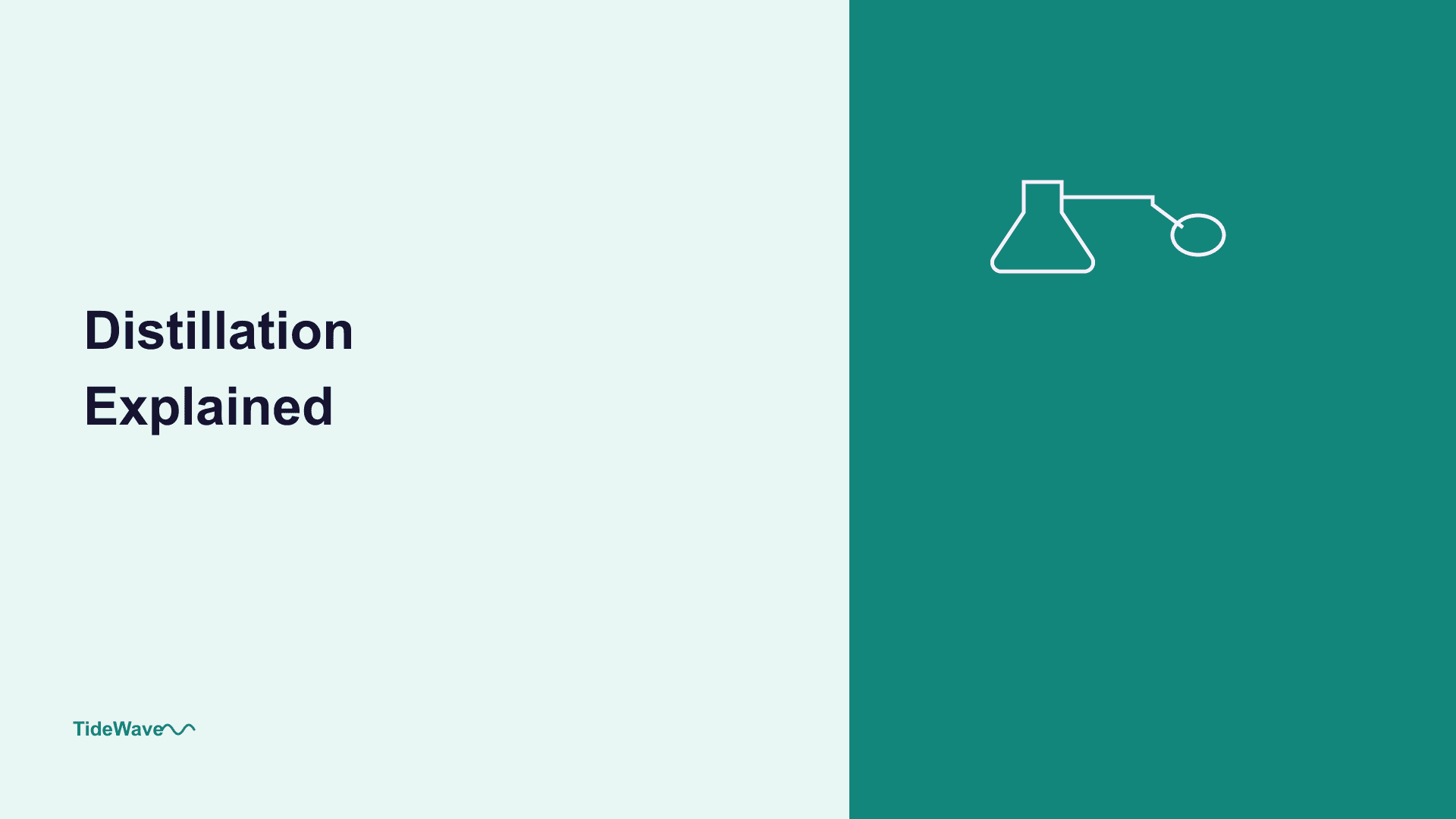
- Condensation: the vapor is cooled (often by a water-cooled condenser) back into liquid form and collected in a separate container, called the distillate.
Simple Distillation
Simple distillation is the most basic version of the process, best suited for separating a liquid from a non-volatile solid dissolved in it (like separating pure water from salt water), or for separating two liquids with a large difference in boiling point (generally more than about 25°C apart).
Example: Purifying water. Salt water is heated in a flask; only the water evaporates (salt has an extremely high boiling point and stays behind), and that water vapor travels through a condenser, cools, and is collected as pure liquid water, leaving the salt behind in the original flask.
Simple distillation struggles, however, when separating liquids with similar boiling points, since both will vaporize to some degree at the same temperature, resulting in a distillate that's still a mixture, just enriched rather than pure.
Fractional Distillation
Fractional distillation solves the similar-boiling-point problem by adding a fractionating column between the heated mixture and the condenser, typically a vertical column packed with material that provides a large surface area (like glass beads or bubble-cap trays in industrial columns).
As mixed vapor rises through the column, it repeatedly condenses and re-vaporizes on the packing material's surface. Each time this happens, the vapor becomes slightly richer in the lower-boiling component (since it re-vaporizes more easily) and slightly poorer in the higher-boiling component. Repeated over and over up the length of the column, this creates a natural temperature gradient, hottest at the bottom, coolest at the top, that effectively performs many small distillations in a row within a single apparatus, achieving a separation far more precise than simple distillation could manage alone.
Real-World Application: Crude Oil Refining
The most large-scale application of fractional distillation in the world is petroleum refining. Crude oil is a complex mixture of hydrocarbons with a huge range of boiling points, and refineries feed heated crude oil into massive fractionating towers, sometimes over 50 meters tall, where different hydrocarbon fractions condense and are drawn off at different heights based on their boiling point:
| Fraction | Approximate Boiling Range | Common Use |
|---|---|---|
| Gases | Below 40°C | LPG, heating fuel |
| Gasoline (naphtha) | 40-205°C | Vehicle fuel |
| Kerosene | 150-260°C | Jet fuel |
| Diesel | 200-350°C | Diesel engines |
| Lubricating oil | 300-370°C | Motor oil, lubricants |
| Residue (bitumen) | Above 370°C | Asphalt, tar |
The lightest, lowest-boiling fractions rise to the top of the tower and are drawn off there, while the heaviest, highest-boiling fractions remain near the bottom, exactly the same principle at work as a lab-scale fractionating column, just built on an industrial scale.
Real-World Application: Spirit Distillation
Distilling spirits like whiskey and vodka also relies on the difference in boiling point between ethanol (about 78°C) and water (100°C). A fermented liquid ("wash" or "beer") containing a relatively low concentration of ethanol is heated, and because ethanol vaporizes more readily than water, the resulting vapor is significantly enriched in ethanol compared to the original liquid. Distillers often repeat this process multiple times (multiple "distillation runs"), or use a design closer to a fractionating column, to progressively concentrate the alcohol content further.
Vacuum Distillation
Some compounds decompose chemically before reaching their normal boiling point at standard atmospheric pressure. Vacuum distillation solves this by reducing the pressure inside the apparatus, which lowers a liquid's boiling point (since less energy is needed to overcome a reduced surrounding pressure). This allows heat-sensitive materials, including many components of crude oil residue and certain pharmaceutical compounds, to be distilled at a lower, safer temperature that avoids decomposition.
FAQ
The bigger the gap between two components' boiling points, the more completely one vaporizes while the other stays behind at a given temperature, producing a cleaner separation in a single pass. When boiling points are close together, both components vaporize to a meaningful degree at the same temperature, requiring the repeated condensation/re-vaporization cycles that a fractionating column provides.
Not effectively through boiling point alone, since distillation depends entirely on a difference in vaporization behavior between components. Certain liquid mixtures, called azeotropes, even boil at a constant, fixed temperature as if they were a single pure substance, requiring an entirely different separation technique (like adding a third substance) to split them apart.
Height corresponds directly to temperature inside the tower, since it runs hottest at the bottom and progressively cooler toward the top. Each height, therefore, is where a specific range of hydrocarbons condenses back to liquid and can be collected, allowing many different fractions to be separated continuously from a single, ongoing process.
Physical. Distillation separates substances based on a physical property (boiling point) without breaking or forming any chemical bonds within the molecules themselves. This is exactly the same distinction that applies to the phase changes distillation relies on, vaporization and condensation.
Boiling point is directly tied to surrounding pressure; lowering the pressure lowers the temperature at which a liquid boils. For substances that would chemically decompose before reaching their normal-pressure boiling point, reducing the pressure lets them vaporize at a lower, safer temperature that avoids that decomposition entirely.
Conclusion
Distillation is a genuinely simple idea, heat a mixture, capture and cool whatever vaporizes first, executed with enough refinement (a fractionating column, repeated passes, or controlled vacuum) to separate mixtures with remarkable precision. The same physical principle that separates salt from water on a classroom bench also separates crude oil into gasoline, diesel, and jet fuel inside a refinery tower fifty meters tall. Once you see boiling point as the actual variable being exploited, both scales of the process make sense as the same chemistry.
Here are some useful references if you want to go deeper:
- Khan Academy – Distillation and Separation Techniques — foundational lessons connecting phase changes to separation methods.
- Chemguide – Fractional Distillation — detailed coverage of fractional distillation and non-ideal liquid mixtures.
- U.S. Energy Information Administration – Refining Crude Oil — an accessible explanation of industrial fractional distillation in petroleum refining.