States of Matter and Phase Changes: A Molecular-Level Guide
Ice, water, and steam are all the exact same substance, H₂O, and yet they behave completely differently: one holds its shape, one flows and fills a container's base, and one expands to fill an entire room. The difference between them has nothing to do with the molecules themselves changing; it's entirely about how much energy those molecules have and how that energy affects the forces holding them together. This is the foundation of the states of matter, and understanding it explains everything from why ice floats to why sweating cools you down.
The Three (or Four) States of Matter
Solid
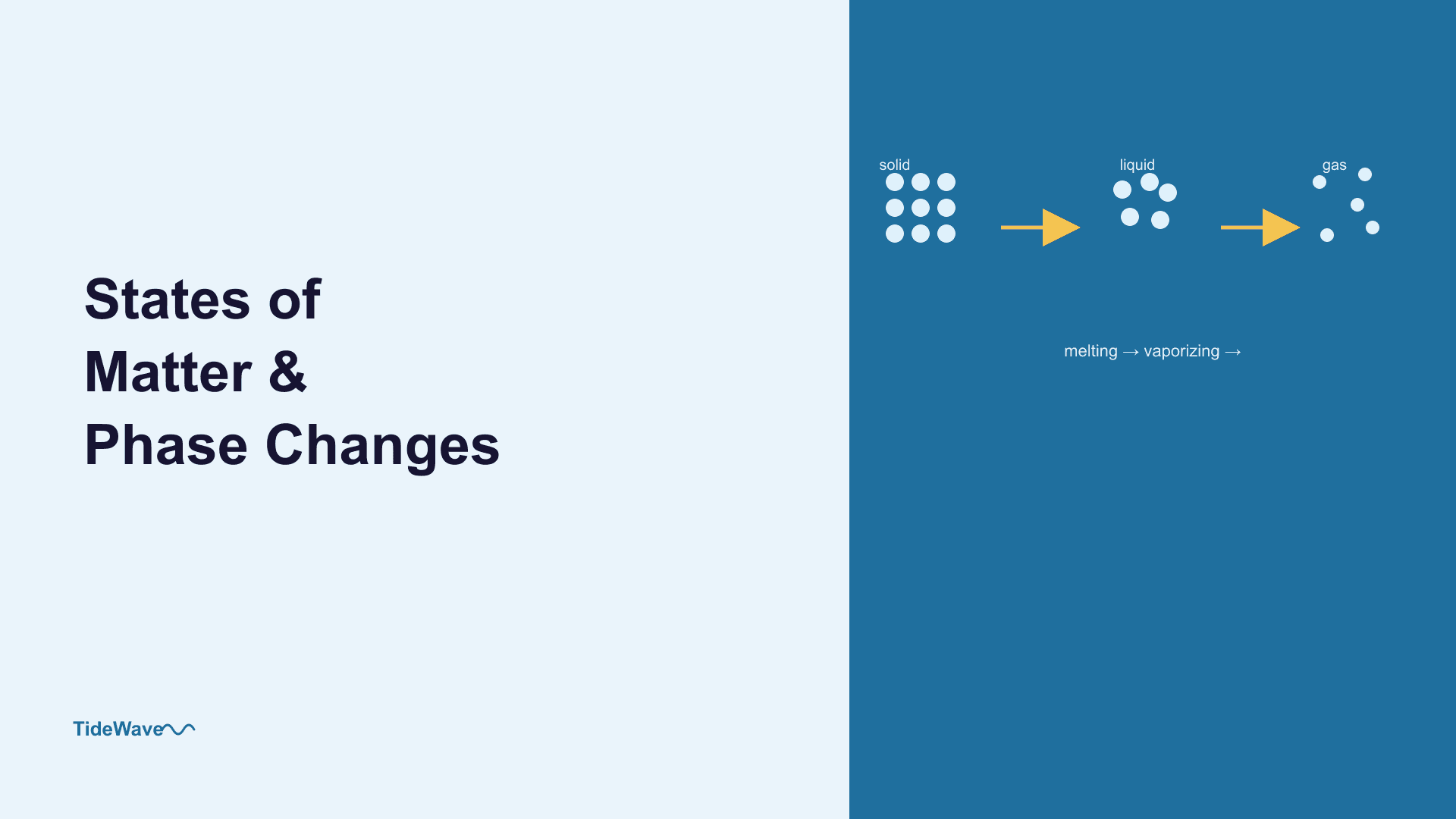
In a solid, particles are packed tightly together in a fixed, ordered arrangement, and the attractive forces between them are strong enough to hold them firmly in place. Particles still vibrate in position, but they don't have enough energy to break free from their neighbors. This is why solids have:
- A fixed shape, independent of their container.
- A fixed volume, since particles can't spread apart.
- High density, generally, because particles are packed closely.
Liquid
In a liquid, particles have enough energy to overcome some of the attractive forces holding them in fixed positions, allowing them to slide past one another while still remaining close together. This gives liquids their defining characteristics:
- No fixed shape, since particles can flow and rearrange, taking the shape of their container.
- A fixed volume, since the particles are still close enough together that they resist being compressed.
- The ability to flow, which is why liquids can be poured.
Gas
In a gas, particles have enough energy to break free from attractive forces almost entirely, moving independently and rapidly in all directions with large distances between them. This produces the properties you'd expect:
- No fixed shape or volume, since gas particles spread out to fill whatever container they're in.
- Low density, since particles are spread far apart.
- Easily compressible, since there's mostly empty space between particles.
Plasma (The Fourth State)
Plasma forms when a gas is given so much additional energy that electrons are stripped from atoms entirely, creating a mix of free-floating ions and electrons. Plasma is actually the most common state of matter in the universe (stars are made of it), even though it's the least commonly discussed in an introductory chemistry class. On Earth, you encounter it in lightning, neon signs, and the aurora borealis.
What's Actually Changing Between States
The key insight that ties all of this together is that a phase change never alters the chemical identity of a substance, only the arrangement and energy of its particles. Ice, liquid water, and water vapor are all still H₂O; no chemical bonds within the water molecule are broken during melting or boiling. What changes is the strength of the intermolecular forces between separate molecules, the attractions holding one molecule near another, not the covalent bonds holding atoms together within a single molecule.
This is a common point of confusion worth being explicit about: melting and boiling are physical changes, not chemical reactions.
The Six Phase Changes
Matter moves between states by absorbing or releasing energy, usually as heat. There are six named transitions:
| Phase Change | From → To | Energy |
|---|---|---|
| Melting | Solid → Liquid | Absorbed |
| Freezing | Liquid → Solid | Released |
| Vaporization (boiling/evaporation) | Liquid → Gas | Absorbed |
| Condensation | Gas → Liquid | Released |
| Sublimation | Solid → Gas | Absorbed |
| Deposition | Gas → Solid | Released |
Notice the pattern: transitions moving toward a more energetic, less ordered state (solid → liquid → gas) always absorb energy, while transitions moving toward a more ordered, lower-energy state always release energy. This is why steam burns feel worse than boiling-water burns at the same temperature: condensing steam back into liquid on your skin releases a large amount of additional energy on top of the heat itself.
Sublimation: The Phase Change That Skips a Step
Sublimation, a solid transitioning directly to a gas without passing through a liquid phase, seems unusual but is common in certain substances. Dry ice (solid carbon dioxide) sublimates at room temperature and pressure rather than melting, which is exactly why it produces a dramatic fog effect without ever leaving a puddle behind.
Why Phase Changes Happen at Specific Temperatures
Every pure substance has a characteristic melting point and boiling point at a given pressure, and these aren't arbitrary; they reflect the strength of the intermolecular forces between that substance's particles.
- Weak intermolecular forces (like in nonpolar molecules) mean particles separate from each other easily, resulting in low melting and boiling points.
- Strong intermolecular forces (like hydrogen bonding in water, or the ionic lattice forces in ionic compounds) require much more energy to overcome, resulting in high melting and boiling points.
This is exactly why water, a small molecule, has a surprisingly high boiling point (100°C) compared to similarly sized nonpolar molecules: its hydrogen bonds are unusually strong for a molecule of its size.
Pressure Matters Too
Boiling point isn't fixed independent of conditions; it depends on surrounding pressure. At high altitude, where atmospheric pressure is lower, water boils at a lower temperature (which is why food takes longer to cook at altitude, since the water never gets as hot before boiling away). This relationship is captured in a phase diagram, a graph showing which state of matter is stable at a given combination of temperature and pressure.
Heating Curves: Why Temperature Plateaus During a Phase Change
If you graph the temperature of a substance as you add heat to it at a constant rate, you'd expect temperature to rise smoothly. Instead, temperature plateaus completely during a phase change, even while heat continues to be added. This happens because, during melting or boiling, all the added energy is being used to break intermolecular forces and change the particles' arrangement, rather than to increase their average kinetic energy (which is what temperature actually measures). Only once the phase change is complete does added heat resume raising the temperature.
FAQ
Water is unusual because its solid form (ice) is less dense than its liquid form. When water freezes, hydrogen bonds lock molecules into a rigid, open hexagonal lattice that actually takes up more space than the same molecules moving freely in liquid water, lowering ice's density enough for it to float.
Evaporation happens at the surface of a liquid at any temperature below its boiling point, as individual high-energy molecules escape into the air. Boiling happens throughout the entire liquid at a specific temperature (the boiling point), where the liquid has enough energy to form vapor bubbles internally, not just at the surface.
Yes, physicists recognize additional exotic states under extreme conditions, most notably Bose-Einstein condensates, which form when certain gases are cooled to temperatures near absolute zero, causing particles to lose their individual identities and behave as a single quantum entity. These aren't typically covered in introductory chemistry but are an active area of physics research.
Sweat cools the skin through evaporation, which is an energy-absorbing phase change. As liquid sweat evaporates from your skin, it draws heat energy from your body to power that transition from liquid to gas, and that lost heat is what produces the cooling sensation.
Most do, but not always at temperatures you'd encounter naturally. Some substances, like carbon dioxide, sublimate directly from solid to gas at normal atmospheric pressure and only exist as a liquid under significantly higher pressure. Other substances, like many complex organic molecules, decompose chemically before they ever reach a melting or boiling point.
Conclusion
The states of matter aren't fundamentally different substances; they're the same particles carrying different amounts of energy, which determines how strongly intermolecular forces can hold them together. Every phase change, melting, freezing, boiling, condensing, sublimating, or depositing, is simply energy being added or removed to shift that balance, without altering the underlying chemical identity of the substance at all. Once you see it this way, oddities like why ice floats or why steam burns are worse than boiling water stop being isolated facts to memorize and become natural consequences of the same underlying principle.
Here are some useful references if you want to go deeper:
- Khan Academy – States of Matter — free lessons covering intermolecular forces and phase changes in detail.
- LibreTexts Chemistry – Phase Diagrams — an open textbook resource with in-depth coverage of phase diagrams and heating curves.
- NASA – The Fourth State of Matter — an accessible explanation of plasma and where it occurs in nature.