How Batteries Work: A Chemistry Perspective
A battery doesn't actually store electricity the way a water tank stores water. What it stores is a chemical reaction waiting to happen, one that's been deliberately split into two separate halves, so the only way electrons can travel from one half to the other is through an external circuit, powering whatever device is connected along the way. Understanding this reframes a battery from a mysterious black box into a direct, practical application of redox chemistry.
The Core Chemistry: A Galvanic Cell in a Package
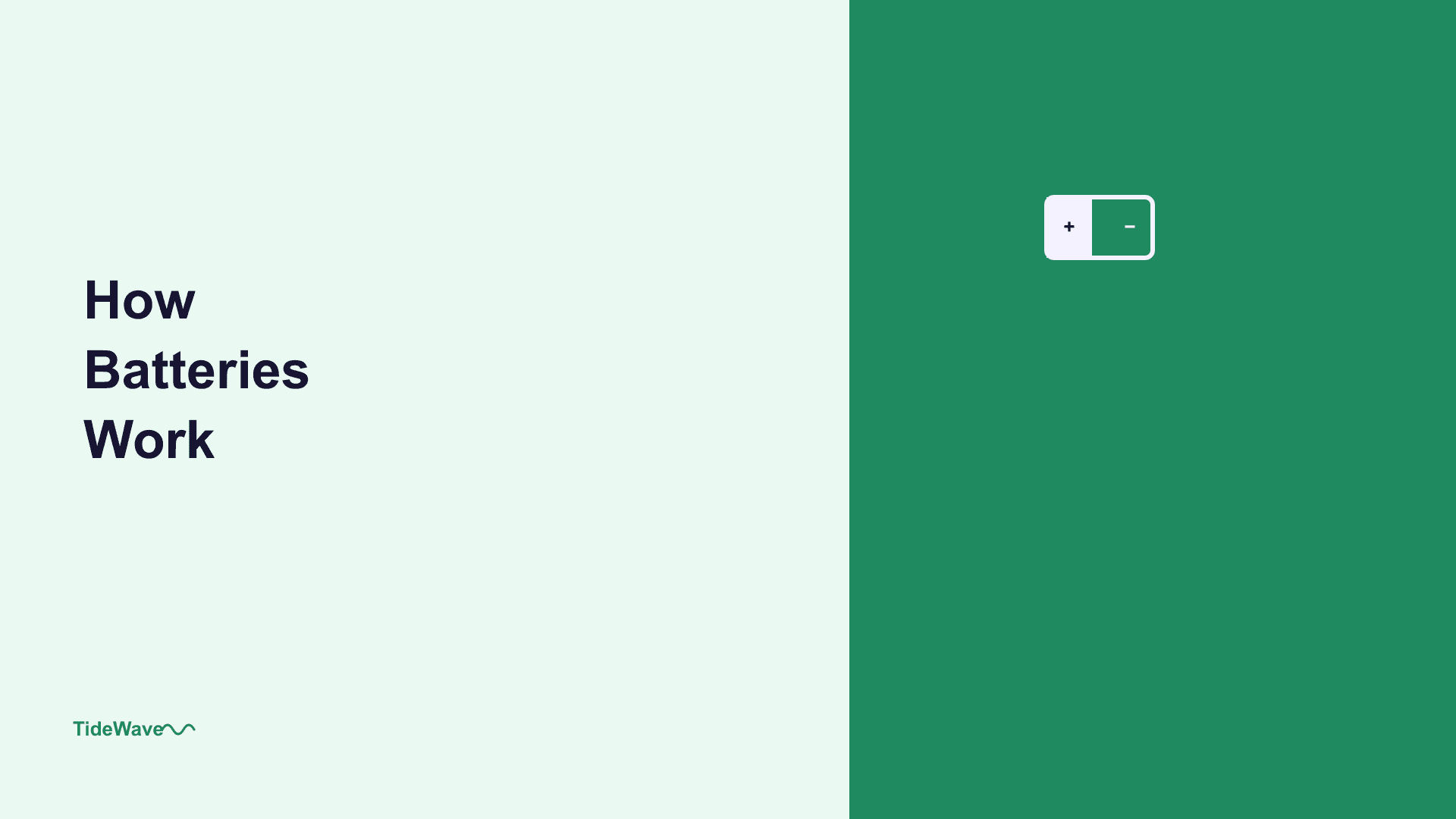
Every battery is fundamentally a galvanic cell: a spontaneous oxidation-reduction reaction engineered so that oxidation happens at one electrode (the anode) and reduction happens at a physically separate electrode (the cathode), forcing the electrons released by oxidation to travel through an external wire to reach the reduction site, rather than transferring directly on contact.
- At the anode, a material is oxidized, releasing electrons into the external circuit.
- At the cathode, a different material is reduced, accepting those electrons after they've traveled through the circuit (and through whatever device the battery is powering).
- An internal electrolyte allows ions (not electrons) to move between the two electrodes, keeping the overall charge balanced as the reaction proceeds.
Primary Batteries: Disposable, One-Way Chemistry
Primary batteries are designed to be used once and discarded, because their internal redox reaction isn't practically reversible. The classic alkaline battery (the standard AA or AAA battery) is the most common example:
Anode (oxidation):    Zn → Zn²⁺ + 2e⁻
Cathode (reduction):  2MnO₂ + H₂O + 2e⁻ → Mn₂O₃ + 2OH⁻
Zinc metal is oxidized at the anode, and manganese dioxide is reduced at the cathode, with the reaction continuing until one of the reactants is significantly depleted, at which point the battery can no longer sustain a useful voltage and is considered "dead." Because reversing this specific reaction efficiently isn't practical with common materials, alkaline batteries aren't designed to be recharged.
Secondary (Rechargeable) Batteries
Secondary batteries are built around a redox reaction that can be run in reverse using an external electrical current, essentially converting the battery temporarily into an electrolytic cell during charging.
- Discharging (using the battery): the spontaneous redox reaction runs forward, generating current, exactly like a primary battery.
- Charging: an external power source forces electrons to flow backward through the cell, driving the non-spontaneous reverse reaction and regenerating the original reactants.
Lithium-Ion Batteries
The lithium-ion battery, used in phones, laptops, and electric vehicles, is built around lithium ions (Li⁺) shuttling back and forth between two electrode materials, rather than the electrode materials themselves being consumed and regenerated as in older rechargeable designs:
Discharging: Li⁺ ions move from the anode (typically graphite) to the cathode (a lithium metal oxide)
Charging:    Li⁺ ions move back from the cathode to the anode
This "rocking chair" style of operation, where lithium ions simply migrate between two stable host structures rather than undergoing a fundamentally destructive chemical change each cycle, is exactly why lithium-ion batteries can typically sustain many hundreds of charge/discharge cycles before their performance meaningfully degrades.
Why Batteries Eventually Wear Out
Even a well-designed rechargeable battery degrades over time, for a few specific chemical reasons:
- Side reactions: small amounts of unwanted, irreversible chemical reactions occur alongside the main desired reaction with every charge cycle, gradually consuming usable material.
- Physical degradation: repeated expansion and contraction of electrode materials during charging and discharging can cause microscopic cracking, reducing the electrode's effective surface area over time.
- Electrolyte breakdown: the electrolyte itself can slowly decompose, particularly under high temperatures or excessive charging voltages, degrading the battery's ability to conduct ions efficiently.
This is why manufacturers specify a battery's expected cycle life, and why keeping a lithium-ion battery at extreme temperatures or constantly charged to 100% tends to accelerate this gradual chemical wear.
Cell Voltage: Why Some Batteries Are 1.5V and Others Are 3.7V
A battery's voltage is determined by the specific pair of redox reactions built into it, not by its physical size. Each half-reaction has an inherent tendency to gain or lose electrons, quantified by its standard reduction potential, and the overall cell voltage is the difference between the cathode's and anode's reduction potentials. This is exactly why an alkaline battery is 1.5V while a lithium-ion cell is closer to 3.7V: they're built from entirely different chemical half-reactions with different inherent electron-transfer tendencies, not simply "stronger" or "weaker" versions of the same reaction.
FAQ
Alkaline batteries rely on a redox reaction that produces some genuinely irreversible byproducts and physical changes at the electrodes, particularly gas buildup, that a reasonable, safe amount of reverse current can't cleanly undo. Forcing current through a standard alkaline battery can cause it to leak, overheat, or rupture rather than actually recharge.
Lithium ions leave the anode material's structure and insert themselves into the cathode material's structure, a process called intercalation, without either electrode material fundamentally decomposing. This is different from older battery chemistries like lead-acid, where the electrode materials themselves undergo a genuine chemical transformation with each cycle.
Low temperatures slow the rate of the internal chemical reactions and reduce ion mobility through the electrolyte, temporarily reducing how much current the battery can deliver, even though the battery's total stored chemical energy hasn't actually changed. This is why a car battery can struggle to start an engine on a cold morning even when it isn't actually depleted.
For most modern lithium-ion batteries, yes, to some degree; repeatedly discharging fully to 0% (called deep discharging) tends to stress the electrode materials more than staying within a moderate charge range, contributing to faster long-term capacity loss, which is why many devices are designed to avoid ever showing a literal 0% until the cell has already stopped just short of a truly empty state.
The electrolyte's job is to allow ions to move between electrodes while blocking electron flow internally (electrons must travel through the external circuit instead). Liquid electrolytes generally allow faster ion movement, while solid or gel electrolytes, used in some newer battery designs, offer improved safety and physical stability at some cost to ion conductivity, an active area of ongoing battery research.
Conclusion
A battery is best understood not as a container of stored electricity, but as a carefully engineered, self-contained redox reaction, split into two halves specifically so its electron transfer has to pass through an external circuit to happen at all. Primary batteries run that reaction once, in one direction only; secondary batteries are built around a reaction that can be pushed backward with an external current, recharging the cell for another cycle. From a AA battery to a smartphone's lithium-ion pack, the same fundamental principle, oxidation at one electrode, reduction at the other, is doing all the actual work.
Here are some useful references if you want to go deeper:
- U.S. Department of Energy – How Batteries Work — an accessible overview of battery chemistry and types.
- Khan Academy – Galvanic Cells — free lessons connecting galvanic cell theory to real battery design.
- Chemguide – Electrode Potentials — a detailed explanation of standard reduction potentials and cell voltage.