Significant Figures: Precision and Accuracy in Chemistry
If a kitchen scale measures a sample as 12.3 grams, writing the result as "12.300 grams" afterward would be dishonest, not because the arithmetic is wrong, but because it implies a level of precision the scale never actually provided. Significant figures are the rules chemists use to make sure every reported number, and every number calculated from it, accurately reflects how precisely it was actually measured, no more and no less.
What Counts as a Significant Figure
A significant figure is any digit in a measurement that contributes meaningful precision, including all certain digits plus one final estimated digit. The rules for identifying which digits count are:
- All non-zero digits are significant. 247 has three significant figures.
- Zeros between non-zero digits are significant. 405 has three significant figures.
- Leading zeros are never significant. 0.0025 has only two significant figures (2 and 5); the leading zeros just place the decimal point.
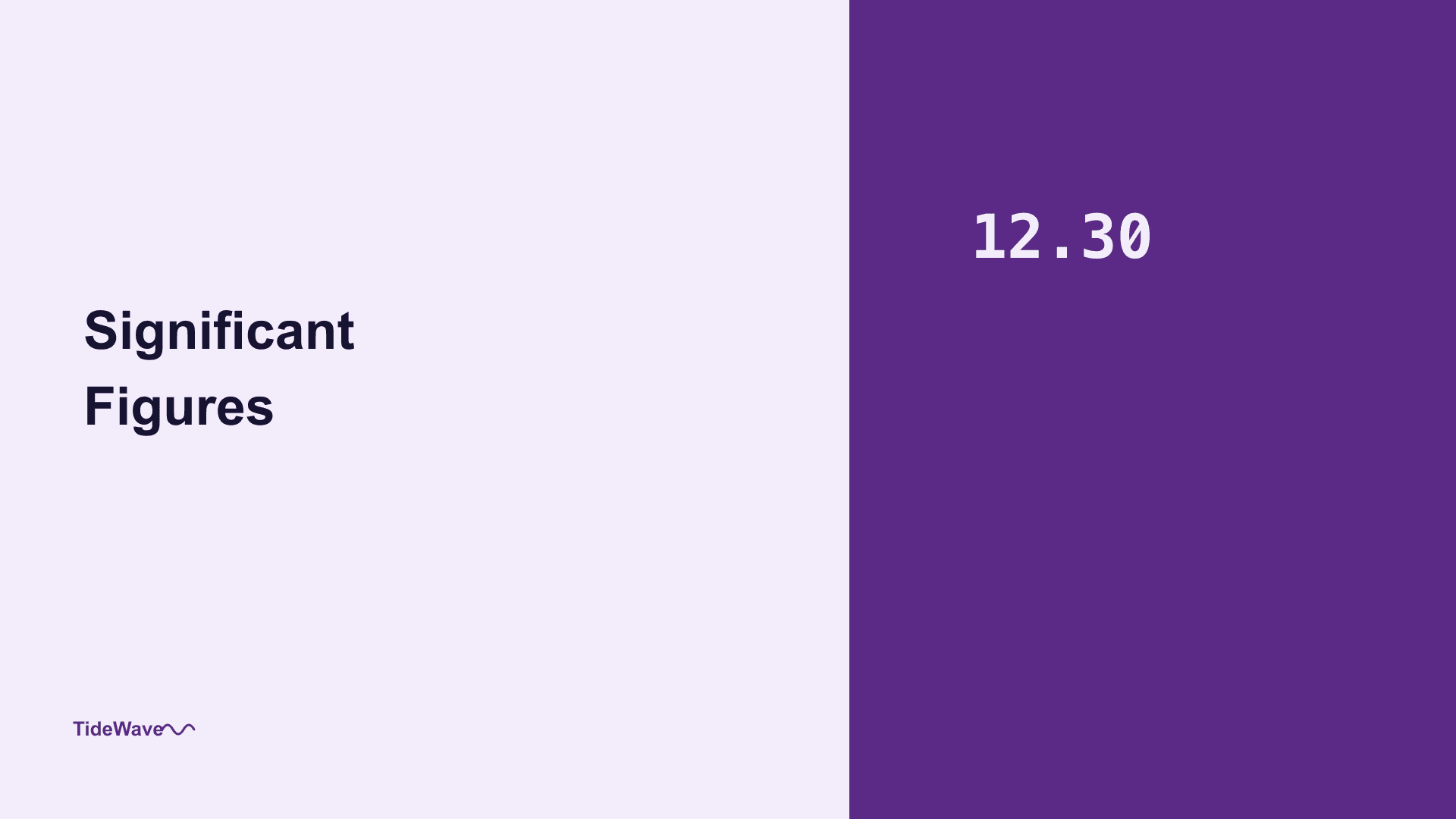
- Trailing zeros after a decimal point are significant. 12.300 has five significant figures, since those trailing zeros indicate the measurement was precise enough to confirm they're actually zero, not just unknown digits.
- Trailing zeros in a whole number without a decimal point are ambiguous. 1,200 could have two, three, or four significant figures depending on how precisely it was actually measured; scientific notation removes this ambiguity entirely.
Using Scientific Notation to Remove Ambiguity
Writing a number in scientific notation makes its significant figures unambiguous, since every digit shown in the coefficient is understood to be significant:
1,200        → ambiguous (2, 3, or 4 sig figs?)
1.2 × 10³    → clearly 2 significant figures
1.200 × 10³  → clearly 4 significant figures
This is exactly why scientific measurements are so often reported in scientific notation rather than plain decimal form.
Rounding to the Correct Number of Significant Figures
To round a number to a specific number of significant figures, count that many digits from the first non-zero digit, then round the final digit based on the digit immediately after it (5 or higher rounds up, below 5 rounds down).
Example: Round 0.048257 to three significant figures.
The first non-zero digit is 4, so the three significant figures are 4, 8, and 2. The next digit is 5, so the last digit rounds up:
0.048257 → 0.0483 (three significant figures)
Significant Figures in Calculations
The real value of significant figures shows up when combining multiple measurements in a calculation, since a calculated result can never be more precise than the least precise measurement that went into it. The rule depends on the type of operation.
Multiplication and Division: Match the Fewest Significant Figures
When multiplying or dividing, the result should have the same number of significant figures as the measurement with the fewest significant figures used in the calculation.
Worked example: Calculate the density of an object with a mass of 24.6 g and a volume of 8.3 cm³.
Density = mass ÷ volume
Density = 24.6 g ÷ 8.3 cm³ = 2.9638... g/cm³
24.6 g has three significant figures; 8.3 cm³ has only two. The answer must be rounded to match the fewer of the two:
Density = 3.0 g/cm³ (two significant figures)
Addition and Subtraction: Match the Fewest Decimal Places
When adding or subtracting, the rule is different: the result should have the same number of decimal places as the measurement with the fewest decimal places, not the fewest total significant figures.
Worked example: Add 12.11 g, 18.0 g, and 1.013 g.
12.11
18.0
+1.013
------
31.123
18.0 has only one decimal place, the fewest of the three values, so the final answer must be rounded to one decimal place:
Total = 31.1 g
Precision vs. Accuracy: Two Different Things
Significant figures relate closely to precision (how consistent and finely-detailed a set of measurements are), but precision is not the same thing as accuracy (how close a measurement is to the true, correct value). A poorly calibrated scale can produce highly precise measurements, several repeated readings agreeing closely with each other, while still being consistently and significantly wrong. Significant figures communicate the precision of a single measurement or instrument; they say nothing about whether that instrument is properly calibrated in the first place.
Why This Actually Matters
Significant figures aren't pedantry for its own sake; they exist to prevent a specific, real problem: overstating how much you actually know. In stoichiometry calculations, a final answer reported with too many significant figures implies a precision the original measurements never supported, which can mislead anyone relying on that result, whether it's a student's lab report, a pharmaceutical dosage calculation, or an engineering specification.
FAQ
No, exact numbers (counted quantities, or defined conversion factors like 100 cm in exactly 1 meter) are considered to have infinite significant figures and never limit the precision of a calculation. Only measured quantities, values that came from an instrument with inherent limitations, are restricted by significant figure rules.
A trailing zero after a decimal point (like the zeros in 12.300) can only appear if the measuring instrument was precise enough to confirm those digits are genuinely zero, not just unknown. A trailing zero in a plain whole number (like 1,200) is ambiguous because it might just be a placeholder marking the number's magnitude, without confirming precision to that digit.
Generally no. Rounding intermediate results introduces small rounding errors that compound with each additional step, so it's standard practice to carry extra digits through intermediate calculations and only round the truly final answer to the correct number of significant figures.
Physical constants used in calculations, like Avogadro's number (6.022 × 10²³) or the ideal gas constant, are typically given to a specific number of significant figures matching or exceeding the precision of the measurement they're being used with, and shouldn't be treated as the limiting factor in a calculation unless they genuinely have fewer significant figures than your actual measured data.
Yes, this is exactly the distinction between precision and accuracy. A malfunctioning or improperly calibrated instrument can produce very consistent, highly precise readings that are all incorrect by roughly the same systematic amount, which is why regular calibration against a known standard matters just as much as reading an instrument carefully.
Conclusion
Significant figures exist to keep a number's reported precision honest, matched to how precisely it was actually measured, not inflated by however many decimal places a calculator happens to display. The multiplication/division rule (match the fewest significant figures) and the addition/subtraction rule (match the fewest decimal places) cover the overwhelming majority of real calculations you'll encounter, and applying them consistently is what separates a scientifically rigorous result from one that merely looks precise.
Here are some useful references if you want to go deeper:
- Khan Academy – Significant Figures — free lessons with practice problems on identifying and applying significant figures.
- NIST – Guide to the Expression of Uncertainty in Measurement — the official U.S. standards reference for measurement precision and uncertainty.
- Chemguide – Significant Figures — practical examples applying significant figures to real chemistry calculations.