Surface Chemistry and Adsorption Explained
Water poured into a sponge disappears throughout the sponge's entire volume, soaked up and distributed evenly inside it. Odor molecules trapped by an activated charcoal filter behave completely differently: they stick to the surface of the charcoal particles and stay there, never actually penetrating inside. These are two distinct physical processes, absorption and adsorption, and mixing them up is one of the most common small mistakes in introductory chemistry, despite the concepts being genuinely different in an important way.
Adsorption vs. Absorption: Not the Same Word
The distinction comes down to a single letter, but it describes a real physical difference:
- Absorption is when one substance is taken up into the bulk volume of another, the way a sponge absorbs water throughout its structure, or the way a paper towel absorbs a spill.
- Adsorption is when particles (atoms, ions, or molecules) accumulate and adhere onto the surface of a material, without penetrating inside it at all.
A helpful way to remember the difference: absorption pulls a substance in, while adsorption sticks a substance on. Surface chemistry is specifically the study of phenomena happening at that outer boundary, the interface between a solid (or liquid) and whatever surrounds it, which makes adsorption one of its central topics.
Why Surfaces Behave Differently From the Bulk Material
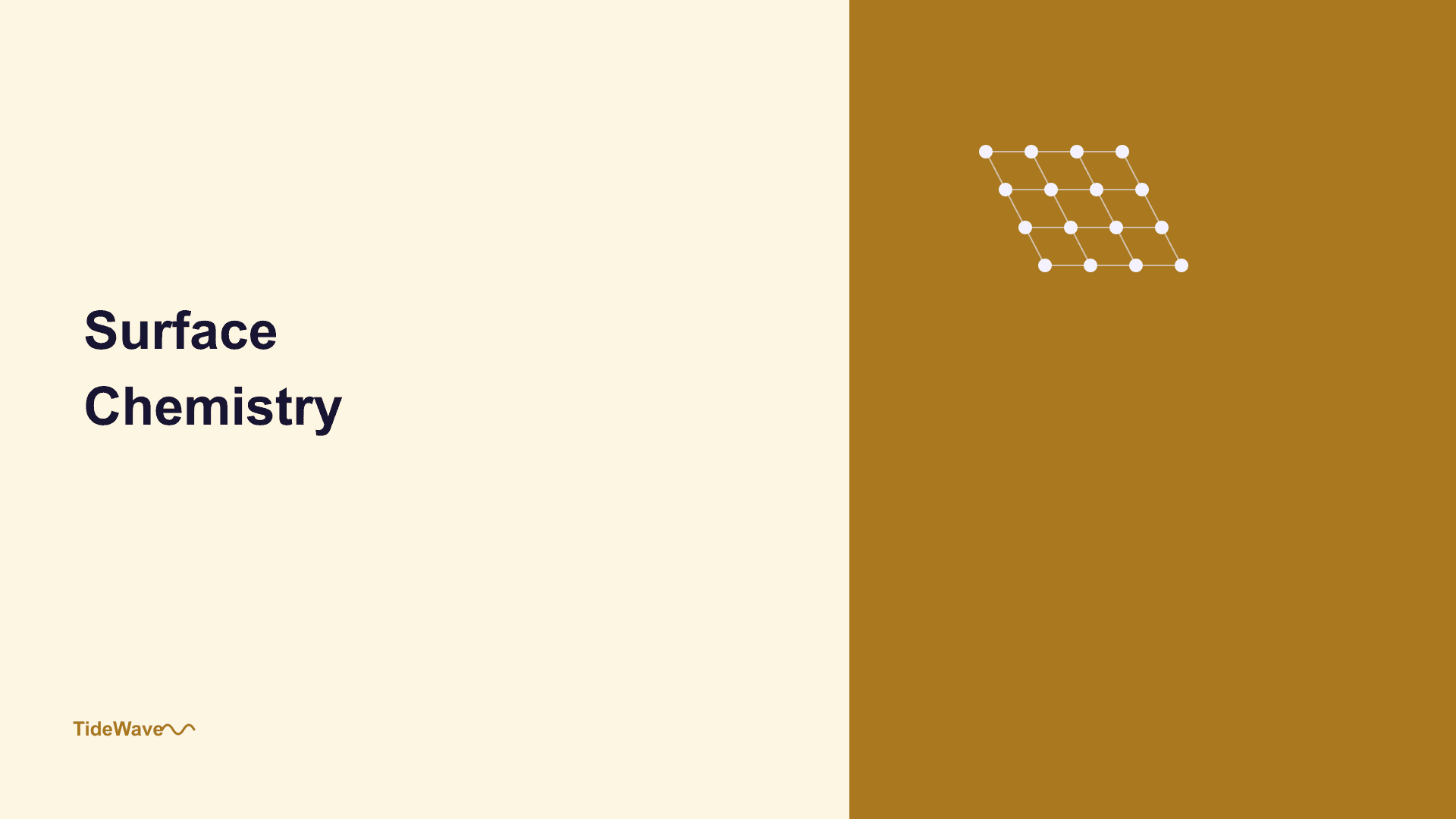
Atoms sitting on the surface of a solid are in a fundamentally different environment than atoms buried deep inside it. An atom in the interior of a crystal is surrounded on all sides by neighboring atoms, with its bonding needs fully satisfied. An atom sitting at the surface is missing neighbors on the side facing outward, leaving it with unsatisfied bonding capacity, sometimes described as "dangling bonds." This unsatisfied capacity is exactly what allows surface atoms to attract and hold onto other atoms or molecules passing nearby, which is the physical basis of adsorption.
Physisorption vs. Chemisorption
Adsorption itself comes in two distinct types, differing in how strongly the adsorbed particle is held:
- Physisorption (physical adsorption) involves weak intermolecular forces, similar to the van der Waals forces holding molecules together in a liquid. It's relatively weak, reversible, and doesn't involve forming new chemical bonds, meaning the adsorbed substance can often be removed again with only a modest change in temperature or pressure.
- Chemisorption (chemical adsorption) involves the formation of genuine chemical bonds between the adsorbed particle and the surface. It's much stronger and typically far less reversible, since actual bonds must be broken to release the adsorbed particle again.
This distinction matters enormously in industrial catalysis: a catalyst surface needs to adsorb reactant molecules strongly enough to hold them in place and weaken their existing bonds (favoring chemisorption), but not so strongly that the products can never release from the surface afterward, which would permanently deactivate the catalyst.
Activated Charcoal: Adsorption in Action
Activated charcoal is one of the clearest everyday demonstrations of adsorption. It's manufactured specifically to have an enormous internal surface area, produced by processing carbon at high temperature to create an extremely porous structure riddled with tiny channels and cavities. A single gram of activated charcoal can have a surface area of over 1,000 square meters, an almost unbelievable amount of surface packed into a tiny mass.
That massive surface area is exactly why activated charcoal is so effective at removing odors, toxins, and impurities from air and water: it isn't dissolving or chemically neutralizing these substances, it's physically adsorbing them onto its vast internal surface as air or water passes through, trapping molecules that would otherwise pass straight through a material with less surface area.
Adsorption and Industrial Catalysis
Many of the most important industrial chemical processes rely on a solid catalyst adsorbing gas-phase reactants onto its surface, a category called heterogeneous catalysis (since the catalyst and reactants are in different physical phases). The general sequence looks like this:
1. Reactant molecules diffuse to the catalyst surface
2. Reactant molecules adsorb onto the surface (often via chemisorption)
3. Adsorption weakens existing bonds within the reactant, lowering the activation energy needed to react
4. The reaction occurs on the surface
5. Product molecules desorb (release) from the surface
This is exactly how the iron catalyst in industrial ammonia production, and the platinum-based catalysts in a car's catalytic converter, actually function: not by being consumed in the reaction, but by repeatedly adsorbing reactants, facilitating a reaction, and releasing products, cycle after cycle.
FAQ
Adsorption happens specifically at the outer surface, not throughout the material's bulk volume, so the total amount adsorbed is directly limited by how much surface area is actually available. Materials like activated charcoal are deliberately engineered with a highly porous structure specifically to maximize surface area within a small physical volume, dramatically increasing their adsorption capacity.
Yes, especially in the case of physisorption, which is a relatively weak, reversible process. Raising the temperature or lowering the pressure around an adsorbed substance can supply enough energy to overcome the weak attractive forces holding it to the surface, releasing it back into the surrounding gas or liquid, a principle used in some industrial gas separation and purification processes.
Adsorption can occur at liquid surfaces too, not only solid ones. Surfactants (like soap molecules) adsorb specifically at the interface between water and air, or between water and oil, which is central to how they reduce surface tension and stabilize the mixture in the first place.
Catalytic converters can become less effective when their active surface gets physically coated or "poisoned" by substances that adsorb very strongly (often through chemisorption) and don't desorb again, permanently blocking active sites on the surface from further use. This is why fuel quality and additives matter for a catalytic converter's long-term performance.
Generally yes for physisorption, since it's a weakly bound, reversible process that's disfavored at higher temperatures where molecules have more kinetic energy to escape the surface. Chemisorption is more complex: since it often requires overcoming an initial activation energy to form a chemical bond, a moderate temperature increase can sometimes increase the rate of chemisorption even while the ultimate bond, once formed, remains strong and doesn't easily reverse.
Conclusion
Adsorption, particles sticking to a surface rather than dissolving into a material's bulk, might sound like a narrow, technical distinction, but it's the mechanism behind an enormous range of practical chemistry: activated charcoal filtration, industrial catalysis, gas storage, and much more. The key insight worth carrying forward is that surfaces behave differently from bulk material precisely because surface atoms have unsatisfied bonding capacity, and engineering materials to maximize usable surface area (as with activated charcoal's porous structure) is one of the most direct, practical ways chemists put that difference to work.
Here are some useful references if you want to go deeper:
- Khan Academy – Surface Chemistry and Catalysis — free lessons connecting adsorption to reaction rates and catalysis.
- Chemguide – Adsorption and Catalysts — a clear explanation of how adsorption enables heterogeneous catalysis.
- IUPAC Gold Book – Adsorption — the official chemistry terminology reference defining adsorption and related surface chemistry terms.