Intermolecular Forces: Van der Waals, Dipole-Dipole, and Hydrogen Bonding
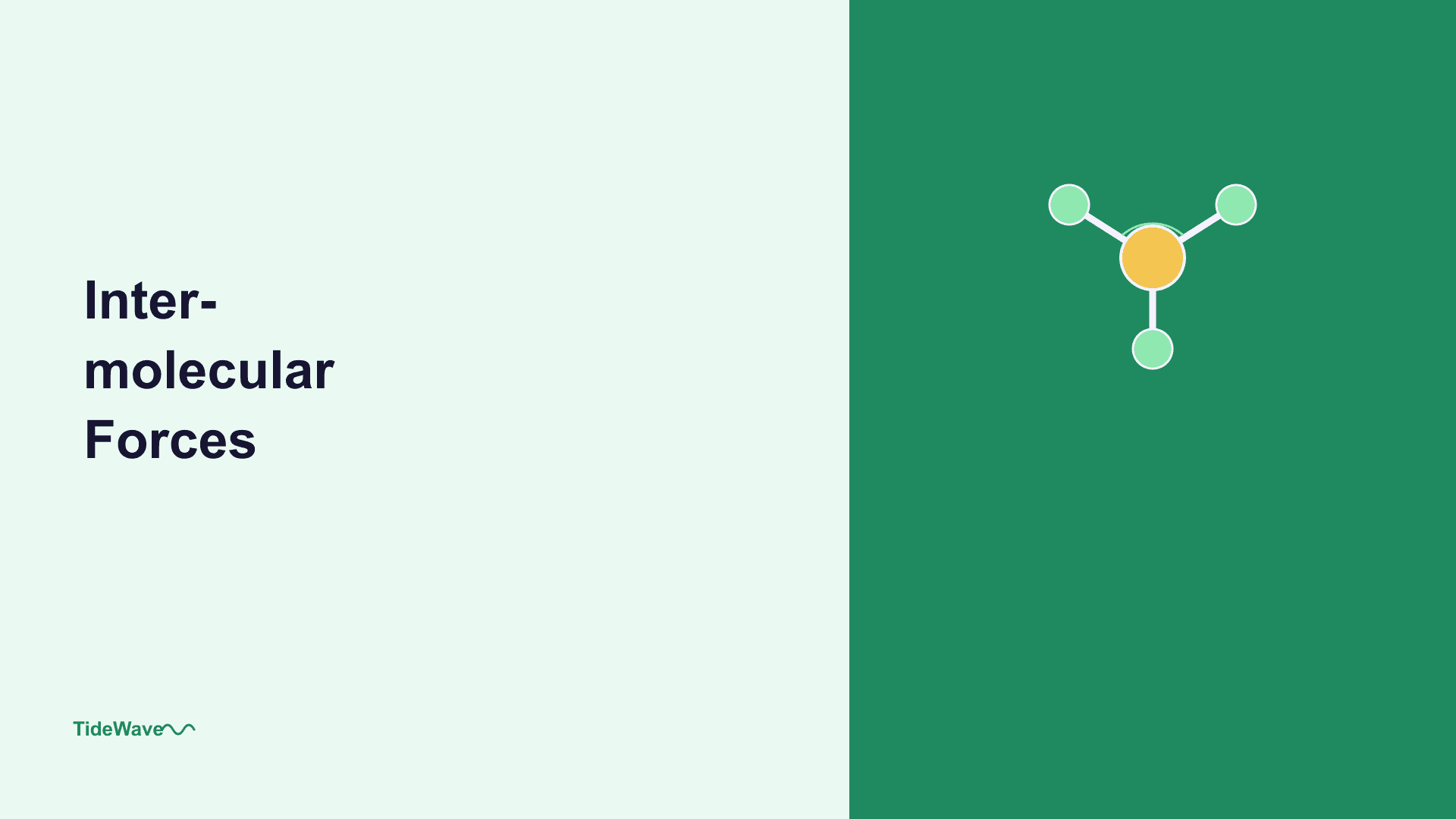
The covalent bonds within a molecule are strong, but the forces holding separate molecules near each other are a completely different, much weaker category, and they're the real reason substances have the melting points, boiling points, and physical states they do. These are called intermolecular forces, and understanding them explains why water is a liquid at room temperature while methane, a similarly small molecule, is a gas, and why states of matter change at the specific temperatures they do.
Intramolecular vs. Intermolecular: A Crucial Distinction
It's easy to confuse these two terms, so it's worth being precise from the start:
- Intramolecular forces are the covalent or ionic bonds holding atoms together within a single molecule. These are strong (hundreds of kJ/mol) and must be broken to trigger a chemical reaction.
- Intermolecular forces are the much weaker attractions between separate, neighboring molecules (typically only a few to a few dozen kJ/mol). These are what get broken during melting and boiling, physical changes, not chemical reactions.
When water boils, no O-H bonds are broken; the water molecules themselves remain completely intact. What breaks is the web of intermolecular attractions holding separate water molecules close together in the liquid.
The Three Main Types of Intermolecular Force
1. London Dispersion Forces (Van der Waals Forces)
London dispersion forces exist between all molecules, polar or nonpolar, making them the only intermolecular force present in purely nonpolar substances. They arise from momentary, random fluctuations in electron distribution: at any given instant, electrons might be unevenly distributed around a molecule, creating a brief, temporary dipole that induces a matching temporary dipole in a neighboring molecule, producing a weak, fleeting attraction.
Dispersion forces get stronger as molecular size and mass increase, since larger molecules have more electrons that can be more easily and more significantly displaced. This is why, moving down a group of nonpolar molecules like the noble gases, boiling points steadily rise: helium boils at -269°C, while much larger xenon boils at -108°C, despite both being nonpolar with no other type of intermolecular force available to them.
2. Dipole-Dipole Forces
Dipole-dipole forces occur between polar molecules, where the partial positive end of one molecule is attracted to the partial negative end of a neighboring molecule. Because this attraction is consistent and directional, rather than random and momentary, dipole-dipole forces are generally stronger than dispersion forces between molecules of similar size.
Example: Hydrogen chloride (HCl) is polar, with a partial positive charge on hydrogen and a partial negative charge on chlorine. Neighboring HCl molecules orient themselves so the positive end of one aligns near the negative end of another, producing an attraction stronger than dispersion forces alone would provide for a molecule of similar size.
3. Hydrogen Bonding: A Special, Unusually Strong Case
Hydrogen bonding is a particularly strong type of dipole-dipole attraction that occurs specifically when hydrogen is bonded directly to one of three highly electronegative, small atoms: nitrogen, oxygen, or fluorine. Because these atoms are so electronegative and so small, the resulting bond dipole is unusually intense, and the small size of hydrogen lets molecules pack closely enough for this attraction to be exceptionally strong compared to typical dipole-dipole forces, though still much weaker than an actual covalent bond.
Example: Water's remarkably high boiling point (100°C) compared to hydrogen sulfide (H₂S, boiling at -60°C), despite oxygen and sulfur being in the same periodic group, is a direct result of hydrogen bonding. Oxygen is far more electronegative and much smaller than sulfur, so water molecules form extensive networks of hydrogen bonds that hydrogen sulfide simply cannot replicate.
Hydrogen bonding also explains several of water's famously unusual properties, including why ice is less dense than liquid water (hydrogen bonds lock molecules into a spacious, open lattice when frozen) and why water has such high surface tension.
Ranking the Forces by Strength
For molecules of comparable size, the general strength ranking is:
Hydrogen bonding > Dipole-dipole forces > London dispersion forces
But size matters enormously too: a very large nonpolar molecule can have stronger dispersion forces than a very small polar molecule has dipole-dipole forces. This is why iodine (I₂, nonpolar) is a solid at room temperature, while much smaller polar molecules can be liquids or gases; dispersion forces scale up dramatically with molecular size and electron count.
How Intermolecular Forces Predict Physical Properties
| Property | Effect of Stronger Intermolecular Forces |
|---|---|
| Boiling point | Higher (more energy needed to separate molecules into gas) |
| Melting point | Higher (more energy needed to disrupt the solid arrangement) |
| Viscosity | Higher (molecules resist flowing past each other) |
| Surface tension | Higher (surface molecules are pulled inward more strongly) |
| Vapor pressure | Lower (molecules escape into gas phase less readily) |
FAQ
No, they're categorically different, not just a weaker version of the same thing. Intramolecular bonds (covalent or ionic) involve actual electron sharing or transfer between atoms; intermolecular forces are electrostatic attractions between already-complete molecules, with no electrons being shared or transferred between them.
Dispersion forces, while individually weak, are still real attractive forces, and they scale up with molecular size. Oils are typically large molecules with many electrons, so their cumulative dispersion forces are substantial enough to keep them liquid at room temperature, even without any dipole-dipole or hydrogen bonding present.
Yes, and this is actually the normal case rather than an exception. A polar molecule capable of hydrogen bonding, like water, also experiences dipole-dipole attractions and London dispersion forces simultaneously; hydrogen bonding is simply the dominant, strongest contributor among the three for that particular molecule.
It specifically requires N, O, or F, not just any electronegative atom. This is because true hydrogen bonding depends on the exceptional combination of high electronegativity and very small atomic size found only in these three elements; chlorine, for example, is fairly electronegative but too large for the effect to be nearly as strong.
The "like dissolves like" principle is really a statement about intermolecular forces: a solute dissolves well in a solvent when the solute's own intermolecular forces are similar in type and strength to the forces it would form with the solvent, allowing new solute-solvent attractions to effectively replace the solute-solute and solvent-solvent attractions being broken.
Conclusion
Intermolecular forces are the quiet, often overlooked reason substances behave the way they do physically, distinct from the covalent and ionic bonds that determine their chemical identity. London dispersion forces exist everywhere but scale with size, dipole-dipole forces add extra attraction between polar molecules, and hydrogen bonding provides an unusually strong boost wherever hydrogen bonds directly to nitrogen, oxygen, or fluorine. Once you can identify which of these forces dominate in a given substance, predicting its relative boiling point, viscosity, and solubility becomes a matter of comparing forces rather than memorizing isolated facts.
Here are some useful references if you want to go deeper:
- Khan Academy – Intermolecular Forces — free lessons covering all three force types with comparative examples.
- Chemguide – Intermolecular Bonding — detailed explanations of van der Waals forces and hydrogen bonding.
- LibreTexts Chemistry – Intermolecular Forces — an open textbook resource connecting these forces to physical properties.