Coordination Compounds and Complex Ions Explained
Hemoglobin, chlorophyll, and the vivid blue color of dissolved copper sulfate all share a common structural theme: a central metal ion surrounded by a cluster of attached molecules or ions, arranged in a specific geometric pattern. This kind of structure is called a coordination compound (or complex ion, when the overall structure carries a charge), and it's central to both transition metal chemistry and much of biological chemistry.
The Basic Structure
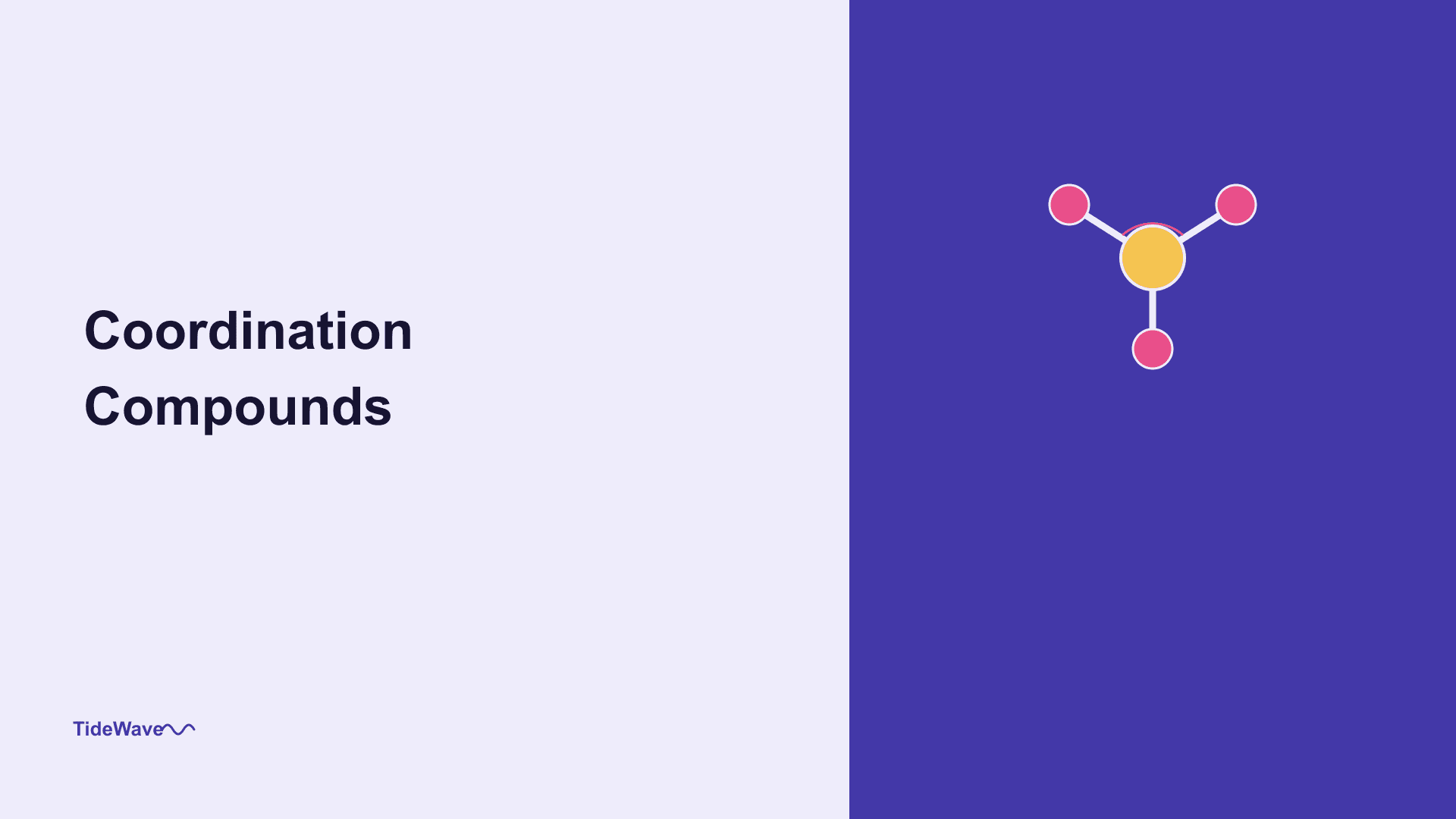
Every coordination compound is built from two components:
- A central metal atom or ion, almost always a transition metal, since their partially filled d-orbitals make them especially good at forming these structures.
- One or more ligands, molecules or ions that attach directly to the central metal through a specific type of bond.
Example: In the complex ion [Cu(NH₃)₄]²⁺, a copper(II) ion sits at the center, surrounded by four ammonia (NH₃) molecules acting as ligands.
The Coordinate Covalent Bond
The bond connecting a ligand to the central metal is called a coordinate covalent bond (or dative bond), a special case of a covalent bond where both shared electrons come from the same atom, the ligand, rather than one electron from each partner as in an ordinary covalent bond. This is possible because ligands have at least one lone pair of electrons available to donate, while the central metal ion has empty orbitals available to accept them.
Ligands: What Can Attach to a Metal Center
A ligand is defined by having at least one lone pair of electrons it can donate to the central metal. Common examples include:
- Water (H₂O): donates through its oxygen lone pair.
- Ammonia (NH₃): donates through its nitrogen lone pair.
- Chloride (Cl⁻): donates through one of its lone pairs.
- Cyanide (CN⁻): donates through carbon.
- Ethylenediamine (en): an organic molecule with two nitrogen atoms, each capable of donating a lone pair.
Ligands are classified by how many bonds they form to a single metal center:
- Monodentate ligands (like water or ammonia) form exactly one bond to the metal.
- Bidentate ligands (like ethylenediamine) form two bonds to the same metal, effectively "clamping" onto it from two points.
- Polydentate ligands form three or more bonds; EDTA, a well-known example, can form up to six bonds to a single metal ion simultaneously, making it extremely effective at binding metals tightly.
Ligands capable of forming more than one bond to the same metal are collectively called chelating agents, from the Greek word for "claw," a fitting description of how they wrap around the central ion.
Coordination Number: How Many Ligands Fit
The coordination number is the total number of bonds formed between the central metal and its surrounding ligands (not the number of separate ligand molecules, since a bidentate ligand contributes two bonds by itself). Common coordination numbers and their associated shapes:
| Coordination Number | Common Geometry |
|---|---|
| 2 | Linear |
| 4 | Tetrahedral or square planar |
| 6 | Octahedral |
A coordination number of 6, arranged octahedrally, is especially common among transition metal complexes, with six ligand attachment points arranged symmetrically around the central metal.
Naming Coordination Compounds
Coordination compounds follow a specific naming pattern, distinct from the simpler rules used for ordinary ionic or organic compounds:
- Name the ligands first, in alphabetical order, using specific ligand names (ammonia becomes "ammine," water becomes "aqua," chloride becomes "chloro").
- Use a prefix to indicate how many of each ligand are present (di-, tri-, tetra-, and so on).
- Name the metal, with its oxidation state shown in Roman numerals in parentheses immediately afterward.
- If the overall complex is an anion (negatively charged), the metal's name takes the suffix "-ate."
Example: [Cu(NH₃)₄]²⁺ is named tetraamminecopper(II), indicating four ammine (ammonia) ligands attached to a copper ion in the +2 oxidation state.
Example: [Fe(CN)₆]⁴⁻ is named hexacyanoferrate(II), six cyano ligands attached to iron in the +2 state, with the "-ate" suffix signaling that the overall complex carries a negative charge.
Why Coordination Compounds Matter
Biological Systems
Hemoglobin contains an iron ion at the center of a coordination complex called a heme group; oxygen binds directly to that iron center as a ligand, which is the actual mechanism by which blood transports oxygen through the body. Chlorophyll uses the same basic structural principle with a magnesium ion at its center instead, central to how plants capture light energy for photosynthesis.
Industrial Catalysis
Many industrial catalysts are coordination compounds, since a central transition metal surrounded by carefully chosen ligands can be tuned to bind, activate, and release specific reactant molecules with high precision, a property exploited throughout the pharmaceutical and petrochemical industries.
Medicine
Chelation therapy uses polydentate ligands like EDTA to bind tightly to toxic heavy metal ions (like lead or mercury) circulating in the bloodstream, forming a stable, water-soluble complex that the body can safely excrete, a direct medical application of the same chelating principle described above.
FAQ
A complex ion refers specifically to the charged central-metal-plus-ligands structure itself (like [Cu(NH₃)₄]²⁺). A coordination compound is the broader, overall neutral substance, which might include the complex ion paired with other ions needed to balance its charge, such as [Cu(NH₃)₄]Cl₂, where the chloride ions balance the complex ion's +2 charge.
Transition metals have empty or partially filled d-orbitals available to accept the electron pairs donated by ligands, along with a favorable size and charge density for this kind of bonding. Main group metal ions generally lack these accessible empty orbitals in the same way, making coordination compound formation far less common for them.
Binding a metal through multiple points simultaneously (the "chelate effect") creates a more thermodynamically stable complex than binding through a single point, similar to how a claw with multiple prongs holds an object more securely than a single hook. This is exactly why EDTA is so effective in applications ranging from chelation therapy to food preservation, where it binds trace metal ions that would otherwise catalyze spoilage reactions.
Yes, this is a direct and commonly observed consequence of how ligands affect a metal's d-orbital splitting, discussed in more depth in the article on transition metals and color. Replacing water ligands with ammonia ligands around the same copper ion, for example, visibly shifts the resulting complex from pale blue to a much deeper blue.
Only when every ligand is monodentate. If a bidentate ligand like ethylenediamine is involved, each individual ligand molecule contributes two bonds toward the total coordination number, so a metal with a coordination number of 6 might be surrounded by six separate monodentate ligands, or by only three bidentate ligands, each contributing two bonds.
Conclusion
Coordination compounds extend ordinary covalent bonding with a specific twist: a ligand's lone pair of electrons forming a bond entirely on its own, attaching to a central metal ion in a precise geometric arrangement. That structural pattern, simple as it sounds, turns out to explain how blood carries oxygen, how plants capture sunlight, how many industrial catalysts work, and how doctors treat heavy metal poisoning. Once you can recognize a central metal surrounded by ligands, a huge and otherwise disconnected range of chemistry starts to look like variations on the same underlying idea.
Here are some useful references if you want to go deeper:
- Chemguide – Introducing Complex Metal Ions — a detailed introduction to coordination number and ligand types.
- Khan Academy – Coordination Chemistry — free lessons on transition metal bonding.
- Royal Society of Chemistry – Coordination Compounds — reference data on transition metals and their common complexes.