Hybridization Explained: sp, sp2, and sp3 Orbitals
A carbon atom's electron configuration is 1s² 2s² 2p², which on paper suggests only two unpaired electrons available for bonding, yet carbon routinely forms four identical, evenly spaced bonds, as in methane (CH₄). This mismatch between the simple orbital picture and carbon's actual bonding behavior is resolved by hybridization, the mixing of atomic orbitals into a new set of equivalent orbitals better suited to bonding. It's one of the most useful models in chemistry for connecting an atom's electron structure to the actual 3D shape of the molecules it forms, a shape predicted more generally by VSEPR theory.
Why Hybridization Is Needed at All
Pure, unmixed atomic orbitals (s, p, d) have fixed shapes and orientations that don't naturally explain the symmetric, evenly spaced bonding angles seen in real molecules. Methane's four C-H bonds, for example, all point toward the corners of a perfect tetrahedron, at 109.5° from each other, identical in length and strength. But carbon's unhybridized orbitals, one spherical 2s orbital and three dumbbell-shaped 2p orbitals oriented at 90° to each other, can't produce four identical bonds at that angle on their own.
Hybridization theory solves this by proposing that, during bonding, an atom's valence orbitals mix together mathematically to form a new set of hybrid orbitals, equal in number to the orbitals that went into the mix, all identical in shape and energy, and oriented to minimize electron repulsion, exactly the geometry VSEPR theory predicts independently from electron pair repulsion alone. The two models arrive at the same shapes from different starting points, which is exactly why they're so often taught together.
sp3 Hybridization: Four Equivalent Orbitals
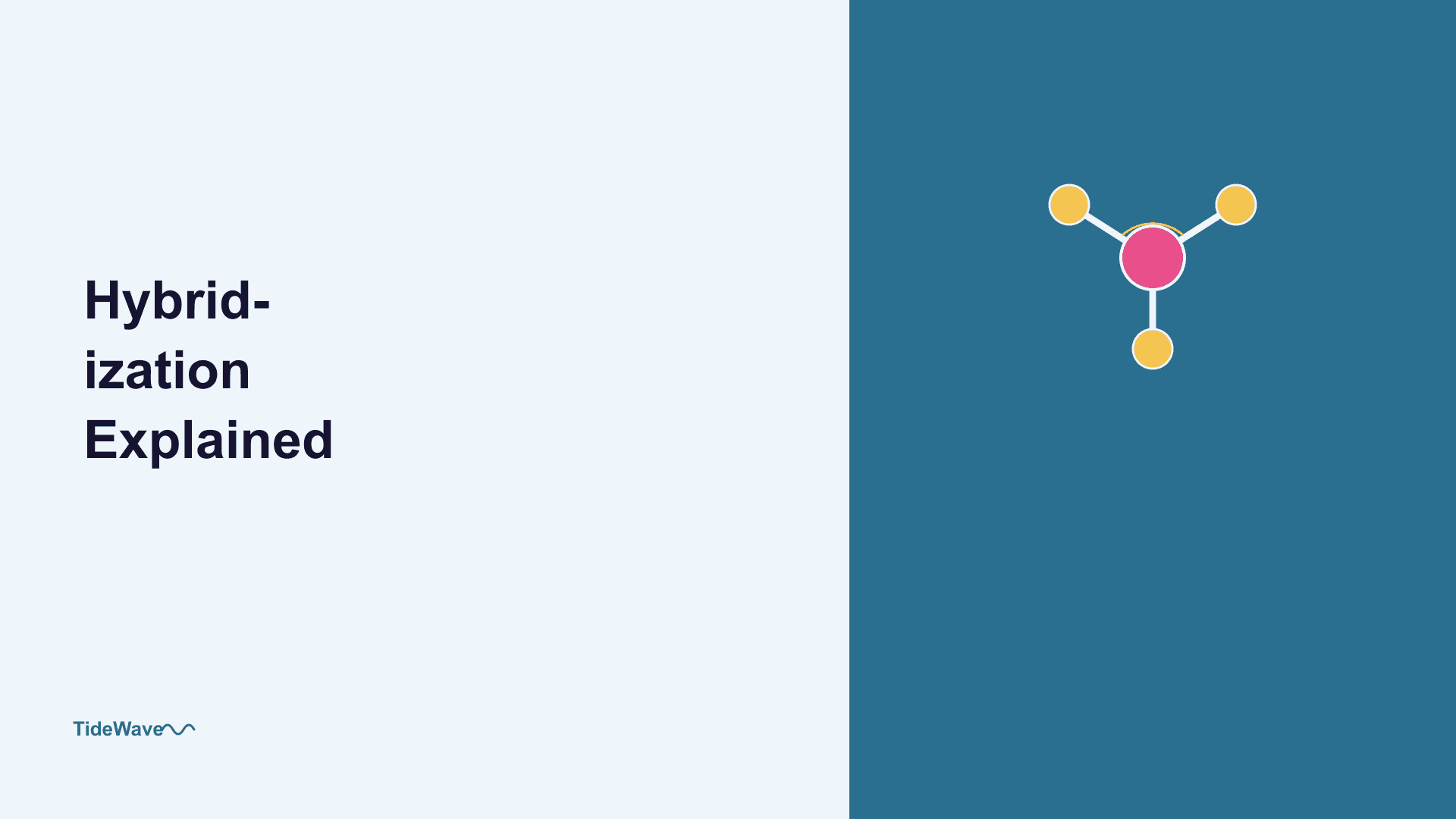
When one s orbital and all three p orbitals mix, the result is four sp3 hybrid orbitals, arranged in a tetrahedral geometry (109.5° apart).
Example: Methane (CH₄)
Carbon's one 2s and three 2p orbitals combine into four equivalent sp3 orbitals, each holding one electron. Each sp3 orbital then overlaps with a hydrogen atom's 1s orbital, forming four identical, tetrahedrally arranged C-H bonds.
This same sp3 pattern appears throughout organic chemistry wherever a carbon atom forms four single bonds, including the carbon backbone of ethane, propane, and every other alkane.
sp2 Hybridization: Three Orbitals Plus One Leftover p Orbital
When one s orbital mixes with only two of the three p orbitals, the result is three sp2 hybrid orbitals, arranged in a flat, trigonal planar geometry (120° apart), while the third, unhybridized p orbital remains perpendicular to that plane.
Example: Ethene (C₂H₄)
Each carbon in ethene forms three sp2 orbitals: two bond to hydrogen atoms, and one bonds to the other carbon atom (a sigma (σ) bond, formed by direct, head-on orbital overlap). The leftover, unhybridized p orbital on each carbon overlaps sideways with its neighbor's leftover p orbital, forming a second bond called a pi (π) bond.
Together, the sigma and pi bonds between the two carbons make up the carbon-carbon double bond in ethene. This is a genuinely important distinction: a "double bond" isn't two identical bonds stacked together, it's one sigma bond and one distinctly different pi bond, and this difference is exactly why double bonds can't rotate freely the way single bonds can (rotating would break the sideways pi overlap).
sp Hybridization: Two Orbitals Plus Two Leftover p Orbitals
When one s orbital mixes with only one p orbital, the result is two sp hybrid orbitals, arranged linearly (180° apart), leaving two unhybridized p orbitals perpendicular to each other and to the sp axis.
Example: Ethyne (C₂H₂)
Each carbon in ethyne (acetylene) forms two sp orbitals: one bonds to a hydrogen atom, and one bonds to the other carbon (a sigma bond). Each carbon's two leftover, unhybridized p orbitals then form two separate pi bonds with the corresponding p orbitals on the other carbon. The result is a carbon-carbon triple bond: one sigma bond plus two pi bonds, and a perfectly linear molecular shape.
A Quick Reference Table
| Hybridization | Orbitals Mixed | Geometry | Bond Angle | Example |
|---|---|---|---|---|
| sp3 | 1 s + 3 p | Tetrahedral | 109.5° | Methane (CH₄) |
| sp2 | 1 s + 2 p | Trigonal planar | 120° | Ethene (C₂H₄) |
| sp | 1 s + 1 p | Linear | 180° | Ethyne (C₂H₂) |
A Shortcut for Determining Hybridization
Rather than working through orbital diagrams every time, a fast practical shortcut is to count the number of regions of electron density around a central atom (bonding groups plus lone pairs, the same count used in VSEPR theory):
- 4 regions → sp3
- 3 regions → sp2
- 2 regions → sp
This works because hybridization exists specifically to create one hybrid orbital per region of electron density, so counting the regions directly tells you how many hybrid orbitals, and therefore which hybridization scheme, is in play.
Hybridization Isn't Limited to Carbon
While carbon is the most common teaching example because of its central role in organic chemistry, the same model applies to nitrogen, oxygen, and other elements. In ammonia (NH₃), nitrogen is sp3 hybridized, with three hybrid orbitals forming N-H bonds and the fourth holding a lone pair, which is exactly why ammonia's H-N-H bond angle (about 107°) is close to, but not exactly, methane's ideal 109.5°: lone pair repulsion compresses the angle slightly, a refinement VSEPR theory accounts for directly.
FAQ
It's best understood as a mathematical model that successfully predicts observed bond angles and molecular shapes, rather than something that can be directly observed happening to an atom. Like many models in chemistry, its value lies in how accurately and simply it predicts real, measurable molecular geometry, not in being a literal description of electrons physically merging.
A pi bond requires sideways overlap of two parallel, unhybridized p orbitals, which can only form in addition to an existing sigma bond between the same two atoms, not as a replacement for one. Every bond between two atoms starts with a sigma bond; only double and triple bonds add pi bonds on top of that initial sigma bond.
It applies to both. In water (sp3 oxygen) and ammonia (sp3 nitrogen), lone pairs occupy hybrid orbitals just like bonding pairs do, which is exactly why lone pairs affect bond angles: they take up one of the tetrahedral hybrid orbital positions and repel the other electron pairs more strongly than a bonding pair would.
Yes, and this is a key concept in reaction mechanisms. A carbon atom undergoing a reaction that converts a double bond into two single bonds (an addition reaction) changes from sp2 to sp3 hybridization in the process, since it goes from three regions of electron density to four.
More shared electron density between two nuclei (one sigma plus two pi bonds, versus just one sigma bond) pulls the atoms closer together and holds them more tightly. This is a consistent, measurable trend across bond types: triple bonds are shortest and strongest, followed by double bonds, followed by single bonds, for the same pair of atoms.
Conclusion
Hybridization bridges the gap between an atom's raw electron configuration and the specific, predictable geometry its molecules actually adopt. Counting regions of electron density around a central atom, four for sp3, three for sp2, two for sp, gives you a fast, reliable way to predict both the hybridization and the resulting bond angles, without needing to draw a full orbital diagram every time. Combined with VSEPR theory, it's the foundation for understanding why molecules are shaped the way they are, and why double and triple bonds behave so differently from single bonds in reactions.
Here are some useful references if you want to go deeper:
- Khan Academy – Hybridization — free lessons covering orbital hybridization and sigma/pi bonding.
- Chemguide – Hybridization — a detailed breakdown of sp, sp2, and sp3 hybridization with diagrams.
- LibreTexts Chemistry – Valence Bond Theory — an open textbook resource covering hybridization within valence bond theory.