Nuclear Fission and Fusion: The Chemistry Powering Nuclear Energy
A single uranium atom splitting apart releases roughly a million times more energy than a single carbon atom burning in a chemical reaction. That staggering difference isn't a matter of degree, it's a matter of kind: ordinary combustion rearranges electrons around unchanged nuclei, while nuclear fission and nuclear fusion rearrange the nucleus itself, tapping into the strongest force in the atom. Understanding how these two processes work, and why they're fundamentally opposite strategies for releasing that energy, explains everything from how nuclear power plants generate electricity to why the sun has burned steadily for billions of years.
Where the Energy Actually Comes From
Nuclear reactions are governed by a relationship first described by Einstein: E = mc², energy equals mass multiplied by the speed of light squared. In both fission and fusion, the total mass of the products is measurably less than the total mass of the starting material, and that missing mass hasn't vanished, it's been converted directly into energy. Because the speed of light squared is such an enormous number, even a tiny amount of missing mass, far too small to detect on a household scale, converts into a tremendous amount of energy.
This "missing mass" is called the mass defect, and it's the single unifying idea behind both processes described below.
Nuclear Fission: Splitting Heavy Nuclei Apart
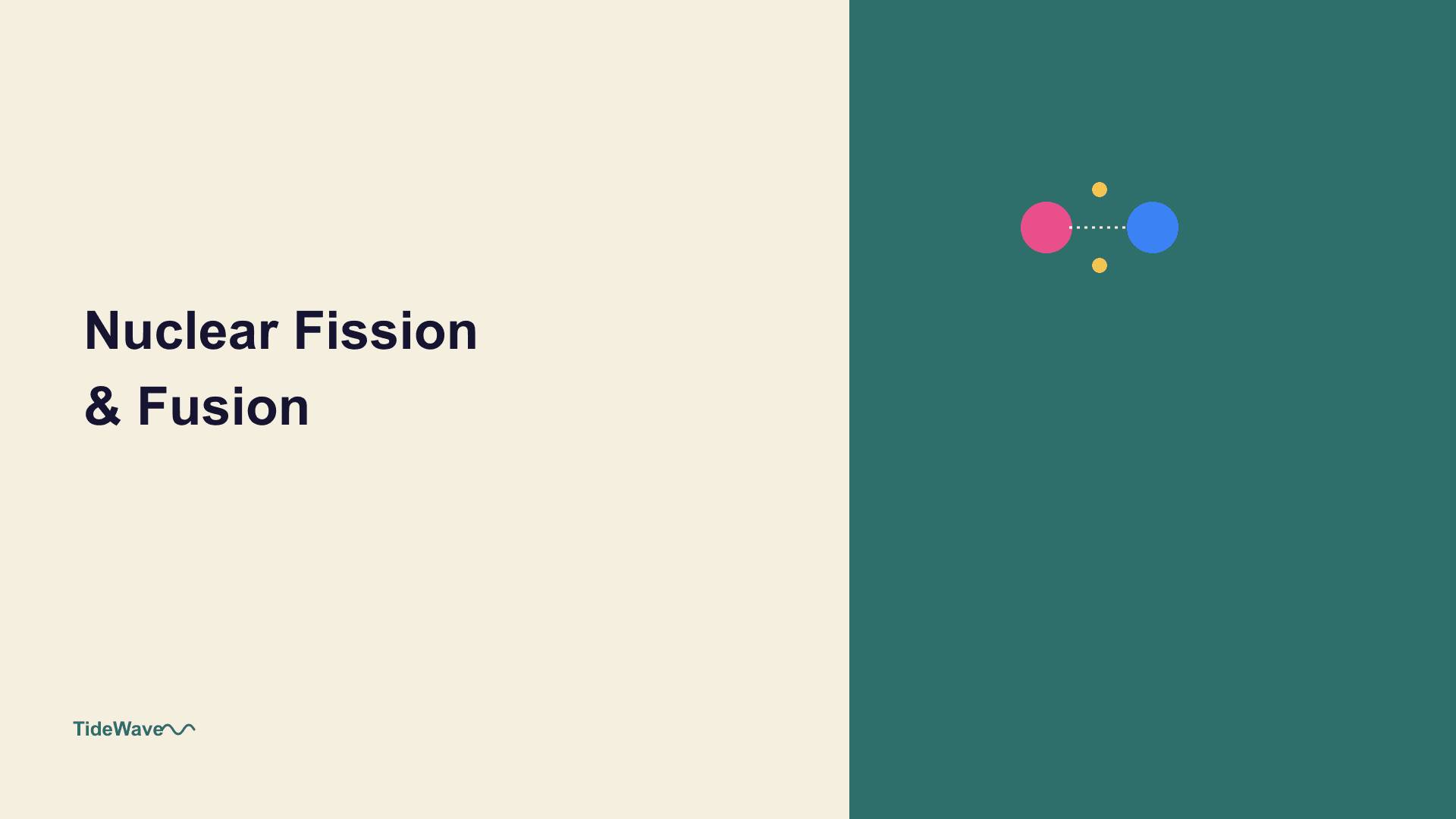
Fission is the splitting of a large, heavy atomic nucleus (typically uranium-235 or plutonium-239) into two smaller nuclei, along with a burst of energy and several free neutrons.
Fission is usually triggered deliberately, by firing a neutron into a heavy, unstable nucleus:
Uranium-235 + neutron → Barium-141 + Krypton-92 + 3 neutrons + energy
The released neutrons are what make fission self-sustaining. Each one can strike another uranium-235 nucleus, triggering further fission events, which release still more neutrons, and so on. This is called a chain reaction, and it's the mechanism behind both nuclear reactors and nuclear weapons, with the critical difference being how tightly that chain reaction is controlled.
Controlling the Chain Reaction
In a nuclear power plant, control rods made of neutron-absorbing material (like boron or cadmium) are inserted into the reactor core to soak up excess neutrons, keeping the chain reaction steady rather than runaway. This controlled reaction generates heat, which boils water into steam, which spins a turbine, generating electricity, essentially a very sophisticated way of boiling water. In an uncontrolled chain reaction, the neutron population multiplies exponentially in a fraction of a second instead, releasing energy far too quickly to be captured usefully.
Nuclear Fusion: Joining Light Nuclei Together
Fusion works in the opposite direction: it combines two small, light nuclei (typically isotopes of hydrogen) into a single, heavier nucleus, also releasing energy in the process. This is the reaction that powers the sun and virtually every other star:
Hydrogen-2 (deuterium) + Hydrogen-3 (tritium) → Helium-4 + neutron + energy
Fusion releases even more energy per reaction than fission, and its fuel (hydrogen isotopes) is far more abundant than uranium. So why don't we generate most of our electricity from fusion today? The answer is the immense difficulty of actually triggering it.
Why Fusion Is So Hard to Achieve
Every atomic nucleus carries a positive charge, and positive charges repel each other strongly at close range. To fuse two nuclei together, they must be forced close enough for the strong nuclear force to take over and bind them, overcoming that electrical repulsion entirely. Doing this requires temperatures of tens of millions of degrees, hot enough to strip electrons away entirely and turn matter into a plasma, the same conditions found naturally at the core of stars.
On Earth, sustaining these conditions long enough, and containing plasma that hot without it touching (and destroying) any physical container, is an immense engineering challenge. Current experimental fusion reactors use powerful magnetic fields or precisely focused lasers to confine and compress the plasma, and while several experiments have achieved brief, net-positive fusion reactions, sustained commercial fusion power remains an active area of ongoing research rather than a deployed technology.
Fission vs. Fusion: A Direct Comparison
| Fission | Fusion | |
|---|---|---|
| Mechanism | Splits a heavy nucleus | Combines light nuclei |
| Typical fuel | Uranium-235, Plutonium-239 | Hydrogen isotopes (deuterium, tritium) |
| Byproducts | Radioactive fission fragments | Helium (not radioactive) |
| Current use | Commercial nuclear power plants | Experimental research reactors; naturally occurring in stars |
| Chain reaction risk | Yes, requires active control | No self-sustaining chain reaction risk in the same way |
Radioactive Waste and Safety Considerations
Fission's byproducts are often themselves unstable isotopes, which is why spent nuclear fuel remains radioactive and requires careful long-term storage and containment, a genuine and actively managed engineering and policy challenge. Fusion's primary byproduct, helium, is not radioactive, which is one of the reasons it's considered an attractive long-term energy goal, though the materials used to build a fusion reactor's containment vessel can themselves become activated (made radioactive) by intense neutron exposure over time.
FAQ
The underlying fission reaction is the same physical process, but the conditions are entirely different. Power plants use a carefully controlled, sustained chain reaction at a relatively low reaction rate to generate steady heat, using fuel that isn't concentrated enough to sustain an uncontrolled reaction. Weapons require a rapid, uncontrolled chain reaction using highly enriched material, a fundamentally different engineering setup, not just a "turned up" version of a reactor.
Fission just requires a neutron to strike an already-unstable heavy nucleus, which doesn't need extreme conditions to occur. Fusion requires forcing two positively charged nuclei close enough to overcome their mutual electrical repulsion, which only happens at extremely high temperatures and pressures, the same conditions found in stellar cores.
The fission reaction itself produces no carbon dioxide, since it doesn't involve combustion at all. Some emissions are associated with mining, fuel processing, and plant construction, but nuclear power's operational emissions are far lower than fossil fuel combustion, which is why it's often included in discussions of low-carbon energy sources.
Helium-4 is an extremely stable nucleus (it's the same particle as an alpha particle) and is not radioactive, so fusion doesn't generate long-lived radioactive waste the way fission does. This is one of the main long-term appeals of fusion power, alongside its more abundant fuel supply.
Yes, several experimental facilities have achieved brief moments of "net energy gain," where the fusion reaction itself released more energy than the fuel absorbed, most notably announced experiments using laser-based inertial confinement. Sustaining that gain continuously, and converting it efficiently into usable electricity at commercial scale, remains an unsolved engineering challenge as of now.
Conclusion
Fission and fusion release energy through opposite nuclear strategies, splitting heavy nuclei apart versus joining light ones together, but both trace back to the same underlying principle: a small amount of mass converting directly into a tremendous amount of energy, exactly as Einstein's mass-energy relationship predicts. Fission is already a mature, deployed technology generating a meaningful share of the world's electricity, while fusion remains the more difficult, longer-term prize, promising more energy, more abundant fuel, and far less long-lived radioactive waste, if the engineering challenge of containing a miniature star can be solved.
Here are some useful references if you want to go deeper:
- World Nuclear Association – Nuclear Power Reactors — an overview of how fission-based reactors generate electricity.
- Khan Academy – Nuclear Chemistry — free lessons covering fission, fusion, and mass-energy equivalence.
- IAEA – Fusion Energy — the International Atomic Energy Agency's overview of current fusion research and technology.