Isotopes and Radioactive Decay: What Makes an Atom Unstable
Every atom of carbon has exactly six protons; that's what makes it carbon rather than nitrogen or oxygen, since atomic number is defined by proton count. But not every carbon atom has the same number of neutrons, and that single difference has enormous consequences: it's the reason carbon dating works, why some materials are dangerously radioactive while others are perfectly stable, and why nuclear power plants can generate electricity at all.
What Is an Isotope?
Isotopes are atoms of the same element (identical proton count) that have a different number of neutrons, and therefore a different mass number (protons + neutrons). Isotopes of an element behave almost identically in ordinary chemical reactions, since chemical behavior is governed by electrons and protons, not by neutrons, but they can differ significantly in nuclear stability and behavior.
Isotopes are typically written with the element's mass number following its name or symbol:
Example: Carbon has three naturally occurring isotopes
- Carbon-12 (⁶ protons, 6 neutrons): stable, and by far the most abundant, making up about 99% of natural carbon.
- Carbon-13 (6 protons, 7 neutrons): stable, but far less common (about 1%).
- Carbon-14 (6 protons, 8 neutrons): unstable (radioactive), present only in trace amounts, but famously useful for dating ancient organic material.
Why Some Isotopes Are Stable and Others Aren't
Inside an atomic nucleus, protons (positively charged) repel each other electrically, while a separate, much stronger force called the strong nuclear force holds protons and neutrons together at extremely short range. Neutrons contribute to this binding force without adding any electrical repulsion of their own, which is why they act as a kind of "nuclear glue."
A nucleus is stable when there's a favorable balance between protons and neutrons:
- Too few neutrons relative to protons: the repulsive force between protons overwhelms the binding force, making the nucleus unstable.
- Too many neutrons relative to protons: the nucleus becomes unstable in a different way, since an excess of neutrons also disrupts the delicate nuclear balance.
For lighter elements, a roughly 1:1 ratio of neutrons to protons tends to be stable. As elements get heavier, the ratio needed for stability shifts higher (more neutrons per proton), since larger nuclei need extra neutrons to help offset the growing electrical repulsion between an increasing number of protons. Every element beyond bismuth (element 83) has no stable isotopes at all; every one of their isotopes is radioactive to some degree.
Radioactive Decay: How Unstable Nuclei Reach Stability
An unstable (radioactive) isotope, called a radioisotope, spontaneously transforms into a different, more stable configuration by emitting particles or energy. This process is called radioactive decay, and it happens in a few characteristic ways:
Alpha Decay
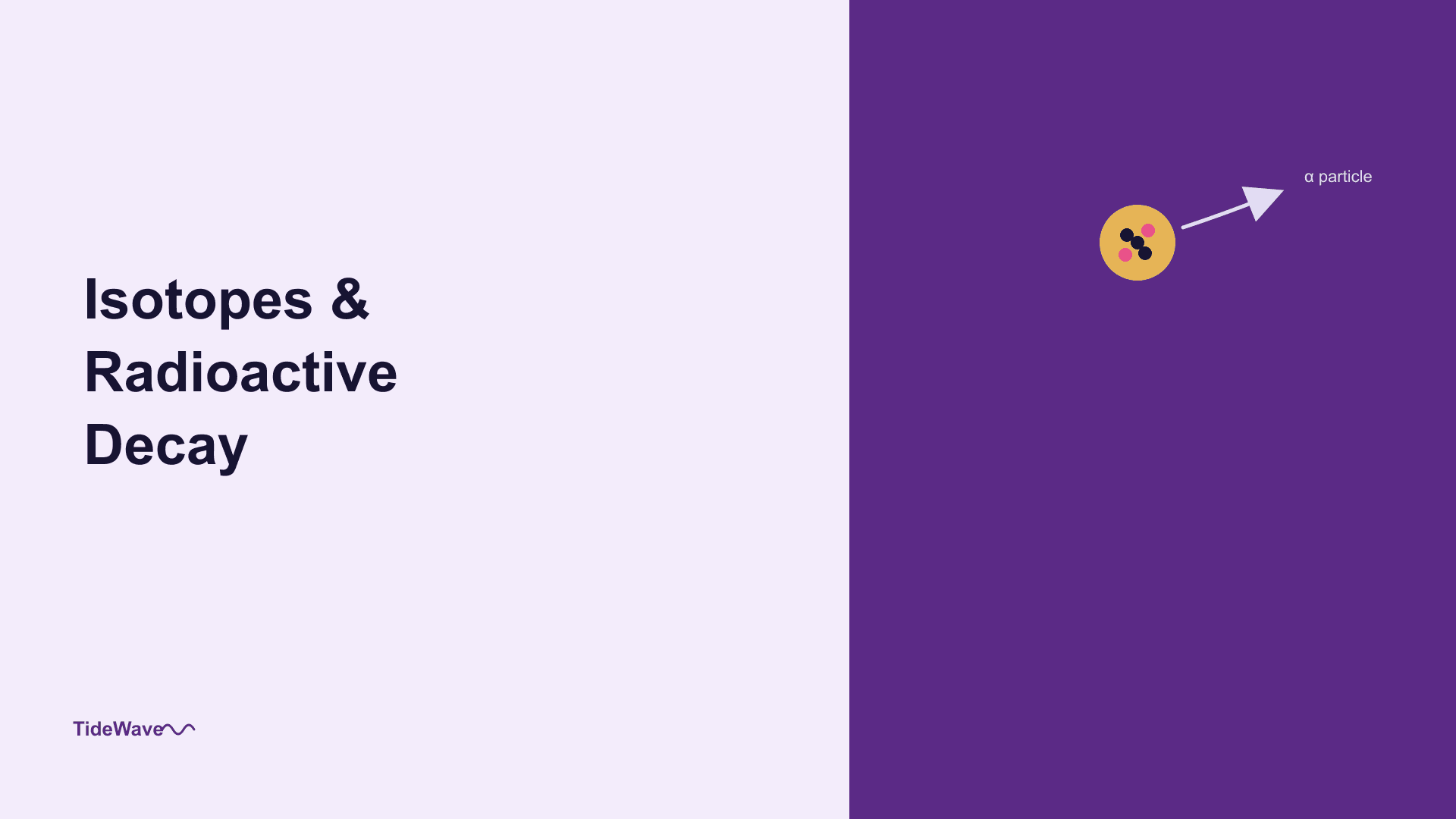
An unstable nucleus emits an alpha particle (two protons and two neutrons bound together, identical to a helium nucleus). This reduces the atomic number by 2 and the mass number by 4, transforming the atom into a different element entirely.
Uranium-238 → Thorium-234 + alpha particle (α)
Beta Decay
In the most common form, a neutron inside the nucleus converts into a proton, emitting a fast-moving electron (called a beta particle in this context) in the process. This increases the atomic number by 1 while the mass number stays the same, since a neutron was simply converted into a proton.
Carbon-14 → Nitrogen-14 + beta particle (β⁻)
Gamma Decay
Often accompanying alpha or beta decay, a nucleus in an excited (high-energy) state releases pure energy in the form of a gamma particle (a high-energy photon), settling into a lower-energy, more stable state without any change to its proton or neutron count at all.
Half-Life: Predicting Decay Without Predicting a Single Atom
You can never predict when any individual radioactive atom will decay, decay is a fundamentally random, probabilistic process at the level of a single atom. But across a large enough sample, decay follows an extremely reliable statistical pattern described by half-life: the time it takes for exactly half of a radioactive sample to decay.
Half-life is a constant property of a specific isotope; it doesn't change based on the amount of material present, temperature, pressure, or any chemical reaction the substance is involved in. After one half-life, 50% of the original radioactive atoms remain; after two half-lives, 25% remain; after three, 12.5%, and so on, halving indefinitely.
| Isotope | Half-Life | Common Use |
|---|---|---|
| Carbon-14 | ~5,730 years | Dating organic material |
| Uranium-238 | ~4.5 billion years | Dating rocks/geological time |
| Iodine-131 | ~8 days | Medical thyroid treatment |
| Cobalt-60 | ~5.3 years | Cancer radiotherapy |
Radiometric Dating: Using Decay to Read the Past
Carbon dating is possible because living organisms continuously absorb carbon (including trace amounts of radioactive carbon-14) from the atmosphere while alive, keeping a roughly constant ratio of carbon-14 to stable carbon-12. Once an organism dies, it stops absorbing new carbon, and its existing carbon-14 begins decaying at its fixed half-life without being replenished. By measuring how much carbon-14 remains relative to carbon-12, and comparing it to the known half-life, scientists can calculate how long ago the organism died, typically useful for objects up to about 50,000 years old, beyond which the remaining carbon-14 becomes too scarce to measure reliably.
For much older material, like rocks and minerals, scientists use isotopes with far longer half-lives, such as uranium-238 (half-life ~4.5 billion years), which is how geologists have dated the Earth itself to approximately 4.5 billion years old.
FAQ
No. Most elements have at least one stable isotope; hydrogen, carbon, and oxygen, for example, each have both stable and unstable isotopes. Radioactivity depends on the specific proton-to-neutron ratio of that particular isotope, not on the element itself.
Only very slightly. Chemical behavior is determined almost entirely by the number and arrangement of electrons, which is identical across all isotopes of an element. The extra neutrons in a heavier isotope add mass but essentially no chemical difference, though very precise reactions can show a small "isotope effect" due to the mass difference alone.
No, danger depends heavily on the type of radiation, the dose, and the duration of exposure. Trace radioactive isotopes exist naturally all around us (in soil, food, and even our own bodies via potassium-40) without meaningful harm, while concentrated exposure to certain isotopes and radiation types can indeed be hazardous, which is why radiation safety protocols exist for medical and industrial use.
Carbon-14 has a relatively short half-life (about 5,730 years), meaning it becomes undetectably scarce after roughly 50,000 years, far too short a window for dating anything on a geological timescale. Rocks are instead dated using isotopes with vastly longer half-lives, like uranium-238, that remain measurable across billions of years.
This is a statistical principle, not a contradiction: any single atom's decay timing is unpredictable, but across an enormous number of atoms (even a small sample contains trillions), the law of large numbers makes the overall decay rate extremely consistent and predictable, in the same way you can't predict a single coin flip but can reliably predict that 10,000 flips will land close to 50% heads.
Conclusion
Isotopes reveal that "carbon" or "uranium" isn't a single, uniform thing at the nuclear level; the same element can come in several versions with dramatically different nuclear stability, depending entirely on neutron count. Radioactive decay is simply an unstable nucleus's way of reaching a more stable configuration, whether through alpha, beta, or gamma emission, and it happens at a rate so statistically reliable that it's become one of science's most powerful tools for reading the age of everything from ancient artifacts to the planet itself.
Here are some useful references if you want to go deeper:
- Khan Academy – Nuclear Chemistry — free lessons covering isotopes, decay types, and half-life calculations.
- USGS – Radiometric Dating — how radiometric dating is used to determine geological ages.
- World Nuclear Association – Radioactive Decay — an accessible overview connecting decay principles to nuclear power and medicine.