Polymers Explained: From Natural Rubber to Synthetic Plastics
Rubber, plastic bags, nylon rope, and your own DNA all share the same basic architectural strategy: taking a small, simple building block and linking thousands or millions of copies of it together into one enormous chain. This strategy is called polymerization, and the resulting giant molecules are called polymers, one of the most consequential ideas in all of organic chemistry, responsible for both the plastics reshaping modern life and many of the essential molecules inside every living cell.
Monomers and Polymers: The Basic Relationship
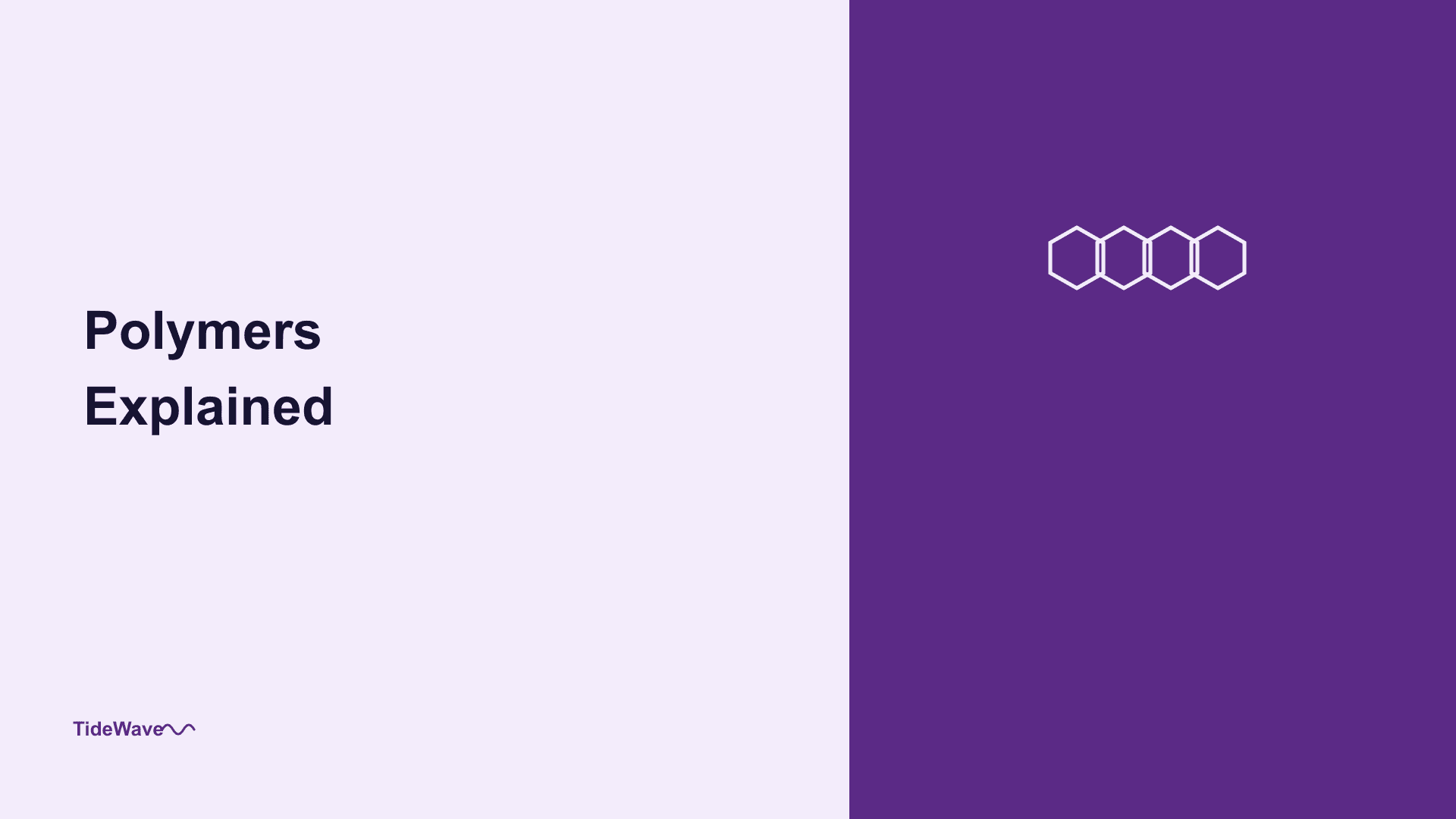
A polymer is a large molecule made of many repeating smaller units, called monomers, chemically bonded together in a long chain. The relationship is directly analogous to a train: a single boxcar (the monomer) isn't very interesting on its own, but link thousands of identical boxcars together and you get something structurally very different, a train (the polymer), with properties the individual boxcar never had.
Example: Polyethylene, the plastic used in shopping bags and milk jugs, is made by linking together thousands of ethylene (C₂H₄) monomers into one continuous chain.
Two Ways to Build a Polymer
Polymers form through one of two fundamentally different chemical processes, and the distinction matters because it determines what kind of byproduct (if any) is released, and what functional groups end up in the final polymer.
Addition Polymerization
In addition polymerization, monomers join together without losing any atoms in the process; the entire mass of the monomers ends up in the final polymer. This typically happens with monomers containing a carbon-carbon double bond, which "opens up" and forms new single bonds to neighboring monomers.
n(CH₂=CH₂) → -[CH₂-CH₂]n-
   (ethylene monomers)   (polyethylene)
Common addition polymers include polyethylene, polypropylene (used in food containers), and polyvinyl chloride, or PVC (used in pipes and vinyl siding).
Condensation Polymerization
In condensation polymerization, monomers join together with the loss of a small molecule, typically water, as a byproduct of each new bond formed. This usually happens between monomers with two reactive functional groups (like a carboxylic acid and an amine), which react and release water each time a new link forms.
Example: Nylon forms through a condensation reaction between a diamine and a dicarboxylic acid, releasing a water molecule at every connection point along the growing chain. This is the same basic reaction (forming an amide bond) that links amino acids together into proteins, which is why nylon is sometimes described as a synthetic analog of natural protein chemistry.
Natural vs. Synthetic Polymers
Polymers aren't a purely artificial invention; nature has been using the same strategy for far longer than chemists have:
| Polymer | Type | Monomer |
|---|---|---|
| Starch | Natural (carbohydrate) | Glucose |
| Cellulose | Natural (carbohydrate) | Glucose (different bond arrangement than starch) |
| Natural rubber | Natural | Isoprene |
| DNA | Natural (nucleic acid) | Nucleotides |
| Proteins | Natural | Amino acids |
| Polyethylene | Synthetic | Ethylene |
| Nylon | Synthetic | Diamines and dicarboxylic acids |
| PET (polyester) | Synthetic | Ethylene glycol and terephthalic acid |
Starch and cellulose are a particularly striking comparison: both are built entirely from the exact same monomer, glucose, yet they behave completely differently, starch is digestible and used for energy storage in plants, while cellulose (differing only in how its glucose units are chemically linked together) forms rigid, indigestible plant cell walls. This is essentially a large-scale version of isomerism: identical building blocks, connected differently, producing genuinely different substances.
Why Chain Structure Determines Material Properties
A polymer's physical properties, whether it's flexible or rigid, whether it melts easily or resists heat, come largely from how its chains are arranged relative to each other, not just from the identity of the monomer itself:
- Linear polymers, with long, unbranched chains, can pack closely together, often producing stronger, denser, higher-melting materials (high-density polyethylene, used in sturdy containers).
- Branched polymers, with side chains breaking up the packing, tend to be softer and more flexible, since the branches prevent chains from lining up as tightly (low-density polyethylene, used in flexible plastic bags).
- Cross-linked polymers, with chemical bonds connecting separate chains to each other, form rigid, heat-resistant networks rather than individual strands. This is exactly what happens during the vulcanization of rubber, where sulfur atoms form cross-links between rubber polymer chains, transforming soft, sticky natural rubber into the durable, elastic material used in tires.
Environmental Considerations: Why Plastics Persist
Many synthetic polymers, especially those formed through addition polymerization with strong carbon-carbon backbones, are extremely resistant to natural chemical breakdown, which is exactly the durability that makes plastic so useful, and exactly the property that makes plastic waste such a persistent environmental problem. Biodegradable polymers, an active area of ongoing chemistry research, are specifically designed with weaker links (often built more like condensation polymers, with bonds that can be broken down by water or microorganisms) so they break apart more readily once discarded, without sacrificing too much of the strength and durability needed while the material is actually in use.
FAQ
Addition polymerization works by opening an existing carbon-carbon double bond and forming new single bonds directly between monomers, with every atom from the original monomers ending up in the final polymer. Condensation polymerization instead involves a reaction between two functional groups (commonly forming an ester or amide bond), a reaction type that inherently releases a small molecule, usually water, as part of the bond-forming step itself.
All plastics are polymers, but not all polymers are what people commonly think of as "plastic." Natural polymers like cellulose, starch, and proteins are equally polymers by the strict chemical definition, even though they aren't referred to as plastics in everyday language, which is generally reserved for synthetic, moldable polymer materials.
The glucose units in starch and cellulose are linked together with a different bond orientation (technically, different glycosidic linkages). Human digestive enzymes are shaped to break down starch's specific linkage but not cellulose's, which is exactly why we can digest potatoes but not wood or grass, despite both being built from the same basic monomer.
Vulcanization introduces sulfur cross-links between separate natural rubber polymer chains, which were previously able to slide past each other relatively freely. Those new cross-links restrict that sliding motion, transforming soft, sticky, temperature-sensitive raw rubber into the stronger, more elastic, and more heat-stable material used in tires and other rubber products.
Yes, this stability is a major factor in why plastic recycling is more complicated than recycling materials like glass or metal. Many common plastics require being sorted by exact polymer type and processed at high heat to be reshaped, and some, especially cross-linked or heavily additive-laden plastics, resist conventional recycling methods entirely, which is part of why chemists are actively researching new chemical recycling techniques that can break polymer chains back down into their original monomers.
Conclusion
Polymers demonstrate one of chemistry's most powerful and reused ideas: link a simple repeating unit together enough times, and you get a material with entirely new properties the individual unit never had. Whether it's addition polymerization building polyethylene from ethylene, condensation polymerization building nylon (or, in nature, proteins and DNA) with water released at every step, the underlying logic is the same. Once you can recognize a polymer's monomer and how its chains are linked and arranged, you can predict a surprising amount about whether the resulting material will be flexible, rigid, biodegradable, or built to last.
Here are some useful references if you want to go deeper:
- Khan Academy – Polymers — free lessons on polymer structure, including biological polymers.
- Chemguide – Addition Polymerisation — a detailed breakdown of how addition polymers form.
- American Chemistry Council – Plastics 101 — an accessible overview of common synthetic polymer types and their uses.