Real Gases vs. Ideal Gases: Where the Model Breaks Down
The ideal gas law is one of the most useful equations in introductory chemistry precisely because it's so broadly accurate, but it's built on two simplifying assumptions that no real gas actually satisfies perfectly. Most of the time, that doesn't matter; the approximation is close enough to be practically indistinguishable from reality. Understanding exactly when and why it stops being close enough is just as important as knowing the equation itself.
The Two Assumptions Behind "Ideal"
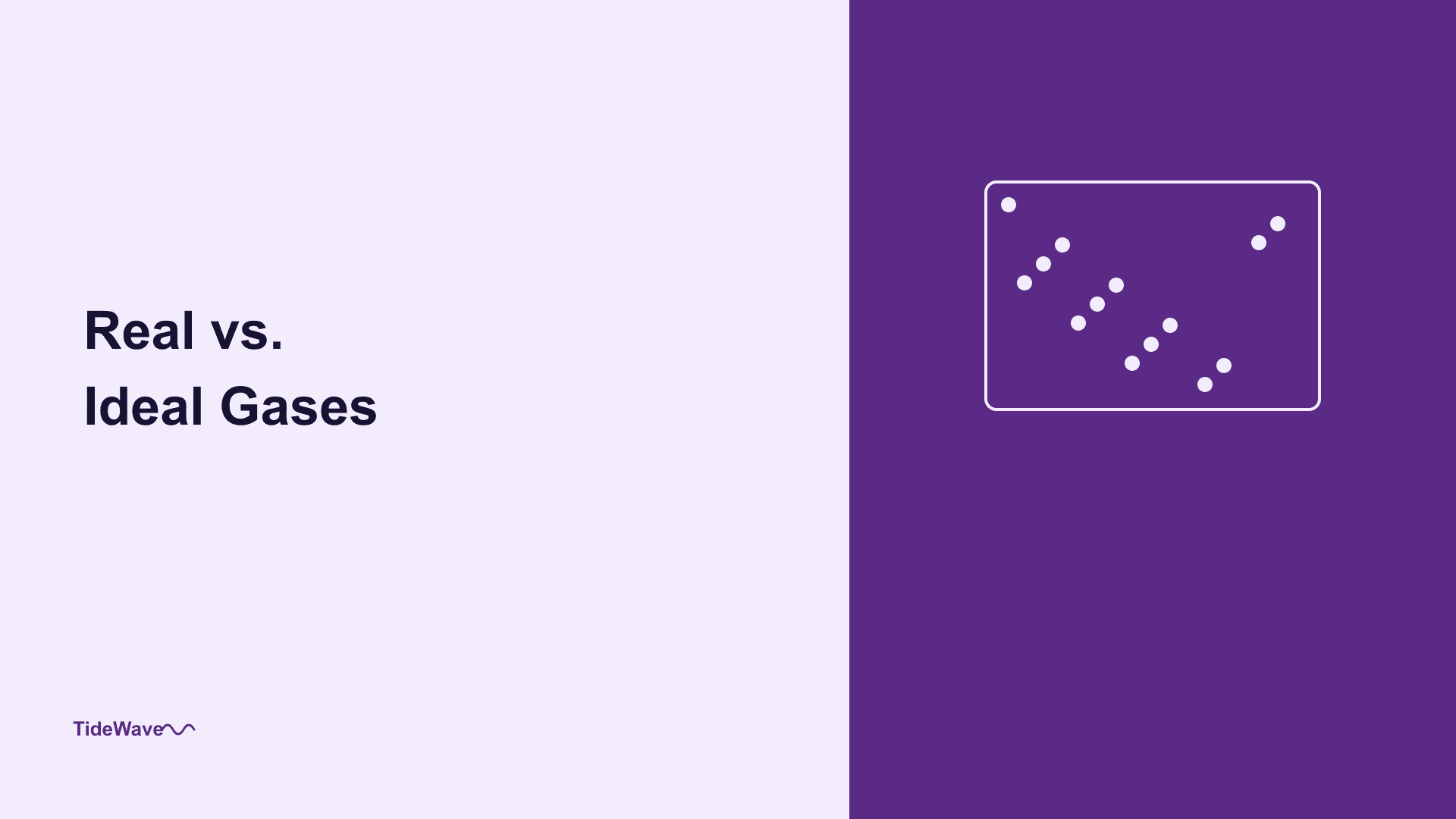
The ideal gas law assumes:
- Gas particles have zero volume of their own, treated as dimensionless points in space.
- Gas particles exert no attractive or repulsive forces on each other, interacting only through perfectly elastic collisions.
Real gas particles, of course, do have actual physical volume, and they do experience intermolecular attractions, the very same intermolecular forces responsible for gases eventually condensing into liquids at low enough temperatures. The ideal gas model simply ignores both effects for the sake of mathematical simplicity, an approximation that works remarkably well under many everyday conditions, but not all.
When Real Gases Deviate Most From Ideal Behavior
Real gas behavior diverges from the ideal gas law most significantly under two specific conditions:
High Pressure
At high pressure, gas particles are forced much closer together, packed into a smaller volume. Under these conditions, the particles' own physical volume becomes a significant fraction of the total volume, no longer negligible the way it is when particles are spread far apart at ordinary pressures. This makes the actual available space for particles to move smaller than the ideal gas law assumes, causing real measured volume to be larger than the ideal prediction at very high pressures.
Low Temperature
At low temperature, gas particles move more slowly, giving intermolecular attractive forces enough time to actually have a noticeable effect (at high temperatures, particles are moving too fast and colliding too briefly for these weaker attractive forces to matter much). These attractions pull particles slightly closer together and slow their collisions with the container walls, causing real measured pressure to be lower than the ideal prediction at low temperatures, right up until the gas condenses into a liquid entirely, a transition the ideal gas law has no way to predict or represent at all.
The Van der Waals Equation: Correcting for Reality
Dutch physicist Johannes van der Waals introduced a modified version of the ideal gas law that adds two correction terms, one for each of the ideal gas law's flawed assumptions:
(P + a(n/V)²)(V - nb) = nRT
- The "a" term corrects for intermolecular attractive forces. Since these attractions pull particles inward and effectively reduce their outward collision force on the container walls, this term is added to the measured pressure to compensate, restoring what the pressure "would have been" without those attractions.
- The "b" term corrects for the actual volume occupied by gas particles themselves. Since particles take up real space, the term nb (b is a constant specific to each gas, multiplied by the number of moles) is subtracted from the total volume, leaving only the space actually available for particles to move freely within.
Both a and b are experimentally determined constants unique to each specific gas, reflecting how strongly that gas's particles attract each other and how large those particles physically are. Gases made of larger, more polarizable molecules (like carbon dioxide) tend to have larger van der Waals constants than gases made of small, weakly interacting molecules (like helium).
Comparing Gases: Which Deviate Most?
Not all real gases deviate from ideal behavior equally. A few reliable patterns:
- Small, nonpolar molecules with weak intermolecular forces (like helium and hydrogen) behave closest to ideal across a wide range of conditions, since they have minimal attractive forces and very small particle volume.
- Larger, more polarizable molecules (like carbon dioxide) deviate more significantly, since they experience stronger intermolecular attractive forces and occupy more actual volume.
- Any gas near its condensation point (close to the temperature and pressure where it would turn into a liquid) deviates dramatically from ideal behavior, since this is exactly the regime where intermolecular attractions become strong enough to start pulling particles together permanently.
A Conceptual Worked Comparison
Consider comparing the ideal gas law's prediction against a real measurement for carbon dioxide at high pressure and low temperature, conditions where deviation is most pronounced:
- The ideal gas law predicts a certain volume based purely on PV = nRT, assuming zero particle volume and zero intermolecular attraction.
- The actual measured volume differs from this prediction because CO₂ molecules take up real physical space (requiring the "b" correction) and experience meaningful attractive forces at this lower temperature (requiring the "a" correction).
- The van der Waals equation, using CO₂'s specific known constants for a and b, produces a corrected prediction that matches the real, experimentally measured behavior far more closely than the simple ideal gas law does under these particular conditions.
This is precisely why engineers working with gases under extreme industrial conditions, high-pressure storage tanks, deep-sea diving equipment, or cryogenic systems, rely on the van der Waals equation or other more sophisticated real-gas models rather than the simpler ideal gas law, where the difference between the two predictions can be too large to safely ignore.
Why This Distinction Matters Practically
- Industrial gas storage and transport: compressed gas cylinders operate at pressures high enough that ideal gas law predictions alone would be dangerously inaccurate for calculating safe fill levels.
- Cryogenics and gas liquefaction: producing liquid nitrogen or liquid oxygen requires operating in exactly the low-temperature, high-pressure regime where real gas behavior dominates.
- Weather and atmospheric science: modeling atmospheric gases at the extreme pressures and temperatures found at different altitudes benefits from real gas corrections for the most precise predictions.
FAQ
There's no single universal cutoff; it depends on the specific gas and how much precision a given application requires. As a rough guideline, most common gases behave close enough to ideal for typical classroom and everyday calculations at pressures below about 10 atm and temperatures well above their boiling point, with deviations becoming increasingly significant beyond that range.
These are two separate effects from two separate assumptions. At high pressure, particle volume (the "b" correction) dominates, making the actual available space smaller and effectively increasing the measured volume needed to reach a given pressure. At low temperature, intermolecular attraction (the "a" correction) dominates, pulling particles inward and reducing their force against container walls, lowering measured pressure below the ideal prediction.
Yes, though less than most other gases, since their attractive forces are unusually weak (limited to weak dispersion forces) and their atomic size is relatively small. This is exactly why helium is often used as a practical reference gas that behaves close to ideal across a very wide range of everyday laboratory conditions.
No, it's the most commonly taught correction in introductory chemistry because of its relatively simple, intuitive two-term structure, but more advanced equations of state (like the Redlich-Kwong or Peng-Robinson equations) offer even greater accuracy for specialized industrial and engineering applications involving extreme conditions.
While individual atoms and molecules are indeed extremely small, at high enough pressure a gas is compressed into a small enough total volume that the particles' own tiny volume becomes a non-negligible fraction of that total space, no longer safely ignorable the way it is when the same particles are spread thinly through a much larger volume at ordinary pressure.
Conclusion
The ideal gas law's simplifying assumptions, zero particle volume and zero intermolecular attraction, hold up remarkably well under everyday conditions, which is exactly why the equation remains so useful and widely taught. But real gases are made of real particles with real size and real attractive forces, and at high pressure or low temperature, those details stop being negligible. The van der Waals equation restores accuracy exactly where it's needed, by adding back the two physical realities the ideal model deliberately set aside for simplicity.
Here are some useful references if you want to go deeper:
- Khan Academy – Real Gases — free lessons covering deviations from ideal gas behavior.
- Chemguide – The Ideal Gas Law and Real Gases — an explanation of where and why the ideal model breaks down.
- NIST – Chemistry WebBook — a reference source for real gas property data and van der Waals constants.