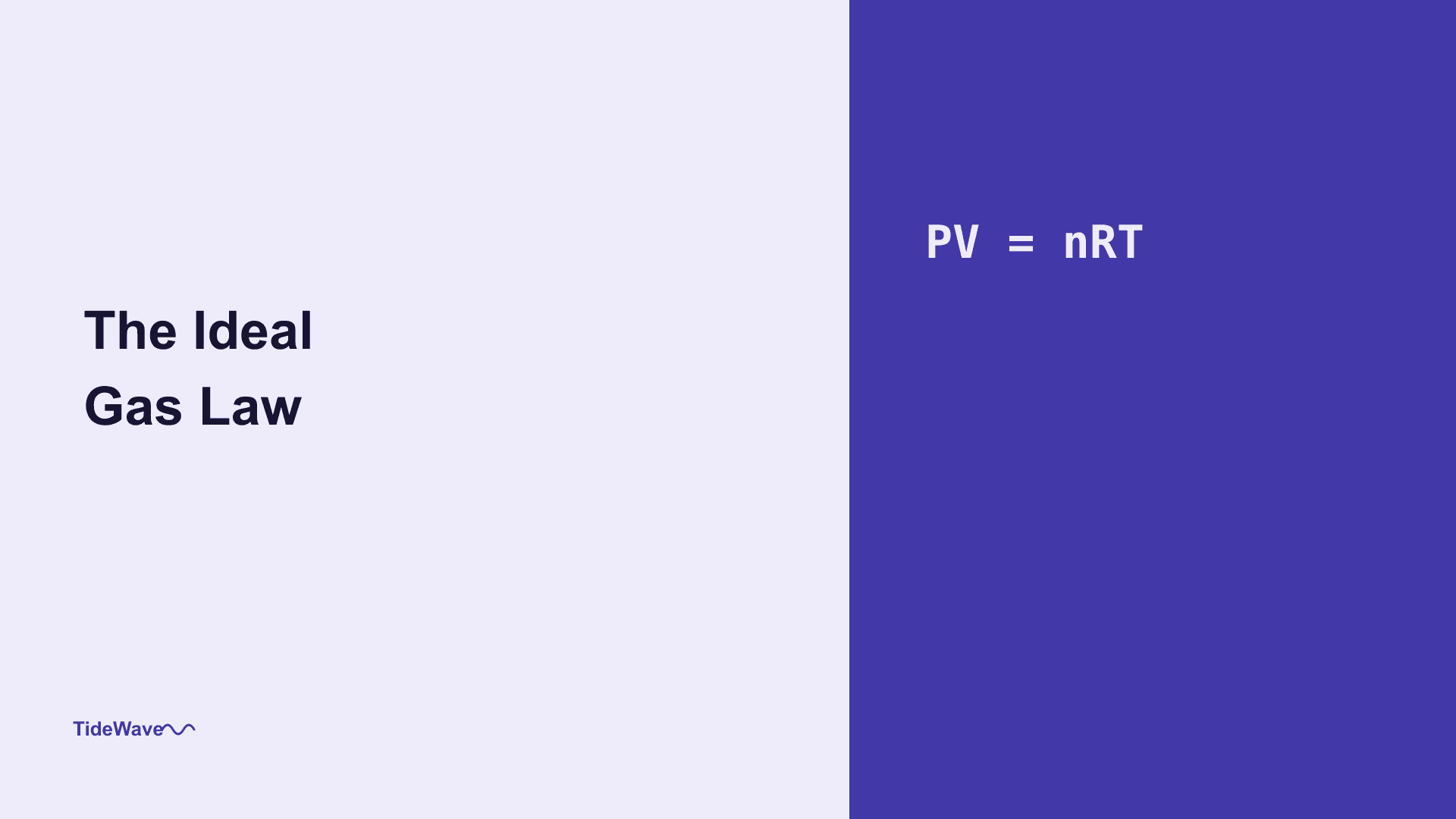
The Ideal Gas Law: Understanding PV = nRT
Of the three states of matter covered in introductory chemistry, gases are by far the most mathematically predictable. Unlike solids and liquids, where particle interactions are complex and structure-dependent, gas particles are spread far enough apart that their behavior can be captured in a single, remarkably simple equation: the ideal gas law, PV = nRT.
The Four Variables
The ideal gas law relates four measurable properties of any gas sample:
PV = nRT
- P = pressure (commonly measured in atmospheres, atm)
- V = volume (commonly measured in liters, L)
- n = amount of gas, in moles
- T = absolute temperature, always in Kelvin, never Celsius or Fahrenheit
- R = the ideal gas constant, a fixed value that makes the units work out consistently: 0.0821 L·atm/(mol·K)
The requirement to use Kelvin, not Celsius, is one of the most common sources of error when applying this equation. Because the relationship is directly proportional to absolute temperature, using Celsius (which allows negative and zero values that don't correspond to zero thermal energy) would break the math entirely. Convert using K = °C + 273.15 before plugging any temperature into this equation.
What "Ideal" Actually Assumes
The word "ideal" in "ideal gas law" refers to a simplified theoretical model built on two key assumptions:
- Gas particles have no volume of their own (they're treated as dimensionless points).
- Gas particles experience no attractive or repulsive forces toward one another (they only interact through perfectly elastic collisions).
No real gas perfectly satisfies either assumption, but at typical everyday conditions, ordinary temperature and pressure, most gases behave close enough to ideal that the equation gives highly accurate, useful predictions. The situations where real gases meaningfully deviate from this model are explored in more depth in real gases vs. ideal gases.
Where the Ideal Gas Law Comes From
The ideal gas law isn't an arbitrary formula; it's the combination of three earlier, individually-discovered relationships, each describing how two gas variables relate while holding the others constant, covered in full in Boyle's Law, Charles's Law, and the combined gas laws:
- Boyle's Law: at constant temperature and amount, pressure and volume are inversely related (PV = constant).
- Charles's Law: at constant pressure and amount, volume and temperature are directly related (V/T = constant).
- Avogadro's Law: at constant temperature and pressure, volume and amount of gas are directly related (V/n = constant).
Combining all three relationships into one unified equation, and introducing the proportionality constant R to make the units consistent, produces exactly PV = nRT.
Solving the Ideal Gas Law for Any Variable
Because it's a single equation with four measurable variables (plus the constant R), the ideal gas law can be rearranged to solve for whichever variable you don't already know, as long as you have the other three:
P = nRT/V
V = nRT/P
n = PV/RT
T = PV/nR
A Worked Example
Question: What volume does 2.5 moles of gas occupy at a pressure of 1.2 atm and a temperature of 300 K?
Step 1: Identify the known values.
n = 2.5 mol
P = 1.2 atm
T = 300 K
R = 0.0821 L·atm/(mol·K)
Step 2: Rearrange the equation to solve for V.
V = nRT/P
Step 3: Substitute and calculate.
V = (2.5 mol)(0.0821 L·atm/mol·K)(300 K) / (1.2 atm)
V = 61.575 / 1.2
V = 51.3 L
Answer: The gas occupies approximately 51.3 liters under these conditions.
Standard Temperature and Pressure (STP)
Chemists frequently reference Standard Temperature and Pressure (STP), defined as 0°C (273.15 K) and 1 atm, as a consistent reference point for comparing gas volumes. At STP, one mole of any ideal gas occupies exactly 22.4 liters, a useful shortcut value worth memorizing, since it lets you skip the full ideal gas law calculation entirely whenever a problem specifically involves STP conditions.
Why the Ideal Gas Law Matters Practically
- Scuba diving and altitude physiology: predicting how gas volume in the lungs and body cavities changes with the pressure changes experienced during diving or high-altitude flight.
- Airbag deployment: engineers use gas law relationships to calculate exactly how much gas-generating chemical is needed to inflate an airbag to the correct volume within milliseconds.
- Weather balloons and industrial gas storage: predicting how a fixed amount of gas will expand or contract as it experiences changing temperature and pressure at different altitudes or storage conditions.
FAQ
Kelvin is the standard SI absolute temperature scale used consistently across all gas law calculations and the value of the constant R itself is defined using Kelvin. Using Celsius would produce a proportionality relationship that breaks down entirely at and below 0°C, since the ideal gas law fundamentally depends on temperature being measured from true zero thermal motion (absolute zero), which Kelvin, uniquely among common scales, does.
The physical constant itself doesn't change, but its numerical value depends entirely on which units you're expressing pressure and volume in. The commonly used 0.0821 L·atm/(mol·K) applies specifically when pressure is in atmospheres and volume is in liters; a different numerical value (8.314 J/(mol·K)) is used when working in SI units like pascals and cubic meters.
Yes, as long as you're calculating total pressure, volume, or moles for the mixture as a whole, using the total number of moles of all gases combined. For finding the individual contribution of one specific gas within a mixture, you'd instead use Dalton's Law of partial pressures alongside the ideal gas law.
You'll get a physically meaningless or clearly wrong answer, since the equation's underlying proportionality only holds true when temperature is measured from absolute zero. A negative value plugged directly into PV = nRT can even produce a negative calculated volume or pressure, an impossible physical result that immediately signals the Kelvin conversion step was skipped.
No, these are different reference points that are easy to confuse. STP is specifically defined as 0°C and 1 atm, while room temperature is typically closer to 25°C (298 K), and "normal conditions" isn't a standardized scientific term at all. Always check which specific reference conditions a problem or dataset actually specifies.
Conclusion
The ideal gas law packs an enormous amount of predictive power into one equation, letting you calculate any one of pressure, volume, moles, or temperature as long as you know the other three, all through a formula that emerges naturally from combining Boyle's, Charles's, and Avogadro's individual observations. The one habit worth locking in from the start is converting temperature to Kelvin every single time; skip that step, and every other part of the calculation, however carefully done, will be wrong.
Here are some useful references if you want to go deeper:
- Khan Academy – Ideal Gas Law — free lessons with worked practice problems.
- Chemguide – The Ideal Gas Equation — a clear derivation and explanation of each variable.
- NIST – Chemistry WebBook — a reference source for real gas property data useful for comparing against ideal gas predictions.