The Chemistry of DNA: How Base Pairing Works
Every instruction your body needs to build and run itself is stored in a molecule made from just four repeating chemical building blocks. DNA (deoxyribonucleic acid) achieves this not through a huge alphabet, but through the precise, predictable chemistry of how those four building blocks pair up with each other. Understanding that pairing rule is the key to understanding how DNA stores information, copies itself, and ultimately directs the organic chemistry of every living cell.
The Building Block: Nucleotides
DNA is a polymer, a long chain built from repeating units called nucleotides. Each nucleotide is made of three parts:
- A phosphate group, which links nucleotides together into a chain.
- A deoxyribose sugar (a five-carbon sugar), which forms the structural backbone alongside the phosphate group.
- A nitrogenous base, one of four possible molecules, which is where the actual genetic information is encoded.
The phosphate and sugar groups alternate to form the two long strands of the DNA backbone, while the nitrogenous bases point inward, toward each other, connecting the two strands like rungs on a ladder.
The Four Bases
DNA uses exactly four nitrogenous bases:
- Adenine (A)
- Thymine (T)
- Guanine (G)
- Cytosine (C)
These four letters are the entire "alphabet" of genetic information. What makes DNA function as a reliable information-storage molecule isn't the bases individually, but a strict chemical rule governing how they pair with each other across the two strands.
Complementary Base Pairing: The Rule That Makes DNA Work
DNA's two strands aren't identical; they're complementary, meaning each base on one strand pairs with one, and only one, specific base on the opposite strand:
- Adenine (A) always pairs with Thymine (T)
- Guanine (G) always pairs with Cytosine (C)
This isn't an arbitrary rule, it's a direct consequence of molecular shape and hydrogen bonding. Adenine and thymine fit together geometrically and form exactly two hydrogen bonds between them. Guanine and cytosine fit together differently and form exactly three hydrogen bonds. Neither pairing works the other way around (adenine cannot form a stable hydrogen-bonded pair with cytosine, for example) because the molecular shapes and available bonding sites simply don't align correctly.
Hydrogen bonds are individually weak compared to the covalent bonds holding each nucleotide together, which is precisely what makes DNA so functional: the two strands can be pulled apart relatively easily (for copying or reading) without breaking the strong covalent backbone, then zipped back together, held in place by the cumulative strength of thousands of individually weak hydrogen bonds along the molecule's length.
Why Three Hydrogen Bonds vs. Two Matters
The difference between a G-C pair (three hydrogen bonds) and an A-T pair (two hydrogen bonds) has a real, measurable chemical consequence: G-C-rich DNA is more thermally stable than A-T-rich DNA, since it takes more energy to break three hydrogen bonds than two. This is why scientists can estimate a DNA sample's G-C content simply by measuring the temperature at which its two strands separate (called the melting temperature), a technique used routinely in molecular biology labs.
The Double Helix
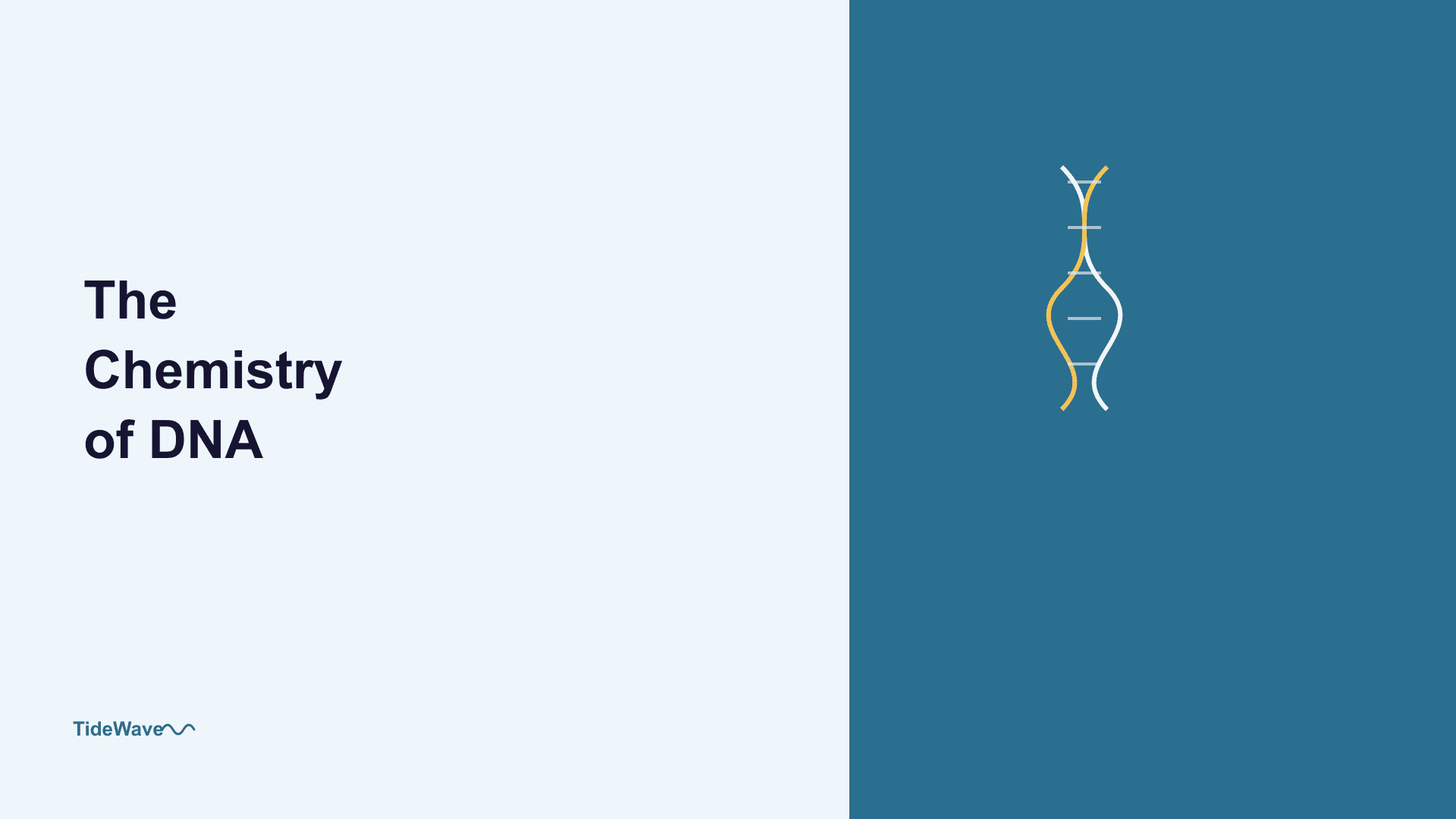
Complementary base pairing alone explains how the two strands connect, but DNA's famous three-dimensional shape, the double helix, comes from an additional detail: the two strands run in opposite directions (described chemically as antiparallel), and they twist around a central axis. This twisting isn't random; it's the most energetically stable arrangement for the molecule, since it allows the hydrophobic nitrogenous bases to stack closely together on the interior (shielded from surrounding water) while the charged, hydrophilic phosphate backbone remains on the exterior, in contact with the watery environment inside a cell.
How Base Pairing Enables DNA Replication
Complementary base pairing isn't just a structural curiosity, it's the entire mechanism that makes DNA copyable. When a cell divides, an enzyme unwinds and separates the double helix into two single strands. Each single strand then serves as a template: free-floating nucleotides in the cell pair up with their complementary base on the exposed template strand (an A on the template attracts a T, a G attracts a C, and so on), and a new, complementary strand is built alongside each original one.
The result is two identical double helices, each containing one original strand and one newly built strand, a process called semiconservative replication. This works reliably specifically because the pairing rule is chemically strict; if any base could pair with any other, replication would introduce constant, uncontrolled errors.
From DNA to Protein: Why the Chemistry Matters Biologically
The specific sequence of A, T, G, and C along a DNA strand encodes the information needed to build proteins, since each group of three bases (called a codon) corresponds to a specific amino acid. Base pairing chemistry is also central to reading this information: during a process called transcription, DNA is used as a template to build a related molecule, RNA, which uses the same A-T/G-C-style pairing logic (with uracil substituting for thymine) to carry the genetic instructions to the cell's protein-building machinery.
FAQ
Uracil and thymine are chemically very similar and pair with adenine in the same way, but uracil lacks a small methyl group that thymine has. This makes uracil slightly less stable, which is one reason RNA (a shorter-lived, working copy of genetic information) uses it, while DNA (the long-term, stable storage molecule) uses the more chemically robust thymine.
Yes, occasionally an incorrect base is incorporated during replication (for example, a G pairing briefly with a T), called a mismatch. Cells have dedicated proofreading and repair enzymes that detect and fix most of these errors, though the small fraction that go unrepaired become mutations, which are a normal source of genetic variation.
The backbone refers to the alternating chain of deoxyribose sugar and phosphate groups that runs along each of the two DNA strands, connected by strong covalent bonds. It's called a backbone because it provides the structural support for the whole molecule, with the more chemically important nitrogenous bases attached to it and pointing inward.
Yes, it's the same fundamental type of intermolecular force, an attraction between a hydrogen atom bonded to an electronegative atom (like nitrogen or oxygen) and a nearby electronegative atom on another molecule. DNA base pairing is actually one of the most commonly cited real-world examples of hydrogen bonding in introductory chemistry, precisely because it's so specific and consequential.
Yes, significantly, different species have different overall G-C versus A-T content, sometimes called their "GC content." What never varies, in any organism, is the pairing rule itself: the amount of adenine always equals the amount of thymine, and the amount of guanine always equals the amount of cytosine, a consistent pattern first noted by biochemist Erwin Chargaff before the double helix structure was even known.
Conclusion
DNA's ability to store, copy, and transmit the instructions for life comes down to a remarkably simple piece of chemistry: four bases, and a strict, shape-driven rule for how they pair across two strands. Adenine with thymine, guanine with cytosine, held together by hydrogen bonds strong enough to keep the molecule stable, yet weak enough to be pulled apart and copied. Once that pairing rule clicks, the double helix, DNA replication, and the path from DNA to protein all stop looking like separate facts to memorize and start looking like consequences of one elegant chemical mechanism.
Here are some useful references if you want to go deeper:
- Khan Academy – DNA Structure and Function — free lessons covering nucleotide structure and base pairing in detail.
- LibreTexts Biology – Nucleic Acids — an open textbook resource on DNA and RNA chemistry.
- National Human Genome Research Institute – Deoxyribonucleic Acid (DNA) — an accessible reference on DNA structure from the U.S. National Institutes of Health.