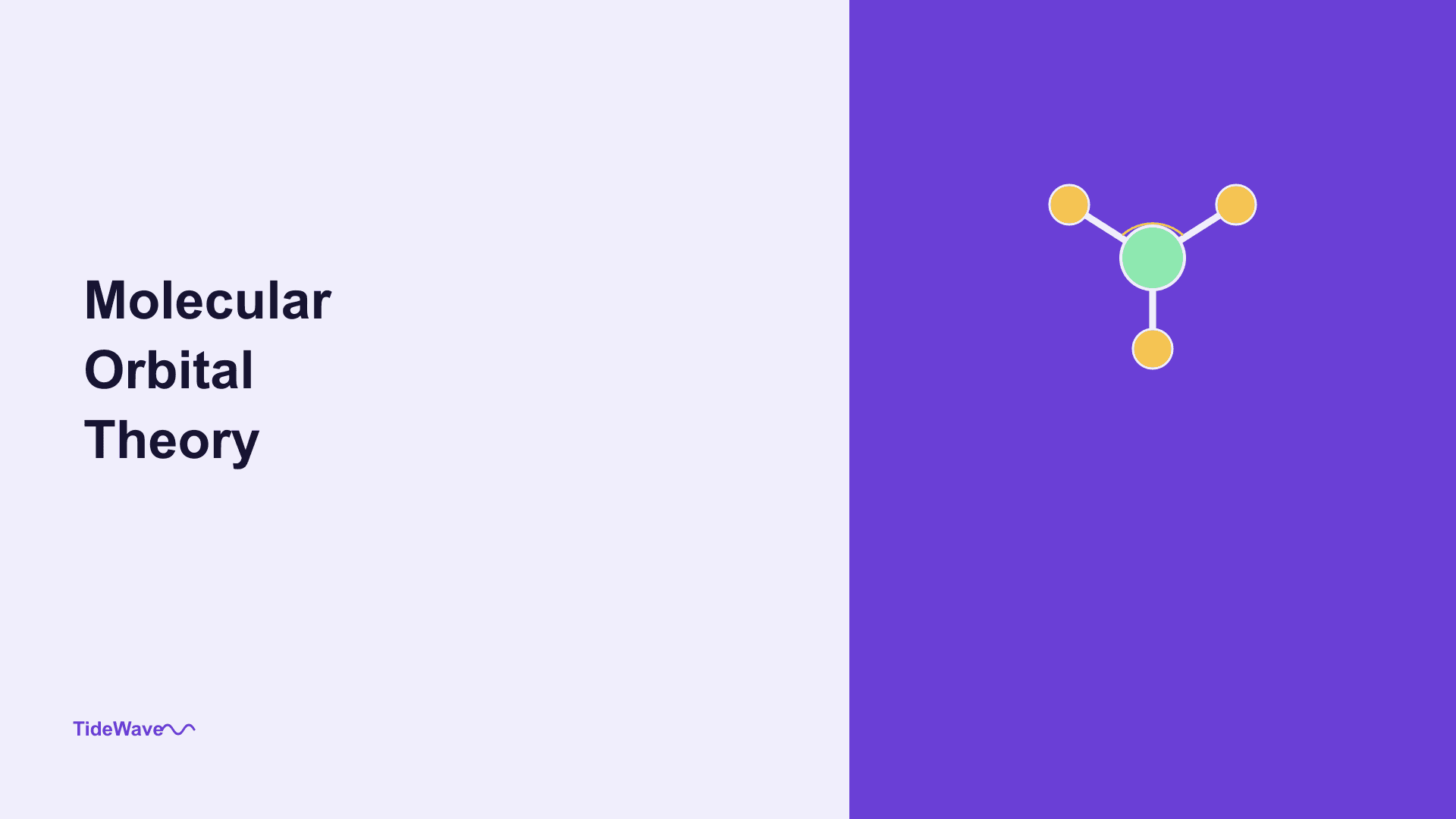
Molecular Orbital Theory: Beyond Simple Bonding Models
Simple bonding models, Lewis structures and hybridization, work remarkably well for predicting molecular shape and basic bonding patterns, but they fail to explain a genuinely strange, real observation: liquid oxygen (O₂) is attracted to a magnet. Lewis structures draw O₂ with all electrons neatly paired, and paired electrons shouldn't produce magnetism at all. Molecular orbital (MO) theory is the more complete model that resolves this, by treating electrons as belonging to the whole molecule rather than to individual bonds.
The Core Idea: Orbitals Belong to the Molecule, Not to a Bond
In simpler bonding models, each covalent bond is drawn as a pair of electrons shared between two specific atoms, essentially localized between them. Molecular orbital theory takes a different approach: when atoms bond, their individual atomic orbitals combine mathematically to form entirely new molecular orbitals that extend across the whole molecule, and electrons are then assigned to these new molecular orbitals rather than to any single bond.
This isn't just a different way of drawing the same picture; it makes genuinely different, testable predictions, including the magnetic behavior of oxygen, which simple Lewis structures cannot explain at all.
Bonding and Antibonding Orbitals
When two atomic orbitals combine, they don't just produce one new orbital, they produce two: one lower in energy and one higher, because combining waves (which is fundamentally what orbitals are, mathematically) can interfere either constructively or destructively.
- A bonding molecular orbital forms from constructive overlap, concentrating electron density between the two nuclei. Electrons placed here lower the overall energy of the molecule and stabilize the bond.
- An antibonding molecular orbital forms from destructive overlap, creating a node (a region of zero electron density) between the nuclei. Electrons placed here raise the overall energy of the molecule and destabilize the bond, and antibonding orbitals are conventionally marked with an asterisk, like σ*.
Which orbital electrons actually occupy is determined by filling molecular orbitals from lowest to highest energy, following the same Aufbau Principle and Pauli Exclusion Principle used for filling atomic orbitals.
Sigma and Pi Molecular Orbitals
Just as in hybridization theory, molecular orbitals come in two main types based on how the original atomic orbitals overlap:
- Sigma (σ) orbitals form from direct, head-on overlap along the axis connecting the two nuclei.
- Pi (π) orbitals form from sideways overlap of parallel p orbitals, with electron density concentrated above and below (or in front of and behind) the bond axis rather than directly between the nuclei.
Each of these comes in both a bonding and antibonding version (σ, σ*, π, π*), giving a full set of molecular orbitals to fill for any given molecule.
Bond Order: Quantifying Bond Strength
Molecular orbital theory introduces a precise way to predict bond strength and even whether a bond should exist at all, called bond order:
Bond order = (bonding electrons − antibonding electrons) / 2
- Bond order of 0 means no stable bond forms; the molecule shouldn't exist (or exists only very transiently).
- Higher bond order generally means a shorter, stronger bond, matching the same trend seen with single, double, and triple bonds in simpler models.
Example: Why He₂ doesn't exist. Two helium atoms bring a total of 4 electrons. Filling the molecular orbitals: 2 electrons go into the bonding σ orbital, and the remaining 2 must go into the antibonding σ* orbital. Bond order = (2 − 2) / 2 = 0. With zero bond order, molecular orbital theory correctly predicts that He₂ is not a stable molecule, exactly matching the fact that helium exists only as isolated atoms, never as a diatomic gas like hydrogen or nitrogen.
The Payoff: Explaining Oxygen's Magnetism
This is where molecular orbital theory demonstrates something Lewis structures genuinely cannot. Filling the molecular orbitals for O₂ (12 valence electrons total) according to their actual energy order shows that the last two electrons end up in two separate, equal-energy antibonding π* orbitals, one electron in each, rather than being forced to pair up together in a single orbital, following the same Hund's Rule that governs atomic orbital filling.
This leaves O₂ with two unpaired electrons. A substance with unpaired electrons is paramagnetic, meaning it's weakly attracted to a magnetic field, exactly the real, observable behavior liquid oxygen displays. Lewis structures, which draw O₂ with all electrons neatly paired into one double bond, offer no way to predict or explain this at all, while molecular orbital theory predicts it directly from the calculated electron filling order.
When to Use MO Theory vs. Simpler Models
| Model | Best For | Limitation |
|---|---|---|
| Lewis structures | Quick, simple bonding overview | Can't explain magnetism, some bond strengths |
| Hybridization / VSEPR | Predicting molecular shape and bond angles | Doesn't address electron delocalization |
| Molecular orbital theory | Explaining magnetism, bond order, delocalized bonding | More mathematically complex to apply |
In practice, chemists reach for the simpler models first, since they're faster and correctly predict the vast majority of everyday bonding questions, and bring in molecular orbital theory specifically when a molecule's behavior (like oxygen's magnetism, or certain unusually stable or unstable bonds) can't be explained any other way.
FAQ
Lewis structures and hybridization are far simpler to draw and use, and for the overwhelming majority of everyday bonding and shape questions, they give correct, useful answers quickly. Molecular orbital theory is more powerful but also considerably more mathematically involved, so it's reserved for cases the simpler models can't adequately explain.
A delocalized molecular orbital extends across more than two atoms at once, rather than being confined between just one pair. This is especially important for explaining molecules like benzene, where pi electrons are spread evenly around the entire ring rather than existing as three fixed, separate double bonds.
Yes, and this is actually common, particularly in molecules with delocalized bonding. The oxygen molecule in ozone (O₃), for example, has a bond order of 1.5 for each oxygen-oxygen bond, reflecting electron density spread evenly across both bonds rather than one single and one double bond.
No, most simple diatomic molecules, like N₂ or HCl, are predicted consistently by both simple bonding models and molecular orbital theory. MO theory becomes essential specifically when a molecule's real, observed properties (like O₂'s magnetism, or certain bond stabilities) contradict what a simple Lewis structure would predict.
It applies the exact same principles, just to a new set of orbitals. Electrons fill molecular orbitals from lowest to highest energy (the Aufbau Principle), no two electrons in the same molecular orbital can have identical spin (the Pauli Exclusion Principle), and electrons fill equal-energy orbitals singly before pairing (Hund's Rule), the same three rules used for atomic electron configurations.
Conclusion
Molecular orbital theory trades the simplicity of Lewis structures for a more complete, more predictive picture of bonding, one where electrons belong to the molecule as a whole rather than to individual localized bonds. Bond order gives a precise way to predict bond strength and even molecule stability, and the model succeeds where simpler approaches fail entirely, most famously in correctly predicting that oxygen is paramagnetic. It's more work to apply, but it's the model to reach for whenever a molecule's real-world behavior doesn't match what a simpler bonding picture would suggest.
Here are some useful references if you want to go deeper:
- Khan Academy – Molecular Orbital Theory — free lessons covering bonding/antibonding orbitals and bond order.
- Chemguide – Molecular Orbital Theory — a detailed explanation with diagrams of orbital energy diagrams.
- LibreTexts Chemistry – Molecular Orbital Theory — an open textbook resource covering diatomic molecular orbital diagrams.